
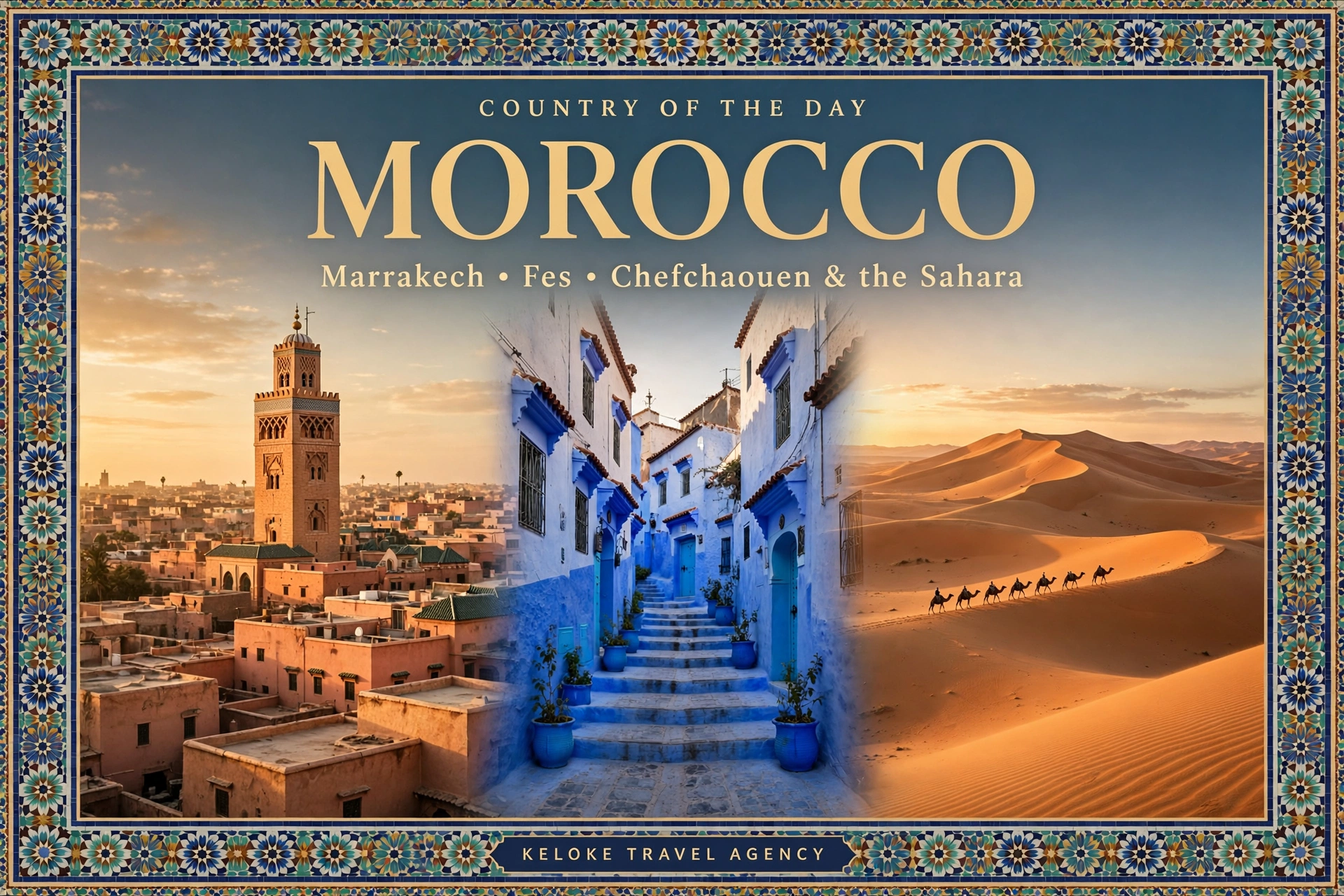
Morocco: Medinas, Blue Streets and a Night in the Sahara
Morocco packs a whole continent of trips into one country: thousand-year-old medinas, a town painted entirely blue, snow on the Atlas Mountains in the morning and a camel ride into the Sahara by sunset. The planning rule is simple — pick a loop (Marrakech, Fes and Chefchaouen, with the desert as the finale), travel between cities by train or driver, and give every medina one unhurried day.
The country, one by one
- Marrakech: the headline chapter — Jemaa el-Fnaa square at dusk, when drum circles, food stalls and storytellers take over, the souks behind it, and the Bahia Palace and Saadian Tombs for the carved-tile Morocco of the postcards. Stay in a riad inside the medina and start market days early, before the heat and the crowds.
- Fes: the deep-history chapter — Fes el-Bali, one of the world's oldest living medieval cities, with its tanneries, madrasas and 9,000 lanes. Hire an official guide for the first day; getting lost is the point on the second. Fes is also the food capital — book a cooking class and learn the pastilla properly.
- Chefchaouen and Casablanca — worth knowing: the contrast chapter — Chefchaouen, the blue-washed mountain town in the Rif, is two slow days of photo lanes, mint tea and mountain air; Casablanca is worth a stop for one building alone, the Hassan II Mosque on the ocean, one of the few mosques in Morocco open to non-Muslim visitors on guided tours.
- Merzouga and the Sahara: the finale chapter — ride into the Erg Chebbi dunes at golden hour, sleep in a desert camp, and wake before dawn for sunrise over the sand. It is a long drive from the imperial cities, so give the desert two nights, not one, and pair it with the Atlas passes and kasbahs on the way.
Culture notes
Morocco runs on hospitality and negotiation: mint tea is an opening, not a drink, and haggling in the souks is expected — start low, smile, and walk away slowly; the final price usually finds you. Arabic (Darija) and French are the everyday languages; a few words go far: salam (hello), shukran (thank you), and la, shukran (no, thank you). Dress modestly away from resorts — shoulders and knees covered in medinas — and ask before photographing people.
When to go
Spring (March to May) and autumn (September to November) are the sweet spots: warm days in the cities, passable mountain roads, and desert nights that are cool rather than freezing. Summer is fierce in Marrakech and the Sahara, though the coast stays pleasant, and winter brings cold desert nights and snow in the Atlas. Ramadan shifts the daily rhythm — many cafes close by day and cities come alive after sunset — so check dates when you book.
Practical tips
- Haitian passport holders — visa REQUIRED in advance, no visa on arrival: Haitian passport holders need a visa for Morocco before they travel — there is no visa on arrival. If you hold a US, UK, EU, Canadian or similar residence permit (valid 180+ days) or a multiple-entry visa from one of those countries (valid 90+ days), you can apply online for Morocco's eVisa on the official portal, acces-maroc.ma — single entry, up to 30 days, and apply at least 10 business days ahead. Without one of those, apply at a Moroccan consulate well ahead of your trip. Ignore paid sites that promise Haitians a simple online eVisa without mentioning the permit condition.
- U.S. passport holders — visa-free up to 90 days: U.S. passport holders are visa-free for up to 90 days — just bring a passport valid 6+ months with a blank page and get stamped on arrival. Living in the US does not change the rule for a Haitian passport — but a US residence permit or multiple-entry visa is exactly what can qualify a Haitian passport holder for the eVisa route above.
- Money is the Moroccan dirham: Morocco's currency is the dirham (MAD), and it is a closed currency — you exchange or withdraw it inside Morocco, and medinas, taxis, guides and small riads run heavily on cash. Cards work in hotels, larger restaurants and modern shops. Carry small dirham notes for tips and souk purchases, and re-confirm tour and driver prices close to departure.
- Power is 220V, plugs are Type C and Type E: Morocco runs 220V with round two-pin Type C and grounded Type E sockets. U.S. flat plugs do not fit, and single-voltage U.S. appliances need a converter, not just an adapter — most phone and laptop chargers are dual-voltage 100-240V, so check the label. A universal adapter/converter kit is the one-pack fix.
- Distance and dress are the real packing rules: Morocco rewards slow travel — trains link Casablanca, Marrakech and Fes well, the desert is a full day from the cities, and medina lanes are cobbled, crowded and step-heavy. Pack for hot days and genuinely cold desert nights in the same bag, and carry a light scarf or layer for modest dress at religious sites. Driving is on the RIGHT; most visitors hire drivers for the desert loop rather than self-drive.
What to pack for Morocco
Medina lanes, mountain passes and a desert night, all on sockets your plugs do not fit. Our country picks: a universal travel adapter and voltage converter with USB ports — Morocco's 220V Type C/E sockets are the one that strands U.S. plugs — an RFID-blocking passport holder and document organizer that keeps your passport, visa papers and cards in one place through medina crowds, compression packing cubes that squeeze warm layers and desert-night clothes into one carry-on, a 3-in-1 handheld mini fan with power bank and flashlight for Marrakech heat and souk afternoons, and a collapsible 25oz water bottle you refill all day instead of buying plastic at every stop. Find them in the KELOKE shop.
