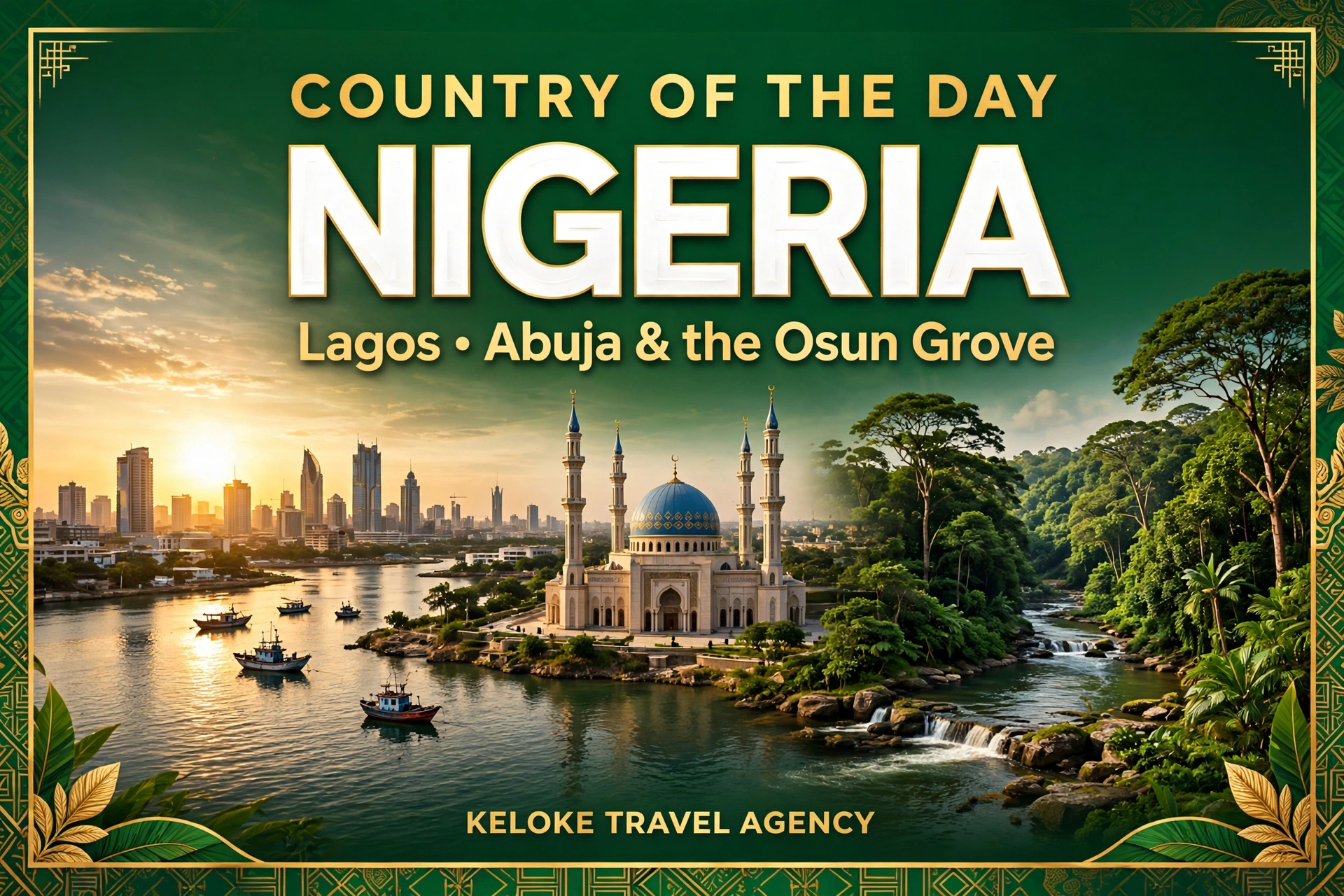
Nigeria: Lagos Energy, Abuja Calm and Ancient Groves
Nigeria is Africa's giant — the continent's most populous country, its biggest music and film exporter, and a trip that rewards travellers who plan the paperwork early and then give each region its own time. The classic first trip pairs Lagos, the loud and brilliant commercial capital on the Atlantic, with Abuja, the planned federal capital in the centre, and adds one heritage stop — the rock city of Abeokuta or the sacred grove at Osogbo — instead of trying to cross the whole country in a week.
The country, one by one
- Lagos: the headline chapter — a megacity on the lagoon and the Atlantic. Base yourself on Victoria Island or in Ikoyi for the Nike Art Gallery's floors of Nigerian art, the Lekki Conservation Centre's canopy walkway high in the trees, live Afrobeats at night, and beach days at Tarkwa Bay, reached by boat. Traffic is part of the city — plan one area per day, not five.
- Abuja: the calm chapter — the purpose-built capital, with the National Mosque, Aso Rock watching over the city, wide roads and a slower pace than Lagos. Zuma Rock, the giant inselberg on the road north, is the classic photo stop, and Abuja makes the easiest base for day trips into the middle of the country.
- Abeokuta and Osogbo — worth knowing: the heritage chapter — Abeokuta, "under the rock," is built around Olumo Rock, climbed for views over the old city. Osogbo is home to the Osun-Osogbo Sacred Grove, a UNESCO World Heritage Site of shrines and monumental sculptures in riverside forest, and the centre of the annual Osun-Osogbo Festival.
- Calabar and the south-east: the slow chapter — Calabar, in Cross River State, is known for its carnival season, its history museums and its gateway position for Cross River National Park's rainforest. It is a flight from Lagos or Abuja, not a casual drive — treat it as its own block if you add it.
Culture notes
Nigeria is home to more than 250 ethnic groups; the largest are the Hausa, Yoruba and Igbo, and English is the official language, with Nigerian Pidgin the street-level bridge everywhere. This is the home of Afrobeats and Nollywood — music is not background here, it is the main event. Jollof rice is a national pride point (never start the jollof wars comparison at the table unless you want a joyful argument). Dress respectfully at religious sites, ask before photographing people, and greet properly — a real greeting before business is basic manners.
When to go
The dry season, roughly November to March, is the easiest window: less rain, clearer roads and the Harmattan haze arriving in December and January in the north. Lagos Carnival-season energy peaks in December, when the diaspora flies home — book flights and hotels early for that month. The rainy season runs roughly April to October in the south, with heavy downpours that slow Lagos traffic to a crawl; if you go then, build wide margins into every plan.
Practical tips
- Haitian and U.S. passport holders — e-Visa REQUIRED before travel, no visa on arrival: For Nigeria, BOTH Haitian and U.S. passport holders need a visa before they fly — Nigeria is not visa-free for either passport, and there is no visa on arrival anymore. Since May 2025 the visa is an e-Visa: apply on the official Nigeria Immigration Service portal, evisa.immigration.gov.ng, well ahead of your trip (approvals are advertised at 48 hours, but don't cut it close — guidance for Haitian applicants says submit at least 15 business days ahead), and wait for the emailed approval with its QR code before you go to the airport. Airlines deny boarding without an approved visa. A U.S. green card does NOT change this rule: a Haitian passport holder living in the U.S. follows the Haitian passport rule.
- Landing and exit card — mandatory, free and online: Since 1 May 2025 the paper forms are gone. Every non-Nigerian traveller completes the landing card online at lecard.immigration.gov.ng BEFORE boarding the flight in, and the exit card before leaving. It is free and in addition to the visa, not a substitute for it — use only the official immigration portals, never a paid third-party seller site.
- Passport, yellow fever and overstays: Bring a passport valid at least 6 months. A WHO yellow fever vaccination card (yellow card) is required for entry, and the U.S. State Department also lists proof of polio vaccination as required. Do not overstay: since 1 September 2025 overstays draw a $15-per-day fine, and long overstays can bring multi-year or permanent entry bans.
- Money is the Nigerian naira: The currency is the naira (NGN). Cards work at larger hotels, malls and restaurants in Lagos and Abuja, but Nigeria still runs heavily on cash and bank transfer — carry naira for markets, drivers and smaller venues, and expect some card machines to fail. Use ATMs inside banks or malls, and keep small notes handy.
- Power is 230V, plugs are Type G: Nigeria runs 230V and uses Type G plugs — three square pins, the British style. U.S. flat plugs do not fit, and single-voltage U.S. appliances need a converter, not just an adapter — most phone and laptop chargers are dual-voltage 100–240V, so check the label. Power cuts are a normal part of the day in much of the country, which is why a real power bank is a Nigeria essential, not a luxury.
- Getting around and malaria country: Domestic flights link Lagos, Abuja and the regional capitals and save days over long road trips. Inside Lagos, use hotel-arranged or app-booked rides and allow serious time for traffic. Nigeria is a malaria area year-round — talk to your clinician or a travel-health clinic about prevention well before you go, use repellent and sleep under protection where it is provided.
What to pack for Nigeria
An e-Visa on your phone, a yellow card you cannot lose, 230V sockets your plugs do not fit, real heat, and power cuts that arrive without asking. Our country picks: a universal travel adapter and voltage converter with USB ports — Nigeria's 230V Type G sockets are the ones that strand U.S. plugs — an RFID-blocking passport and document organizer that keeps your passport, yellow fever card and printed e-Visa approval together, a 20,000mAh power bank with a built-in retractable cable for outage hours and long Lagos traffic days, a 3-in-1 handheld mini fan with power bank and flashlight for the heat when the power is out, and a portable travel first aid kit for road days and excursions far from a pharmacy. Find them in the KELOKE shop.