Ghana: Accra Welcome, Castle Coasts and Ashanti Gold
Ghana is West Africa's friendliest first trip — English-speaking, famously welcoming ("Akwaaba" means welcome, and people mean it), and built around one classic route: start in Accra, drive the coast to the great castles of Cape Coast and Elmina with a stop at Kakum's rainforest canopy, then head inland to Kumasi, the Ashanti capital. The paperwork is the one part that punishes improvisation — since May 2026 the visa is online-only and must be approved before you fly — so plan that first and the rest of the trip is easy.
The country, one by one
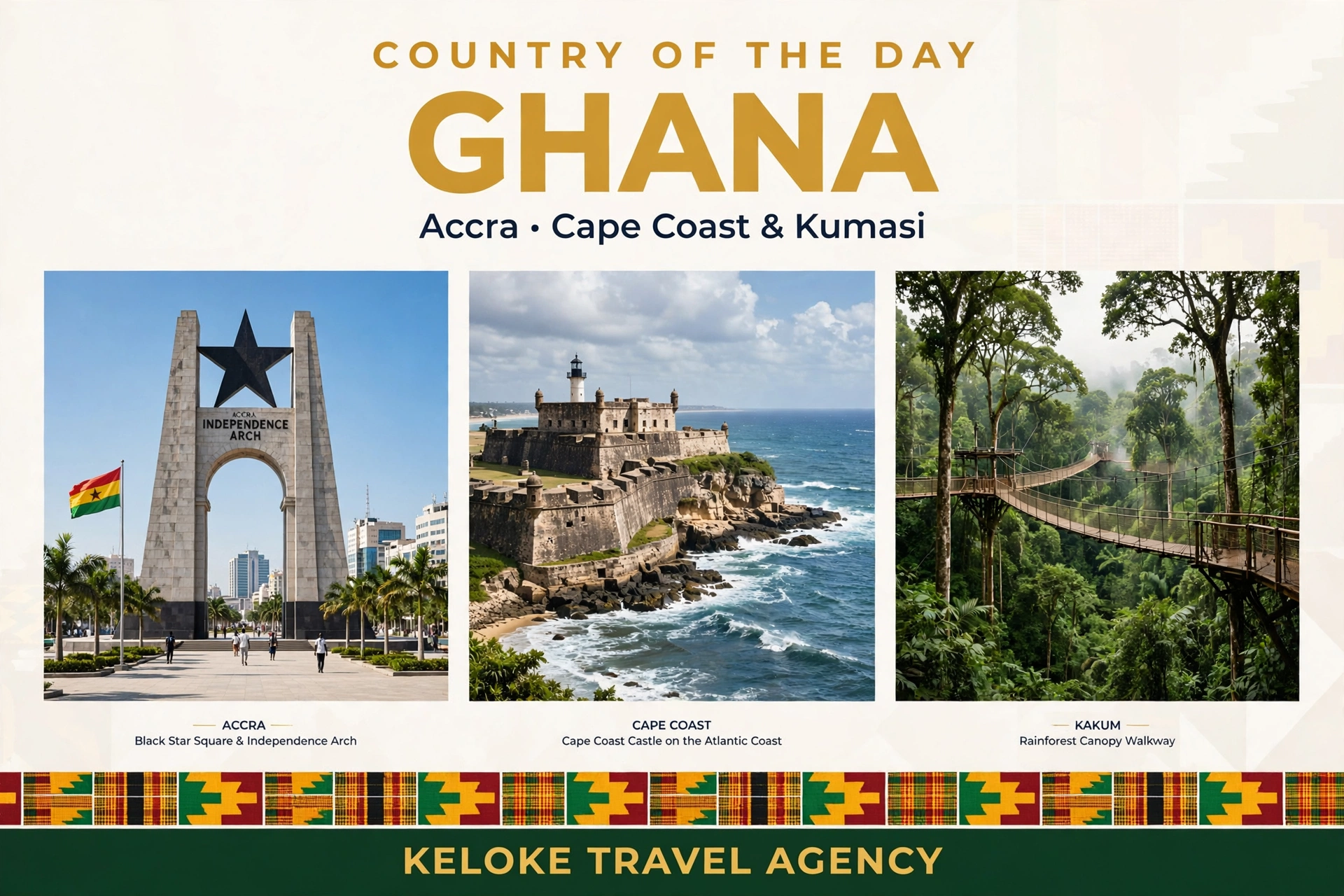
- Accra: the headline chapter — the capital on the Gulf of Guinea. The Kwame Nkrumah Memorial Park and mausoleum, the Black Star (Independence) Square, Jamestown's lighthouse and fishing harbour, Makola Market's beautiful chaos, and Osu's Oxford Street for restaurants and nightlife. Labadi Beach on a Sunday is Accra at play.
- Cape Coast and Elmina: the history chapter — about 2.5–3 hours west of Accra. Cape Coast Castle and Elmina Castle (St. George's Castle, the oldest European building in sub-Saharan Africa) are UNESCO-listed and sobering: the dungeons and the Door of No Return are essential, difficult history, best taken with a guide and unhurried. Pair them with the fishing harbour and a beach lunch in Elmina town.
- Kakum National Park: the rainforest chapter — just north of Cape Coast. Its famous canopy walkway hangs some 30 metres above the forest floor on a series of rope bridges; go early in the morning for birds, butterflies and the quietest crossings.
- Kumasi and the Ashanti region — worth knowing: the culture chapter — Ghana's second city and the historic Ashanti capital, about 4–5 hours north of Accra by road or a short flight. The Manhyia Palace Museum, the vast Kejetia Market, and Bonwire, the village where kente cloth is woven on wooden looms. Lake Bosomtwe, a crater lake ringed by villages, is the easy half-day escape.
Culture notes
Ghana is home to the Ashanti (Asante), Ga, Ewe, Fante and many other peoples; English is the official language and Twi is widely spoken in the south and centre. This is the land of kente and adinkra symbols, of highlife music and a fierce, joyful jollof debate with Nigeria (pick Ghana's side while you are here). Funerals are major social celebrations, drumming and dancing are everyday life, and greetings matter — a proper "good morning" before business is basic manners. Dress respectfully at the castles and at religious sites, and ask before photographing people.
When to go
The dry season, roughly November to March, is the easiest window: less rain, better roads and the Harmattan haze — dry, dusty trade winds — arriving in December and January, strongest in the north. The south has two rainy seasons, a major one roughly April to July and a shorter one around September to November, with heavy downpours that slow Accra traffic; if you go then, build wide margins into every plan. December is peak diaspora season ("Detty December") — book flights and Accra hotels early.
Practical tips
- Haitian and U.S. passport holders — paid e-Visa REQUIRED before travel, no visa on arrival: For Ghana, BOTH Haitian and U.S. passport holders need a visa before they fly — and since May 2026 there is no visa on arrival. Apply on Ghana Immigration's official e-Visa portal, evisa.immigration.gov.gh: a single-entry tourist e-Visa costs $260 with standard processing inside 96 hours (faster tiers cost more — $338 Priority, $442 Express), it is valid 90 days from issue, and your stay — up to 60 days — is set when you arrive. Confirm the live total in the portal before paying, and use only the official portal, never a third-party seller. Don't be misled by the headlines: Ghana's free travel authorisation is for African passport holders and a specific list of waiver countries (Jamaica, Barbados, Trinidad and Tobago and others) — Haiti is not on that list, even though Ghanaians can visit Haiti visa-free. A U.S. green card does NOT change this rule: a Haitian passport holder living in the U.S. follows the Haitian passport rule.
- Passport and yellow fever — the two documents that decide boarding: Bring a passport valid at least 6 months with 3 blank pages. The ORIGINAL yellow fever vaccination certificate (International Certificate of Vaccination) is required for entry for travellers over 9 months old and is checked at the port of entry — a photo or photocopy is not the document; carry the original card with your passport. The e-Visa application itself asks for your passport bio page, a recent photo, your itinerary, accommodation for the full stay and proof of funds.
- Money is the Ghana cedi: The currency is the cedi (GHS). Cards work at larger hotels, malls and restaurants in Accra, but Ghana still runs heavily on cash for markets, taxis and smaller venues — carry cedis in small notes, use ATMs inside banks or malls, and expect some card machines to fail. Mobile money is everywhere for locals; visitors should not count on it.
- Power is 230V, plugs are Type D and Type G: Ghana runs 230V and uses two plug types — Type G (three square pins, British style) and the older Type D (three round pins). U.S. flat plugs fit neither, and single-voltage U.S. appliances need a converter, not just an adapter — most phone and laptop chargers are dual-voltage 100–240V, so check the label.
- Getting around and malaria country: Base in Accra and hire a driver or join a tour for the Cape Coast–Kakum run; intercity coaches and a short domestic flight link Accra and Kumasi. Inside Accra, use hotel-arranged or app-booked rides and allow serious time for traffic. Ghana is a malaria area year-round — talk to your clinician or a travel-health clinic about prevention well before you go, use repellent and sleep under protection where it is provided.
What to pack for Ghana
An e-Visa that must be approved before you board, an original yellow card you cannot lose, 230V sockets in two shapes your plugs do not fit, and real heat from Accra to Kumasi. Our country picks: a universal travel adapter and voltage converter with USB ports — Ghana's 230V Type D and G sockets are the ones that strand U.S. plugs — an RFID-blocking passport and document organizer that keeps your passport, original yellow fever certificate and printed e-Visa approval together, a collapsible 25oz water bottle you fill at the hotel and empty through security for Kakum and castle days in the heat, wireless noise-canceling headphones for the long-haul flights into Accra and the road hours to Kumasi, and a 5-piece packing cube set that keeps a three-base trip — Accra, the coast, Kumasi — in one suitcase without the daily dig. Find them in the KELOKE shop.
