
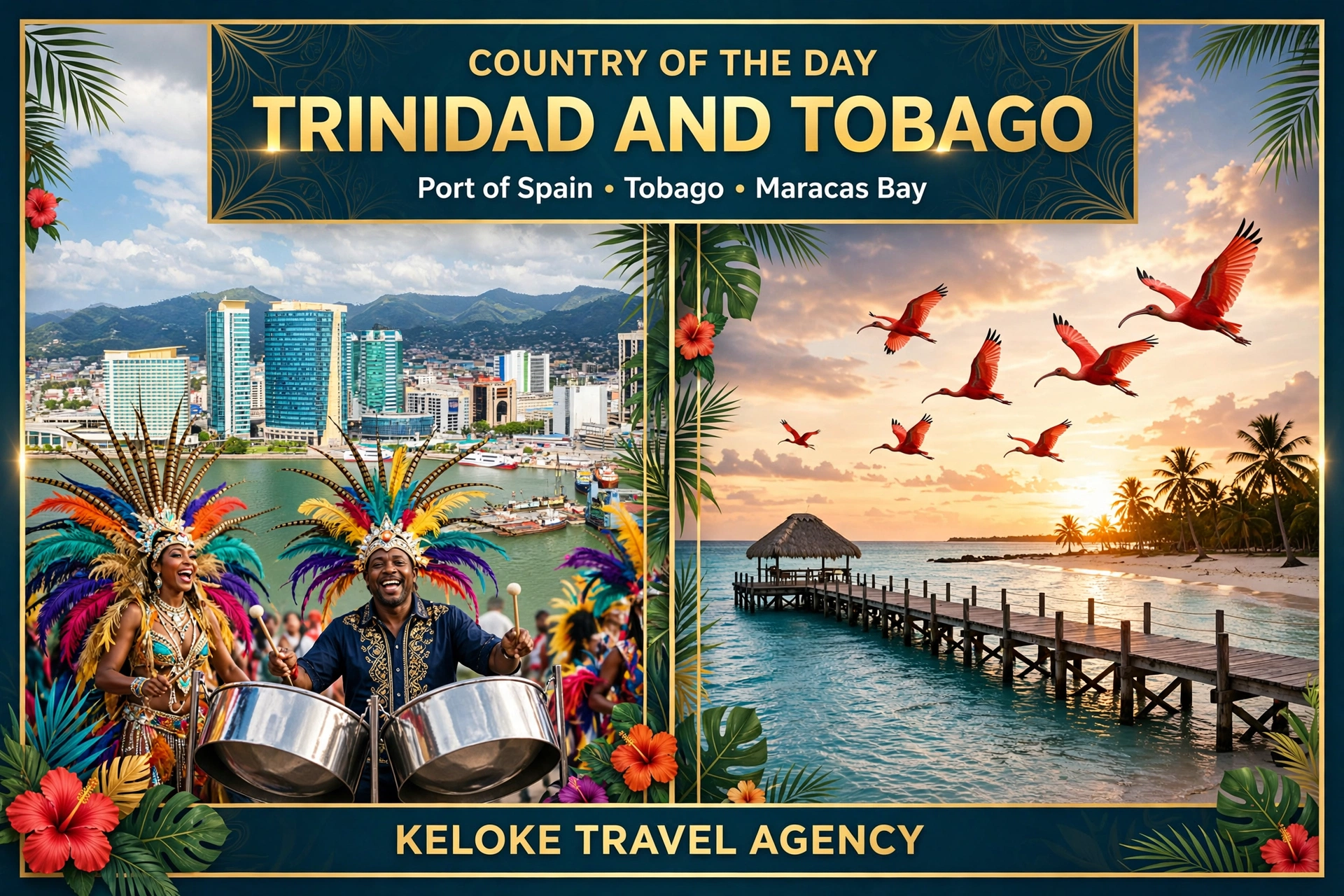
Trinidad and Tobago: One Country, Two Different Islands
Trinidad and Tobago is the Caribbean's two-for-one: Trinidad is the big, loud, working island — Carnival's home port, oil money, Indo- and Afro-Caribbean food and music stacked block on block — and Tobago, a short flight or ferry northeast, is its quiet little sister of fishing villages, rainforest and reef. The classic mistake is treating them as one place with two names. The classic success is giving each its own days: fetes, food and wetlands on Trinidad, then slow water and empty sand on Tobago. Pick the split first; the packing — heat, beach, and boat days — follows.
The islands, one by one
- Port of Spain & Carnival (Trinidad): the capital and arrival chapter — the Queen's Park Savannah, the Magnificent Seven mansions, Woodford Square, and the world's loudest two days when Carnival (Monday and Tuesday before Ash Wednesday) turns the whole city into a moving stage of soca, steelpan and feathers. Outside Carnival season the panyards still rehearse at night and are worth an evening on their own.
- The north coast (Trinidad): the beach chapter — the winding mountain drive to Maracas Bay for bake and shark at the water's edge, Las Cuevas' calmer curve beyond it, and up the Paria trail, waterfalls hidden in the Northern Range jungle.
- Tobago: the slow chapter — Pigeon Point's postcard jetty, Store Bay and the glass-bottom boats over Buccoo Reef, Englishman's Bay for near-empty sand, Main Ridge Forest Reserve (the oldest protected rainforest in the Western Hemisphere), and villages like Castara and Charlotteville where the day's plan is the catch coming in.
- Caroni & the central wetlands (Trinidad): the wild chapter — the Caroni Bird Sanctuary at sunset, when hundreds of scarlet ibis, the national bird, come in to roost in the mangroves in one red wave; nearby, the Hanuman Murti and Temple in the Sea at Waterloo tell the Indo-Trinidadian half of the country's story.
- San Fernando & the south (Trinidad): the deep chapter — the second city, San Fernando Hill's view over the Gulf, and La Brea's Pitch Lake, a walkable lake of natural asphalt that has paved roads on other continents.
Culture notes
This is the Caribbean's great mix: African and Indian heritages side by side, with Chinese, Syrian-Lebanese, and Venezuelan threads woven in — and the food proves it: doubles at dawn, roti at lunch, callaloo and pelau on Sunday. Steelpan was invented here, calypso and soca were born here, and liming — the art of hanging out well — is the national sport. English is official, with Trinidadian Creole in daily speech. Carnival is planned a year ahead and band costumes sell out; even outside the season, a fete is never far away.
When to go
January through May is the dry season: the easiest beach weather, Tobago's reefs at their clearest, and Carnival landing in February or March — the single biggest week of the year, with prices and crowds to match, booked months ahead. June through December is the wet season: short, heavy afternoon rains, greener hills, lower prices, and Tobago at its quietest. The islands sit at the southern edge of the hurricane belt and direct hits are rare — one more reason the wet season here is a bargain rather than a gamble.
Practical tips
- U.S. visitors: visa-free, up to 90 days: U.S. citizens are visa-exempt for Trinidad and Tobago for stays of up to 90 days. You still need a valid passport, a return or onward ticket, and you may be asked to show your accommodation and sufficient funds.
- Haitian passport holders — visa in advance, no arrival waiver: Haiti is the CARICOM exception — ordinary Haitian passport holders must obtain a visa BEFORE travel (the eVisa/consular route), and they are explicitly excluded from the "Waiver of the Visa" on arrival; only Haitian diplomatic or service/official passport holders are exempt. Do not book non-refundable travel before the visa is in hand, and re-check the current rule with Trinidad and Tobago Immigration before booking (see KELOKE's Haitian passport guide for the full country map).
- Passport validity: your passport must be valid at least 6 months beyond your arrival date — check it before anything else.
- Two islands, one hop: Caribbean Airlines flies Piarco (POS) to Crown Point (TAB) in about 25 minutes, many times a day; the fast ferry from Port of Spain to Scarborough takes roughly 3 hours and can be rough in open water — book both ahead in Carnival season, and never schedule the hop on the same day as your flight home.
- Currency is the Trinidad and Tobago dollar (TTD): U.S. dollars are accepted in many tourist-facing spots but change comes back in TTD; cards work widely in the cities, cash rules in Tobago's villages and at bake-and-shark stands.
- Power is the easy part for Americans: Trinidad and Tobago uses Type A/B sockets at 115V — U.S. devices plug straight in, no adapter, no converter.
- Driving is on the LEFT: a British inheritance that surprises Americans at the first junction — on Tobago most visitors are happier with a local driver or short taxi hops, and in Port of Spain the maxi taxis and the Savannah loop are the local way to move.
What to pack for Trinidad and Tobago
Heat, humidity, boat decks, and two islands in one trip. Our country picks: a 3-in-1 handheld mini fan that doubles as a power bank and flashlight for fete nights and hot Savannah afternoons, waterproof shoe bags so Tobago's sandy, seawater-soaked sandals never touch clean clothes, packing cubes that keep Trinidad city clothes and Tobago beach gear in separate worlds inside one bag, a 20,000mAh power bank with a built-in cable for Carnival days that start at dawn and end long after dark, and an insulated travel mug that keeps coffee hot on the early drive over the Northern Range to Maracas and water cold on the ferry deck. Find them in the KELOKE shop.