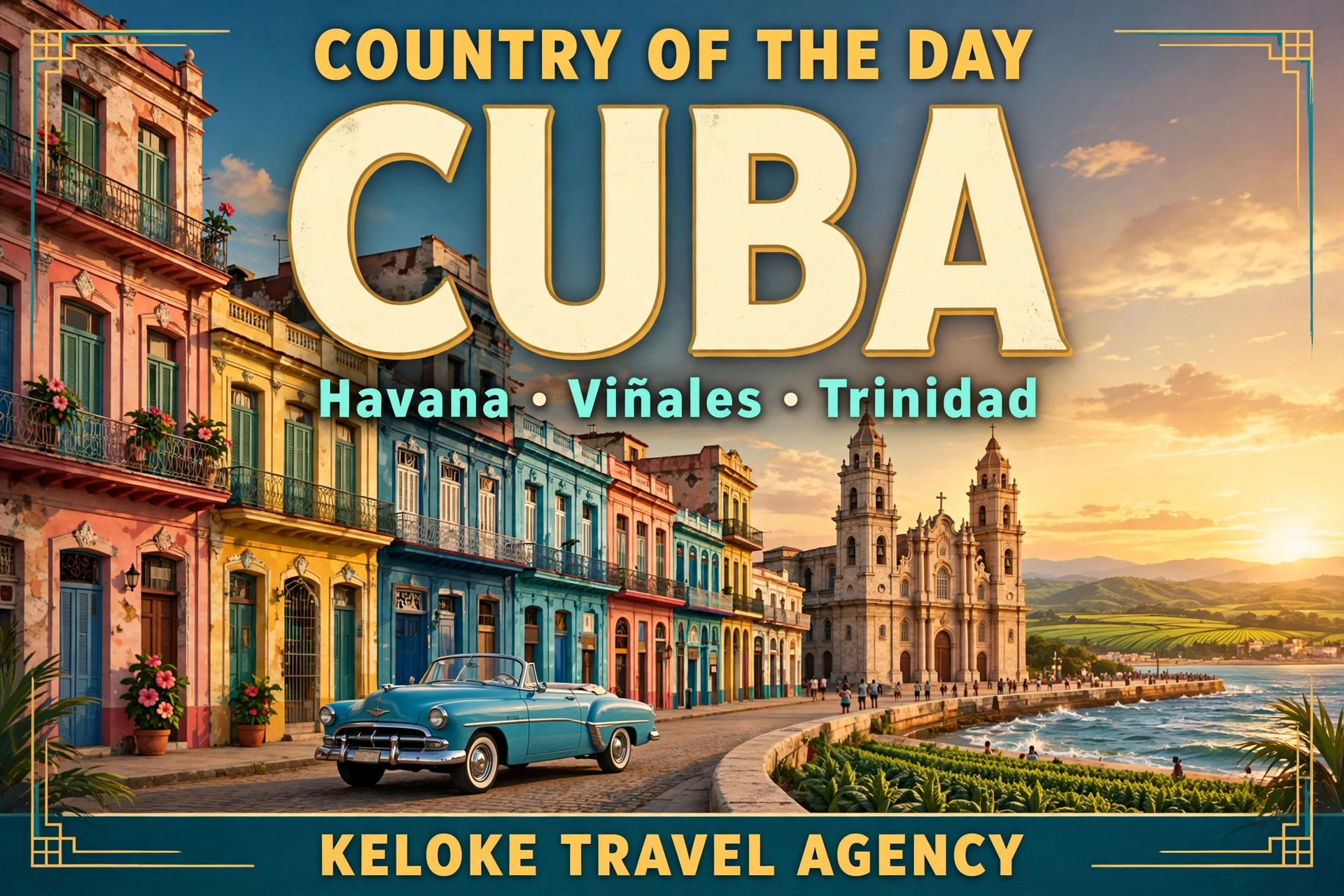
Cuba: The Island Where the Rules Are Part of the Trip
Cuba is the Caribbean’s great time capsule — 1950s Chevrolets rolling past Spanish colonial plazas, son and salsa pouring out of doorways, and a tobacco valley that looks painted. It is also the one island where a traveler can do everything “right” on the Cuban side and still break the rules on the American side, because for U.S. travelers Cuba is not a normal vacation at all. The classic success is a legal, people-first trip: a private casa in Old Havana, days built around independent Cuban guides, artists and paladar owners, one valley, one colonial town. Pick the purpose first — in Cuba, the purpose is literally the law; the packing — heat, cash, and power cuts — follows.
The regions, one by one
- Havana: the arrival chapter and most travelers’ base — Old Havana’s four plazas and cathedral, the Malecón at sunset, Vedado’s mansions and the Fábrica de Arte Cubano at night, and the classic-car tours that are cliché because they earn it. Base here and day-trip west or east.
- Viñales Valley: the green chapter, about three hours west — limestone mogotes rising over red-earth tobacco farms, horseback rides to family fincas where cigars are rolled by hand, and the island’s best countryside mornings.
- Trinidad: the colonial chapter — a UNESCO time capsule of cobblestones and pastel mansions on the south coast, with Playa Ancón’s beach minutes away and the Valle de los Ingenios sugar mills telling the harder history behind the beauty.
- Varadero & the north coast: the resort chapter — 20 km of white sand on the Hicacos Peninsula. Beautiful beach, but U.S. travelers take note: many large resorts sit on the U.S. State Department’s Cuba Restricted List, which is one more reason the people-first route bases in casas instead.
- Santiago de Cuba: the Afro-Cuban heart — the island’s second city, closer in spirit to Haiti and Jamaica than to Havana: son cubano was born in these hills, Carnival in July is the country’s biggest, and the Moncada barracks and El Cobre basilica carry the island’s revolutionary and religious history.
- Baracoa & the far east: the remote chapter — Cuba’s first town, founded in 1511, ringed by mountains and cacao farms, reached by a mountain road called La Farola. For travelers who want the Cuba almost nobody sees.
Culture notes
Music is not entertainment in Cuba, it is infrastructure: son, salsa, rumba and Afro-Cuban jazz set the schedule of every plaza. The private economy is the culture a visitor can actually support — casas particulares (family-run guesthouses, marked with a blue anchor sign) and paladares (private restaurants, often in grand old mansions) are where the best food, rooms and conversations are. Santiago and the east carry deep African roots — Santería (Regla de Ocha) practice, Haitian-Creole-speaking communities descended from Haitian migrants in Oriente, and tumba francesa dance traditions recognized by UNESCO, so Haitian travelers will find familiar rhythms in the east. Spanish is the language of daily life; English works in Havana’s visitor corridors and fades fast outside them.
When to go
November through April is the dry season: the easiest walking weather, Havana’s jazz festival in January, and the highest casa prices — book ahead. May through October is hot, humid and officially hurricane season (June 1–November 30, highest risk August–October): prices drop, afternoon storms are routine, and flexible plans plus insurance earn their money. July in Santiago is Carnival — worth planning around on purpose, not by accident.
Practical tips
- U.S. travelers — pure tourism is prohibited, by U.S. law: Americans and anyone subject to U.S. jurisdiction may only travel under one of the 12 OFAC general-license categories — most visitors use “Support for the Cuban People,” which requires a full-time schedule of meaningful activities with independent Cuban people and businesses (private casas, paladares, independent guides), not a beach week. There is no OFAC application to file for a general license, but you must declare the category when booking, keep records of activities and expenses for 10 years, and avoid properties on the Cuba Restricted List. A Cuban visa alone does not make a trip legal under U.S. rules — the two systems are separate.
- Cuba’s own entry documents: most visitors now enter on Cuba’s electronic visa (the old paper tourist card has been phased out) and must also complete the D’Viajeros online entry form before arrival and carry mandatory health insurance (often bundled by the airline). Keep printed or offline copies of everything — connectivity on arrival is unreliable.
- Haitian passport holders — consular visa in advance, do not rely on the e-Visa: Cuba lists Haiti among the nationalities that cannot use the standard tourist e-Visa and must obtain a visa in advance through a Cuban consulate, even though some third-party tables still show “eVisa.” Treat the consulate route as the rule, start early, and do not book non-refundable travel before the visa is in hand. (See KELOKE’s Haitian passport guide for the full country map.)
- Money runs on cash: U.S. debit and credit cards do not work in Cuba at all. Bring clean U.S. dollars or euros in cash — enough for the whole trip — plus small bills for casas, paladares, taxis and tips. Cuba’s currency is the peso (CUP); exchange rates and rules shift, so confirm the current picture the same week you travel and keep money and documents in an RFID-blocking organizer.
- Power and connectivity — plan for outages: Cuba’s grid has frequent blackouts, sometimes lasting hours. A high-capacity power bank and a rechargeable fan are not luxuries here. Download offline maps and translations before arrival, expect hotel and casa Wi-Fi to be slow or paid by the hour, and note sockets are a mix of Type A/B (U.S.-style) and C/L, with both 110V and 220V in the wild — check before plugging in anything that is not dual-voltage.
- Bring your health kit with you: pharmacies run short of basics. Carry your prescriptions, pain relief, rehydration salts and a real first-aid kit from home rather than planning to buy them on the island.
What to pack for Cuba
Heat, walking days, cash-only logistics and a flickering grid — Cuba rewards the traveler who arrives self-sufficient. Our country picks: a 20,000mAh power bank with a built-in cable, because blackouts are routine and your phone is your map, translator and record book; a 3-in-1 handheld mini fan that doubles as a power bank and flashlight for hot plazas and dark casa stairwells; a travel first-aid kit, because Cuban pharmacies run short of basics you can easily bring from home; an RFID-blocking passport and document organizer that keeps your cash, e-Visa printout and OFAC records together and protected in a cash-only country; and a collapsible water bottle you can refill at your casa all day instead of hunting for bottled water. Find them in the KELOKE shop.