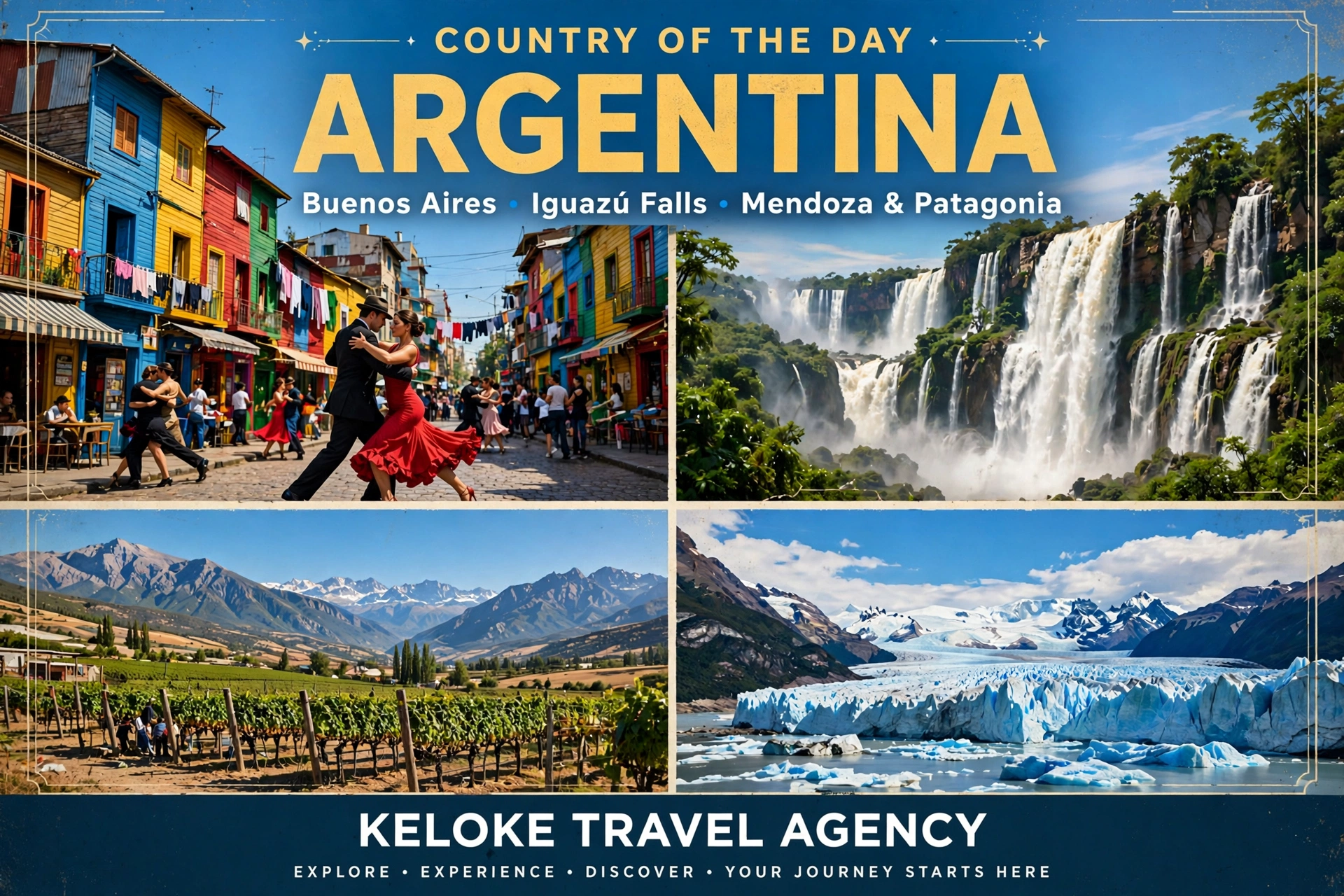
Argentina: Tango, Waterfalls and the End of the World — One Country, Every Climate
Argentina is the eighth-largest country on Earth, and it behaves like several countries stacked north to south: subtropical jungle and the biggest waterfalls on the planet at the top, a European-feeling capital and wine country in the middle, and glaciers, penguins and the southernmost city in the world at the bottom. Distances are the planning rule here — Buenos Aires to Iguazú is a flight, Buenos Aires to Ushuaia is a longer one — so pick two or three regions, fly between them, and let each one be its own trip.
The country, one by one
- Buenos Aires: the capital chapter — Paris-style avenues and café culture with a Latin heartbeat. La Boca's painted houses, San Telmo's antiques and Sunday market, Recoleta Cemetery, Palermo's parks and parrillas, and tango where it was born: a milonga late at night beats any stage show. Give the city three days minimum; it rewards slow wandering and late dinners (nobody eats before 9 PM).
- Iguazú Falls (Puerto Iguazú, Misiones): the waterfall chapter — some 275 falls spread across nearly 3 km of jungle cliffs on the Brazil border, with the Garganta del Diablo (Devil's Throat) boardwalk standing over a U-shaped chasm 82 metres tall. The Argentine side holds most of the falls and the full trail network — plan a full day inside the park, start at opening, and expect to get wet on the lower circuit.
- Mendoza: the wine chapter — Argentina's Malbec capital at the foot of the Andes, all tree-lined streets, irrigation channels and bodegas in Maipú, Luján de Cuyo and the high Uco Valley, with Aconcagua (6,961 m, the highest peak outside Asia) on the horizon. Bike the wine routes, book winery lunches ahead, and let the siesta rhythm set the pace.
- Patagonia — El Calafate & El Chaltén: the glacier chapter — El Calafate is the gate to Perito Moreno, a 30 km-long advancing glacier whose calving icebergs thunder into Lago Argentino in front of the boardwalks. El Chaltén, Argentina's trekking capital, puts the Fitz Roy and Cerro Torre trails right at the edge of town — no shuttle, no fee booth, just walk out of your lodge and up.
- Ushuaia & Tierra del Fuego: the end-of-the-world chapter — the southernmost city on Earth, between the Beagle Channel and the Martial mountains. Boat the channel past sea lions and the Les Eclaireurs lighthouse, ride the End of the World Train into Tierra del Fuego National Park, eat centolla (king crab), and send a postcard stamped at the end of the world.
- Worth knowing — Salta & the Northwest, and Bariloche: Salta's colonial north brings red-rock quebradas, high-altitude vineyards in Cafayate and the Train to the Clouds; San Carlos de Bariloche anchors the Lake District with alpine lakes, chocolate shops and Cerro Catedral skiing in winter. Either one swaps cleanly into an itinerary in place of Mendoza.
Culture notes
Argentina runs on ritual: the asado (a slow, social barbecue that is an event, not a meal), mate shared from one gourd and passed hand to hand — accept when offered, it's a welcome — and fútbol as a genuine civic religion, with the Boca–River Superclásico dividing the capital. Tango is UNESCO-listed heritage, café cortados stretch for hours, and the Italian and Spanish immigration waves show up everywhere from hand gestures to dinner at 10 PM. A few words of Spanish go far, and note the local accent: the 'll/y' sounds like 'sh' — calle sounds like 'ca-sheh'.
When to go
Seasons are reversed south of the equator, and the country is too long for one best month. Buenos Aires is best in spring (September–November) and autumn (March–May) — summer (December–February) is hot and humid. Patagonia is a November-to-March destination: outside that window the wind is fierce, days are short and many services close. Iguazú is year-round, with the fullest falls after rainy periods and the most comfortable temperatures March–May and August–September. Mendoza's vendimia (harvest festival) peaks in early March. Bariloche skis June–August. Match the region to the month, not the other way around.
Practical tips
- U.S. visitors: visa-free up to 90 days: U.S. citizens do not need an Argentine tourist visa for stays of 90 days or less. Your passport must be valid at entry — bring six months' validity anyway, since airlines and connecting countries often enforce it — and you need one blank page for the entry stamp. No vaccinations are required for entry, and you can carry up to US$10,000 (or equivalent) undeclared if you are over 16.
- Haitian passport holders — tourist visa REQUIRED in advance: Haitian citizens with ordinary Haitian passports must get an Argentine tourist visa before traveling — this is stated directly by the Argentine Embassy in Haiti (ehait.cancilleria.gob.ar, 'Visa Turista': 'Los ciudadanos haitianos, titulares de pasaportes haitianos ordinarios, requieren visa para ingresar a la Argentina en calidad de turistas') and by argentina.travel, which lists Haiti among the countries that need to apply. The process is personal, with a consular interview: request the form and an appointment at the embassy (ehait@cancilleria.gov.ar / (509) 2940-6711) at least about 30 days before your planned travel, bring proof of work and income, bank/credit-card statements, a round-trip flight reservation, and a hotel reservation or a notarized invitation letter; the fee at the Embassy in Haiti is USD 50, paid by bank deposit on the appointment day. A granted tourist visa allows a stay of up to 90 days, extendable once. Do NOT buy air tickets before the visa is confirmed — the embassy itself advises against it. (An older Cancillería visa-regime chart still lists Haiti as visa-free — that chart is stale: Argentina reinstated the tourist visa for Haitian citizens in August 2018. Do not rely on it.)
- Money is the peso — and prices move: Argentina's currency is the peso (ARS), and inflation means posted prices, tour rates and exchange conditions change fast — re-confirm every price close to departure, carry a mix of cards and some U.S. dollars in clean notes to exchange through official channels, and never rely on a price printed in an old guidebook (or an old blog post — including ours: the daily runner re-verifies before publishing).
- Power is 220V, plugs are Type C and Type I: Argentina runs 220V with two plug shapes — the European-style Type C and the angled three-pin Type I. U.S. flat plugs do not fit Type I sockets, and single-voltage U.S. appliances need a converter, not just an adapter — a universal adapter/converter kit is the one-pack fix.
- Distances are flights, not drives: Buenos Aires–Iguazú is ~1.5 hours by air (17+ by bus), Buenos Aires–El Calafate ~3.5 hours, Buenos Aires–Ushuaia ~3.5 hours. Book domestic flights early (Aerolíneas Argentinas, Flybondi, JetSMART), and note Buenos Aires has two airports — Ezeiza (EZE, international) and Aeroparque (AEP, domestic/regional); many connections require changing airports across the city, so leave hours, not minutes.
- Altitude appears quietly in the northwest: Salta city sits ~1,200 m, but Cafayate, the quebradas and the Train to the Clouds climb past 4,000 m — take the climb days easy, hydrate, and go light on the Malbec until you've acclimatized.
- Yellow fever is an Iguazú question: no vaccine is required to enter Argentina, but yellow fever vaccination is recommended for the forested northeast including Iguazú Falls (Misiones) for travelers aged 9 months to 60 years — ideally at least 10 days before. It is NOT recommended for itineraries limited to Buenos Aires, Mendoza or Patagonia. Ask a clinician what fits your exact route.
- Driving is on the RIGHT, and rental cars make sense in Mendoza, Salta and the Lake District — less so in Buenos Aires, where the Subte, buses and taxis cover the city.
What to pack for Argentina
Subtropical jungle, capital evenings and subantarctic wind can all land in the same suitcase. Our country picks: a universal travel adapter and voltage converter with USB ports — Argentina's 220V Type C/I mix is the one that strands U.S. plugs — noise-cancelling over-ear headphones for the 9–11 hour overnight flights in and the long domestic hops and buses between regions, compression packing cubes so Buenos Aires layers and Patagonia insulation ride in one carry-on strategy, a 20,000 mAh fast-charge power bank for glacier boardwalks, Iguazú trail days and end-of-the-world boat trips far from outlets, and an insulated vacuum travel mug that keeps coffee hot through a Patagonian morning and mate culture company all day. Find them in the KELOKE shop.