
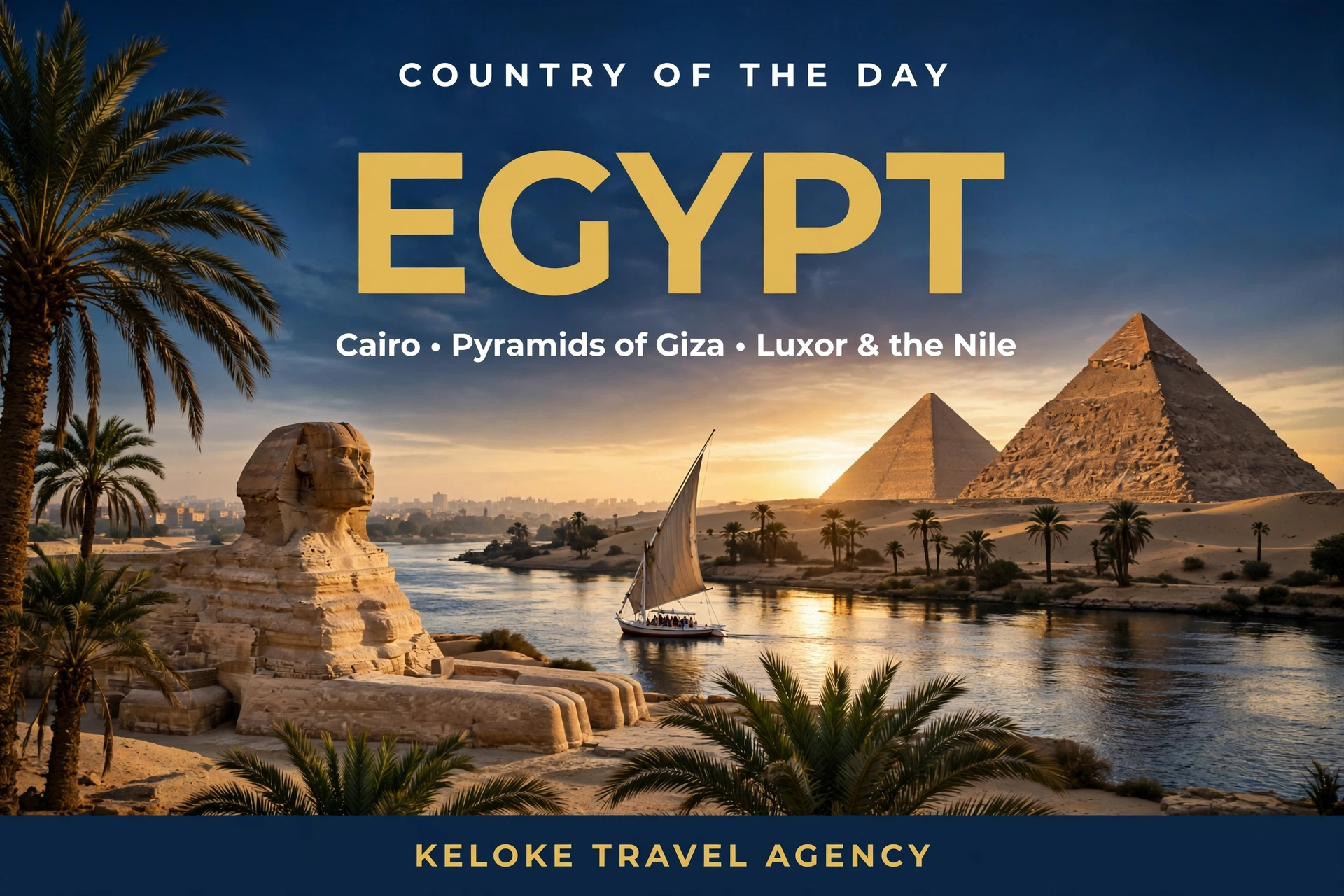
Egypt: Pyramids, Pharaohs and the Nile — the Trip of a Lifetime
Egypt is the trip people dream about for decades and then wonder why they waited: the only surviving wonder of the ancient world, temples so big they hum, and a river that carries you through 5,000 years of history in a single week. The planning rule is simple — Cairo and Giza first, then follow the Nile south to Luxor and Aswan, start every sightseeing day early against the heat, and leave the Red Sea for the slow finish.
The country, one by one
- Cairo and Giza: the headline chapter — the Pyramids of Giza and the Great Sphinx on the plateau, the Grand Egyptian Museum beside them, and a capital of minarets, markets and Nile-side cafes. Give Cairo three days: the plateau early in the morning, Khan el-Khalili bazaar by evening, and Islamic Cairo's mosques and citadel in between.
- Luxor: the open-air museum chapter — Karnak and Luxor Temple on the East Bank, the Valley of the Kings and Hatshepsut's mortuary temple on the West Bank. Cross the river at sunrise, do the tombs before the heat peaks, and take a felucca on the Nile at sunset.
- Aswan and the Nile cruise: the slow chapter — sail between Luxor and Aswan past Kom Ombo and Edfu, visit Philae Temple on its island, and ride out to Abu Simbel, the colossal temples moved stone by stone to save them from the rising waters. Aswan's Nubian villages and spice markets are Egypt at its gentlest.
- Alexandria and the Red Sea — worth knowing: the coast chapter — Alexandria for Mediterranean seafood, the modern Library of Alexandria and a very different, sea-breeze Egypt; and the Red Sea resorts of Hurghada and Sharm el-Sheikh for reefs, diving and the beach finish after the temples. Pick one coast, not both, unless you have two full weeks.
Culture notes
Egyptian hospitality is warm, loud and generous — expect tea offered everywhere and haggling treated as friendly sport in the bazaars, where a smile and a walk-away settle most prices. Arabic is the language; a few words go far: shukran (thank you), sabah el-kheir (good morning), and la, shukran (no, thank you) for persistent sellers at the sites. Dress modestly for mosques — shoulders and knees covered, women carry a light scarf for head covering inside — and always ask before photographing people.
When to go
October to April is the sweet spot: warm days, cool evenings and sightseeing weather from Cairo to Aswan. Summer (June to August) brings fierce heat in Luxor and the south, where temple touring becomes a dawn-only sport, though Red Sea resorts stay popular year-round. Ramadan shifts the rhythm — many sites keep shorter hours and evenings come alive after sunset — so check dates when you book.
Practical tips
- Haitian passport holders — tourist visa ON ARRIVAL, 30 days: Haitian passport holders can get a tourist visa on arrival in Egypt — 30 days, single entry, passport valid 6+ months, with your return ticket and hotel details handy; it's not visa-free entry, and rules can change, so confirm with the Egyptian consulate before you fly. Haiti is not on the official eVisa portal's eligible-country list, so do not let a third-party site sell you an eVisa.
- U.S. passport holders — visa required, eVisa or on arrival: U.S. passport holders also need a visa: get the eVisa at least 7 days ahead on the official portal visa2egypt.gov.eg, or buy a visa on arrival — $30 in exact-change US dollars (the fee rose from $25 in March 2026), good for 30 days. The official eVisa lists $30 single-entry and $65 multiple-entry; passport valid at least 6 months from arrival.
- The Sinai-only permit is NOT an Egypt visa: arriving at Sharm el-Sheikh for the South Sinai resorts only, a free short-stay Sinai-only permit exists — it does NOT cover Cairo, Luxor, Aswan or the pyramids. Do not plan a mainland trip around it.
- Money is the Egyptian pound: Egypt's currency is the Egyptian pound (EGP). Cards are accepted in hotels and bigger restaurants; sites, markets, taxis and tipping (baksheesh is a way of life) run on cash, so carry small pound notes. Prices change — re-confirm site, cruise and tour prices close to departure.
- Power is 220V, plugs are Type C and Type F: Egypt runs 220V with round two-pin Type C and grounded Type F sockets. U.S. flat plugs do not fit, and single-voltage U.S. appliances need a converter, not just an adapter — most phone and laptop chargers are dual-voltage 100-240V, so check the label. A universal adapter/converter kit is the one-pack fix.
- Heat and distance are the real packing rules: Egypt days are long, dusty and spread out — Cairo traffic, temple complexes measured in acres, and domestic flights or the sleeper train between Cairo and the south. Sightsee early, carry water all day, and pack light layers for cool desert evenings. Driving is on the RIGHT; most visitors hire drivers rather than self-drive in Cairo.
What to pack for Egypt
Desert sun, dusty temple floors, long days between Cairo, Luxor and Aswan, and sockets your plugs do not fit. Our country picks: a universal travel adapter and voltage converter with USB ports — Egypt's 220V Type C/F sockets are the one that strands U.S. plugs — a 3-in-1 handheld mini fan with power bank and flashlight for Valley of the Kings heat and site queues, a collapsible 25oz water bottle you refill all day instead of buying plastic at every temple, a 20,000mAh power bank with a built-in USB-C cable for dawn-to-dusk camera and map days far from outlets, and waterproof shoe bags that keep dusty site shoes away from clean clothes and carry your shoes at mosque visits. Find them in the KELOKE shop.
