
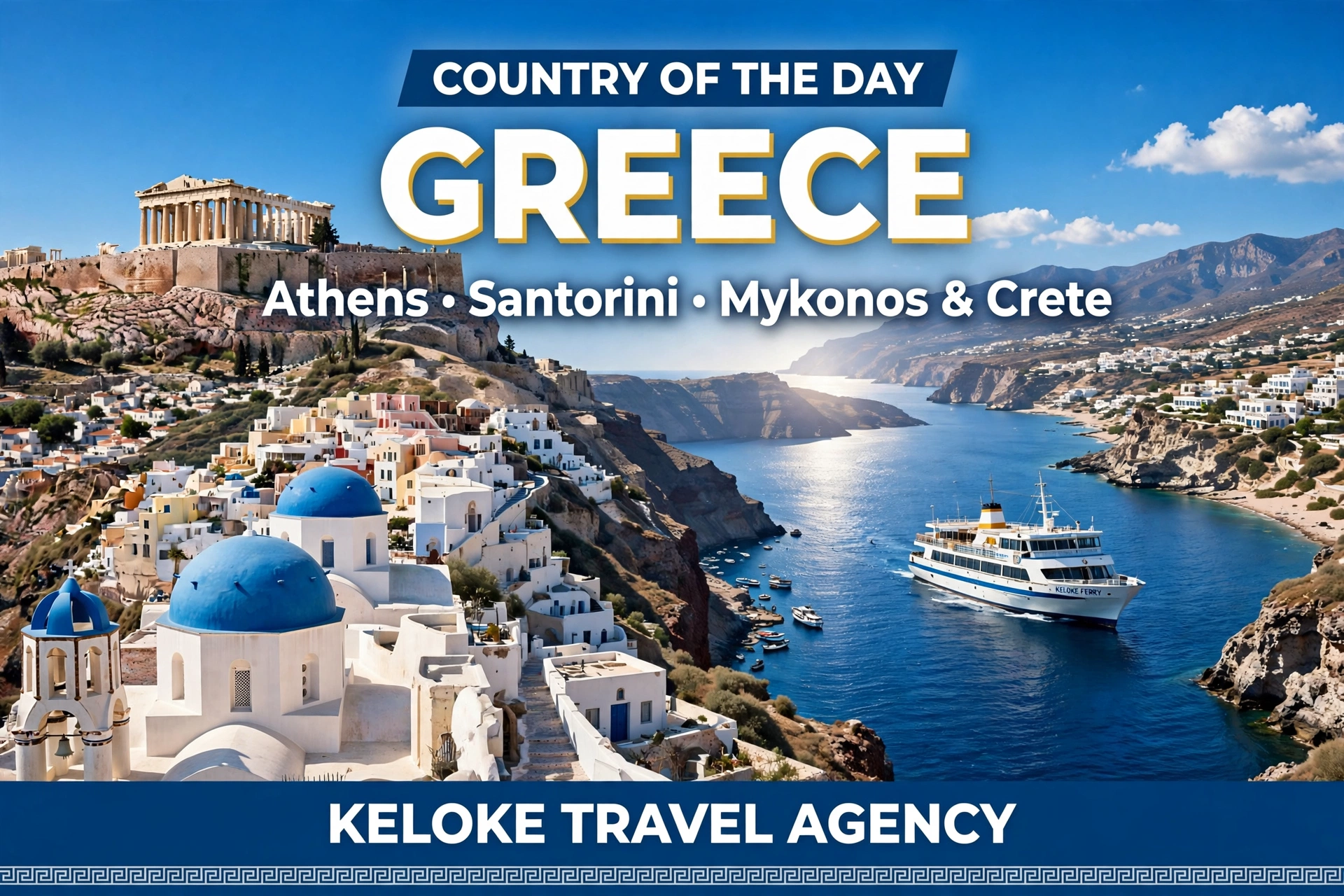
Greece: Athens, Islands and Ancient Light — One Country, a Thousand Trips
Greece is two trips in one: a mainland of ancient capitals, mountain monasteries and long road journeys, and an island world where ferries, white villages and blue water set the pace. The planning rule is not to chase every island — pick Athens plus one island group, travel by ferry like the Greeks do, eat late, swim often, and let the heat shape your day: sights early, shade at midday, and the waterfront at sunset.
The country, one by one
- Athens: the capital chapter — the Acropolis and the Parthenon above the city, the Acropolis Museum, the Ancient Agora, and the lanes of Plaka and Monastiraki below. Give Athens two to three days: climb to the Acropolis early before the heat and crowds, then take the evenings in Psyrri and Exarchia for tavernas and rooftop views back up at the floodlit rock.
- Santorini: the caldera chapter — white villages of Oia and Imerovigli on a drowned volcano, black-sand beaches at Kamari and Perissa, Akrotiri's buried ancient city, and sunsets that fill every lane in Oia. Santorini is small, busy and priced for its fame — visit in shoulder season if you can, and book caldera-view stays well ahead.
- Mykonos: the party-and-beaches chapter — Mykonos Town's white maze, its windmills and Little Venice waterfront, and beach clubs that run from quiet mornings to loud nights. It is also a useful ferry hub for the Cyclades, so even a short stop pairs well with quieter islands nearby.
- Crete: the big-island chapter — Greece's largest island is a country of its own: the Palace of Knossos near Heraklion, Chania's Venetian harbour, the Samaria Gorge hike, and Elafonissi's pink-tinged sands. Crete needs its own days, a rental car, and an appetite — Cretan food, from dakos to slow lamb, is a reason to go by itself.
- The other islands and the mainland — worth knowing: the quieter chapter — Naxos and Paros for Cycladic villages without the crowds, Rhodes for its medieval old town, Corfu for green hills and Venetian lanes, and on the mainland the clifftop monasteries of Meteora and the oracle site of Delphi. Ferry-hop one or two, and save the rest for the return trip Greece always seems to cause.
Culture notes
Greek life runs on philoxenia — hospitality to strangers — and on long, shared meals where nobody rushes the table. Coffee is a ritual, from a quick freddo espresso on a hot street to a slow Greek coffee in a village kafeneio. Churches and monasteries are living places, not just sights: dress modestly inside, with shoulders and knees covered at sites like Meteora. A few words go far: efharisto (thank you), kalimera (good morning), and parakalo (please / you're welcome).
When to go
Late spring (May to June) and early autumn (September to October) are the sweet spots: warm seas, open tavernas and ferries on full schedules, without peak crowds. July and August are hottest and busiest, island prices peak, and Athens sightseeing becomes an early-morning sport. Winter is quiet and cheap in Athens and the mainland, but many island hotels and ferry routes close or thin out — islands are a spring-to-autumn story.
Practical tips
- Haitian passport holders — Schengen visa REQUIRED in advance: Haitian passport holders need a Schengen visa in advance for Greece — apply early (processing is normally 15 days and can stretch to 45), with €30,000 travel medical insurance, proof of stay and funds, and a flight reservation; don't buy non-refundable tickets before the visa is granted. This is a short-stay Type C Schengen visa (adult fee €90), applied for at a Greek embassy or consulate or an authorized visa center, in person with biometrics, up to 6 months before travel and at the latest 15 days before.
- U.S. visitors: visa-free up to 90 days in any 180: U.S. visitors are visa-free for up to 90 days in any 180-day period across the whole Schengen area — days in Italy, Spain or any other Schengen country count against the same allowance — with a passport valid 3+ months beyond departure from Schengen and issued within the previous 10 years.
- No ETIAS is needed or available yet in 2026: ETIAS is NOT operating as of October 2026 — no applications are open and nobody needs one yet. Any website selling an ETIAS for Greece now is fraudulent. The EU Entry/Exit System (EES) IS operating — a digital border registration (passport scan, photo and fingerprints) at your first Schengen entry — with no advance application and no fee; expect a digital check at the border, nothing to do before you travel.
- Money is the euro: Greece's currency is the euro (EUR). Cards are widely accepted in Athens and the tourist islands; small tavernas, taxis, markets and remote villages can prefer cash, so carry small euro notes. Prices in this post are not quoted because they change — re-confirm ferry, site and tour prices close to departure.
- Power is 230V, plugs are Type C and Type F: Greece runs 230V with round two-pin Type C and grounded Type F sockets. U.S. flat plugs do not fit, and single-voltage U.S. appliances need a converter, not just an adapter — most phone and laptop chargers are dual-voltage 100-240V, so check the label. A universal adapter/converter kit is the one-pack fix.
- Ferries and heat are the real packing rules: Island trips mean ferry decks, cobbled lanes, boat days and serious summer sun. Pack light enough to carry up village steps, bring sun protection and a refillable bottle, and plan ruins and hikes for early morning. Getting around: metros and buses cover Athens, ferries link Piraeus and Rafina to the islands, domestic flights serve the big islands, and a rental car earns its keep on Crete and the mainland — driving is on the RIGHT.
What to pack for Greece
Ancient hills in the heat, ferry decks, island steps and long days away from your hotel in one trip. Our country picks: a universal travel adapter and voltage converter with USB ports — Greece's 230V Type C/F sockets are the one that strands U.S. plugs — a 3-in-1 handheld mini fan with power bank and flashlight for Acropolis climbs, ferry queues and hot island lanes, a collapsible 25oz water bottle you refill all day instead of buying plastic at every ruin, packing cubes that keep island-hopping luggage ferry-light and organised between Athens, Santorini and Crete, and a double-support travel neck pillow for the long overnight flight in and slow ferry crossings. Find them in the KELOKE shop.
