
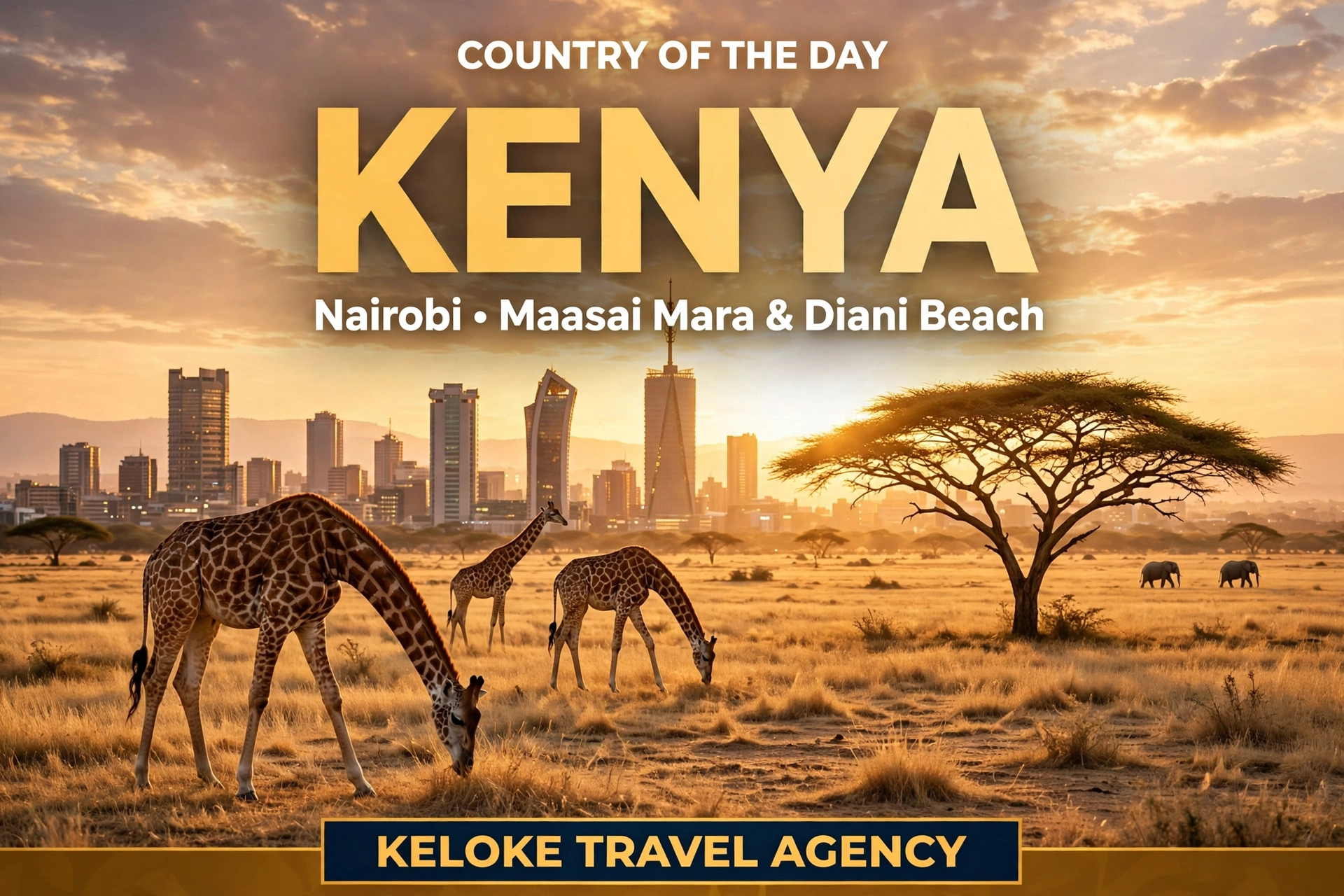
Kenya: Nairobi Buzz, Mara Safaris and a Swahili Coast
Kenya is East Africa's classic trip in one country — a capital with a national park on its skyline, the Maasai Mara's great safari plains, elephants under Kilimanjaro at Amboseli, and a warm Swahili coast to finish on. The one part that punishes improvisation is the paperwork: Kenya scrapped visas in 2024 but replaced them with an eTA that must be approved before you fly — so sort that first and the rest of the trip is easy.
The country, one by one
- Nairobi: the headline chapter — the capital, and the only city in the world with a national park against its skyline, where giraffes graze with towers behind them. Add the Giraffe Centre, the Sheldrick elephant nursery, the Karen Blixen Museum and a serious food and coffee scene, and Nairobi earns a full day or two, not just a layover.
- Maasai Mara: the safari chapter — Kenya's share of the Serengeti ecosystem and the best place in the country for big cats. From roughly July to October the Great Migration's wildebeest herds are in the Mara; the rest of the year the resident lions, leopards, cheetahs and elephants are still there with fewer vehicles around them.
- Amboseli and the Rift Valley — worth knowing: the views chapter — Amboseli National Park's elephant herds photographed against Mount Kilimanjaro across the Tanzanian border, best at dawn before the clouds build. On the way, the Great Rift Valley lakes — Naivasha for boat rides among hippos and Hell's Gate's cycleable gorge, Nakuru for flamingos and rhinos.
- The coast — Mombasa, Diani and Lamu: the slow chapter — about an hour's flight or a modern train ride from Nairobi. Mombasa's Old Town and Fort Jesus, Diani Beach's white sand south of the city, and car-free Lamu Island further north, where Swahili culture, dhow boats and donkeys set the pace.
Culture notes
Kenya is home to more than 40 peoples — Kikuyu, Luo, Luhya, Kalenjin, Maasai and many others; Swahili and English are the official languages, and "Karibu" (welcome) and "Asante" (thank you) will carry you a long way. This is the land of the Maasai and their red shukas, of world-beating distance runners, of nyama choma (grilled meat) shared off a board, and of some of the best coffee and tea on earth grown in the highlands. Dress modestly on the mainly Muslim coast and in Lamu, and ask before photographing people — especially Maasai, for whom a small fee for photos is customary in tourist settings.
When to go
The long dry season, roughly June to October, is prime safari time: animals gather at water, the grass is short, and the Migration is in the Mara from about July. A shorter dry window runs roughly January to March, warm and clear with excellent game viewing. The long rains fall roughly April to May and the short rains around November to December — roads to the parks get harder, some camps close, but prices drop and the country turns green. Nairobi sits at altitude, so evenings are cool year-round even when the coast is hot.
Practical tips
- Haitian and U.S. passport holders — $30 eTA REQUIRED in advance, no visa or eTA on arrival: For Kenya, BOTH Haitian and U.S. passport holders need an approved eTA before they fly — Kenya scrapped visas in 2024, but not the paperwork, and there is no visa or eTA on arrival. Apply only on the official portal, etakenya.go.ke, at least 3 days before you travel: the standard single-entry eTA costs $30 (card charges extra), it is valid for travel within 90 days of issue, and on arrival the officer sets your stay, up to 90 days. Don't be misled by "Kenya is visa-free for everyone" headlines — the exemption covers East African citizens, most African passports, and a named list of countries like Jamaica, Barbados and Trinidad and Tobago; Haiti and the United States are not on it (Kenyans visiting Haiti visa-free is the reverse trip, and it doesn't change the rule for Haitians). Airlines check for an approved eTA before boarding. U.S. passport holders who go often can also pick the 5-year multiple-entry eTA for $185.
- Passport and yellow fever — know which documents actually decide boarding: Bring a passport valid at least 6 months beyond arrival with at least one blank page. A yellow fever certificate is required ONLY if you are arriving from — or have transited through — a country where yellow fever is endemic; neither Haiti nor the United States is endemic, so a direct trip from the U.S. or Haiti does not need one, but a route through an endemic country changes that. The eTA application itself asks for your passport bio page, a photo or selfie, your accommodation booking (or an invitation letter and host ID if staying with friends or family) and your itinerary or onward ticket.
- Money is the Kenyan shilling, and mobile money is king: The currency is the shilling (KES). Cards work at larger hotels, malls and restaurants in Nairobi, but Kenya runs on M-Pesa mobile money for locals — visitors should not count on using it, so carry shillings in small notes for markets, taxis and park-side purchases, and use ATMs inside banks or malls.
- Power is 240V, plugs are Type G: Kenya runs 240V and uses Type G plugs — three square pins, British style. U.S. flat plugs do not fit, and single-voltage U.S. appliances need a converter, not just an adapter — most phone and laptop chargers are dual-voltage 100–240V, so check the label. Safari lodges may run on generators or solar with set charging hours, which is exactly when a power bank earns its space.
- Getting around and safari country sense: Base in Nairobi and fly or join a safari operator for the Mara — the road is long — and use the modern SGR train or a short flight for the coast. Inside Nairobi, use hotel-arranged or app-booked rides and allow real time for traffic. The Mara and Amboseli are low-risk malaria areas compared with the coast, which is malaria country — talk to your clinician or a travel-health clinic about prevention well before you go, use repellent, and follow your guide's rules around wildlife at all times.
What to pack for Kenya
An eTA that must be approved before you board, 240V Type G sockets your plugs do not fit, dawn-to-dusk game drives with nowhere to charge, and a trip that moves from a high-altitude capital to a safari camp to a hot coast. Our country picks: a universal travel adapter and voltage converter with USB ports — Kenya's 240V Type G sockets are the ones that strand U.S. plugs — an RFID-blocking passport and document organizer that keeps your passport, printed eTA approval, accommodation booking and onward ticket together for the airline check, a 20000mAh power bank for full days in a safari vehicle, wireless noise-canceling headphones for the long-haul flights into Nairobi and the road and rail hours after, and a 6-piece compression packing cube set that keeps a three-base trip — Nairobi, the Mara, the coast — compact enough for safari vehicles and small planes. Find them in the KELOKE shop.
