
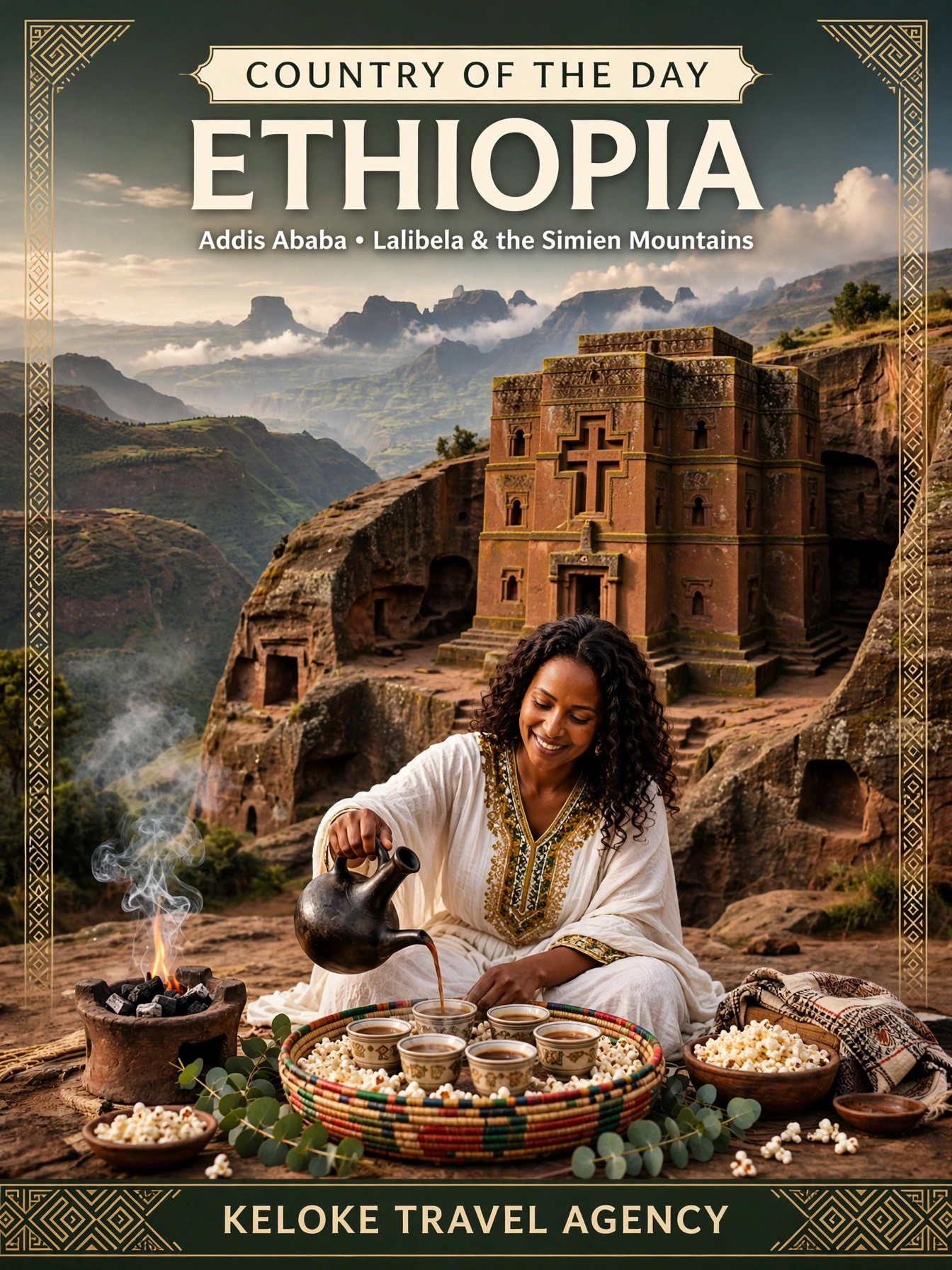
Ethiopia: Lalibela’s Stone Churches, High Mountains and the First Coffee
Ethiopia is the African trip that feels like nowhere else — the only country on the continent never colonised, with its own calendar, its own clock, its own script, and churches carved down into solid rock 800 years ago. Addis Ababa is one of the highest capitals in the world, the Simien Mountains are among Africa’s great treks, and coffee was born here. The paperwork is the one part to handle early: in 2026 the visa is an eVisa you must hold before you fly, not something to sort out at the airport.
The country, one by one
- Addis Ababa: the headline chapter — the capital at about 2,355 metres, home to the National Museum and “Lucy,” the famous early human fossil, the vast Merkato market, Entoto Hill above the city, and the buna (coffee) ceremony you will be offered everywhere — beans roasted, ground and brewed in front of you, three rounds deep.
- Lalibela: the wonder chapter — a small highland town built around eleven medieval churches carved out of single pieces of living rock, connected by tunnels and trenches, still active places of worship. Fly in from Addis; give it at least a full day, ideally two, and go with a local guide who knows the order and the stories.
- The Simien Mountains and Gondar — worth knowing: the mountains chapter — jagged highlands, deep escarpments, gelada monkeys and walia ibex, reached from Gondar, the old imperial capital with its castle compound. Even a short guided walk on the plateau is unforgettable; serious trekkers stay for days.
- The south and east — Lake Tana, Harar and the Danakil: the range chapter — Bahir Dar and the island monasteries of Lake Tana with the Blue Nile Falls nearby; walled Harar in the east, its hundreds of alleyways and famous hyena feeding; and, for the truly adventurous with a specialist operator only, the Danakil Depression’s sulphur springs and salt flats, one of the hottest and lowest places on earth.
Culture notes
Ethiopia is home to more than 80 peoples and languages; Amharic is the working language of government and Addis, English is widely taught and spoken in tourism, and Oromo and Tigrinya are major regional languages. The Ethiopian Orthodox Church shapes the calendar — which runs about seven to eight years behind the Gregorian one, with 13 months — and fasting days shape menus, which is one reason Ethiopian vegetarian platters are so good: injera, the spongy teff flatbread, serves as plate, spoon and food at once, eaten by hand from a shared platter. This is the birthplace of coffee, in the Kaffa region; refusing a coffee ceremony is nearly impossible and never necessary. Dress modestly at churches — shoulders and knees covered, heads covered for women in some — and remove shoes at church doors.
When to go
The dry season, roughly October to February, is the easiest window for most of the classic route: clear skies in the highlands, Lalibela accessible, and major festivals including Ethiopian Christmas in January and Timket (Epiphany) in mid-to-late January, the country’s great celebration. March to May is warmer with some rain; the main rains fall roughly June to September, when Simien trekking and rural roads get hard but the highlands are at their greenest and the waterfalls are at full power. Addis is cool year-round because of the altitude — pack layers whatever the month.
Practical tips
- Haitian and U.S. passport holders — eVisa REQUIRED before travel, do not rely on visa on arrival: For Ethiopia, BOTH Haitian and U.S. passport holders need a visa before they fly — only Kenyan and Djiboutian visitors enter visa-free. Apply on the official portal, evisa.gov.et, at least 3 days before you travel (normal processing is 3 days): a single-entry tourist eVisa costs $62 for a stay of up to 30 days, or $152 for up to 90 days, and its validity starts on the arrival date you put in the application, so use your real date. Don’t plan on a visa at the airport — in 2026 visa on arrival at Addis Ababa is restricted (mainly African Union nationals and travellers of Ethiopian origin with an Origin ID card), airlines can refuse boarding without an approved visa, and older pages quoting $52 or promising airport visas for Americans are out of date. Confirm the live total on evisa.gov.et before paying, and use only the official portal, never a third-party seller.
- Passport and yellow fever — the documents that decide boarding: Bring a passport valid at least 6 months from your intended entry date; the eVisa application itself asks for a recent passport-size photo and a scan of your passport bio page, and the visa details must match the passport you travel on. A yellow fever certificate is required ONLY if you are arriving from — or have transited through — a country where yellow fever is a risk; neither Haiti nor the United States is a risk country, so direct travel from the U.S. or Haiti does not trigger it.
- Money is the Ethiopian birr, and cash still matters: The currency is the birr (ETB). Cards work at larger hotels and some restaurants in Addis Ababa, but much of the country — markets, smaller towns, Lalibela guides and drivers — runs on cash, so change money at banks or official counters in Addis, keep small notes, and do not count on ATMs outside the capital.
- Power is 220V, plugs are Type C, F and L: Ethiopia runs 220V and uses a mix of plug types — Type C and F (two round pins) and the older Type L (three round pins). U.S. flat plugs fit none of them, and single-voltage U.S. appliances need a converter, not just an adapter — most phone and laptop chargers are dual-voltage 100–240V, so check the label.
- Altitude and getting around: Addis Ababa at 2,355 metres and Lalibela higher still will slow you down for a day or two — hydrate, take the first day easy, and go easy on alcohol until you adjust. Domestic flights are the sane way to reach Lalibela, Gondar and Bahir Dar; roads between the historic sites are long and slow, however good the scenery. Ethiopia is a malaria risk mainly in lowland areas — the highland circuit sits largely above the worst of it, but talk to your clinician or a travel-health clinic before you go and follow current advice for your exact route.
What to pack for Ethiopia
An eVisa that must be approved before you board, 220V sockets in three shapes your plugs do not fit, high-altitude sun in Addis and Lalibela, and layers for cold highland mornings. Our country picks: a universal travel adapter and voltage converter with USB ports — Ethiopia’s mixed 220V Type C, F and L sockets are the ones that strand U.S. plugs — an RFID-blocking passport and document organizer that keeps your passport and printed eVisa together, a collapsible 25oz water bottle for altitude hydration and long church days, wireless noise-canceling headphones for the long haul into Addis and the domestic hops after, and a 6-piece compression packing cube set that keeps highland layers and lowland clothes separate in one bag. Find them in the KELOKE shop.
