
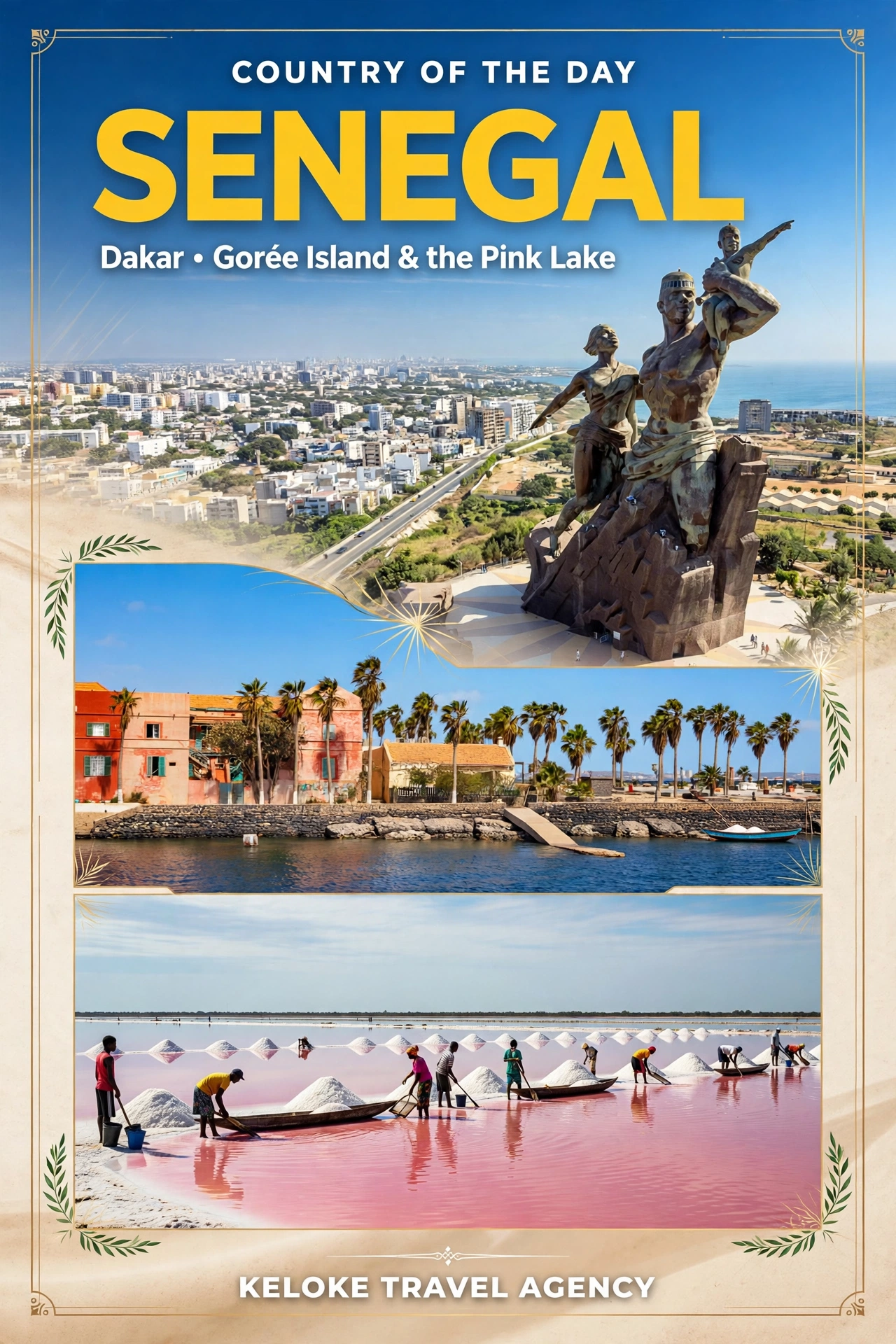
Senegal: Dakar’s Energy, Gorée’s Memory and the Pink Lake
Senegal is West Africa’s Atlantic door — a French-speaking, famously hospitable country (“teranga” means hospitality, and it is a national creed) built around one classic route: start in Dakar, take the ferry out to Gorée Island, see the Pink Lake, then head north to colonial Saint-Louis or south to the mangroves of the Sine-Saloum and the beaches of Casamance. It is also a Country of the Day where the two passports in our audience split cleanly — Americans walk in visa-free, Haitians get their visa at Dakar airport — so read the paperwork section carefully and the rest is easy.
The country, one by one
- Dakar: the headline chapter — West Africa’s westernmost capital, wrapped around a peninsula. The African Renaissance Monument above the city, the markets of Sandaga and Tilène, the Soumbédioune fish market at landing time, the surfers and restaurants of the Almadies and N’Gor Island a short boat ride offshore, and a live-music scene — mbalax was born here — that starts late and means it.
- Gorée Island: the memory chapter — a 20-minute ferry from Dakar’s port. A small, car-free island of pastel colonial houses and baobabs that was a departure point in the slave trade; the House of Slaves and its Door of No Return are essential, difficult history, best taken with a guide and unhurried, then given time to settle over lunch in the island’s quiet lanes.
- The Pink Lake and Saint-Louis — worth knowing: the colour chapters — Lac Rose (Lake Retba), about an hour from Dakar, glows pink in the dry, windy season when its salt-loving algae peak, with salt harvesters working its shores. Four to five hours north, Saint-Louis — the old colonial capital on an island in the Senegal River — offers faded grand architecture, the Guet Ndar fishing quarter at its most alive in the morning, and bird-rich Djoudj National Park nearby, one of West Africa’s great wetlands.
- Sine-Saloum and Casamance: the slow chapters — south of Dakar, the Sine-Saloum delta’s mangrove channels, shell islands and bolongs (creeks) explored by pirogue; further south across the Gambia, Casamance’s palm beaches around Cap Skirring and its Diola villages — greener, quieter Senegal, reached by a short flight or a long, beautiful drive.
Culture notes
Senegal is mainly Wolof-speaking in daily life with French as the official language; Pulaar, Serer, Diola and Mandinka are widely spoken by region. The country is predominantly Muslim, with famous Sufi brotherhoods — the Mourides’ great mosque at Touba is the country’s spiritual heart — alongside Catholic communities, and religious festivals are shared warmly across faiths. Greetings are long, warm and non-negotiable: a proper greeting with handshakes and enquiries after family comes before any business. Music is everywhere — Youssou N’Dour’s mbalax above all — and so is wrestling, the national sport. Dress modestly away from the beach resorts, especially at religious sites and in Saint-Louis’s older quarters, and ask before photographing people.
When to go
The dry season, roughly November to June, is the easy window — and from about November to April it is also the most pleasant: warm days, cool ocean breezes, little rain, and the Pink Lake at its pinkest. The rainy season runs roughly July to September or October: hot, humid, with heavy downpours that can slow roads to Casamance and the interior, though the country is at its greenest and birdlife peaks as migrants arrive. Book Dakar hotels early around Grand Magal and Tabaski, when the city fills.
Practical tips
- The two passports split — U.S. visa-free 90 days; Haitian visa on arrival, 1 month, Dakar airport ONLY: U.S. passport holders are visa-free for up to 90 days — just arrive with a passport valid at least 6 months. Haitian passport holders are NOT visa-free, but they don’t need a visa in advance either: Haiti is on Senegal’s visa-on-arrival list, issued only at Dakar’s airport (Blaise Diagne International) — not at land borders — for a stay of up to one month, and you must show a passport valid at least 6 months, a round-trip ticket, and proof of accommodation. Ignore older lists calling Haiti “visa-exempt” for Senegal, and tables promising Haitians 90 days on arrival — the current rule is one month at the airport. (Senegalese citizens visiting Haiti visa-free is the reverse trip and doesn’t change this.) A U.S. green card does NOT change the rule for a Haitian passport holder. As always, confirm the current rule before you book — Senegal has talked about a reciprocal visa policy since 2019 without implementing it.
- Passport and yellow fever — what is required and what is only recommended: Every visitor needs a passport valid at least 6 months from arrival. A yellow fever certificate is required ONLY if you are arriving from — or have transited through — a country with yellow fever risk; direct travel from the U.S. or Haiti doesn’t trigger it. The yellow fever vaccine is still recommended for Senegal itself, where the disease is present — recommended is not the same as required at the border for a direct arrival, but talk to your clinician well before you go either way.
- Money is the West African CFA franc: The currency is the CFA franc (XOF), shared across the region and pegged to the euro. Cards work at larger hotels, malls and restaurants in Dakar, but Senegal still runs heavily on cash for markets, taxis, pirogues and smaller towns — carry francs in small notes, use ATMs inside banks or malls, and expect some card machines to fail.
- Power is 230V, plugs are Type C, D, E and K: Senegal runs 230V and uses a mix of plug types — mainly Type C and E (two round pins, French style), with D and K also found. U.S. flat plugs do not fit, and single-voltage U.S. appliances need a converter, not just an adapter — most phone and laptop chargers are dual-voltage 100–240V, so check the label.
- Getting around and malaria country: Base in Dakar and take the ferry to Gorée, hire a driver or join a tour for the Pink Lake, and use a domestic flight, a tour or a long scenic drive for Saint-Louis and Casamance. Inside Dakar, agree taxi fares before you get in or use an app-booked ride, and allow serious time for peninsula traffic. Senegal is a malaria area, especially in the south and in the rainy season — talk to your clinician or a travel-health clinic about prevention well before you go, use repellent, and sleep under protection where it is provided.
What to pack for Senegal
Two different entry rules depending on your passport — which makes your document set the trip — 230V sockets in four shapes your plugs do not fit, and real heat from Dakar to Saint-Louis. Our country picks: a universal travel adapter and voltage converter with USB ports — Senegal’s mixed 230V Type C, D, E and K sockets are the ones that strand U.S. plugs — an RFID-blocking passport and document organizer that keeps your passport, round-trip ticket and proof of accommodation together for the Dakar airport visa desk, a collapsible 25oz water bottle for Gorée and Pink Lake days in the heat, a 3-in-1 handheld mini fan that doubles as a phone charger for market and ferry queues, and a 5-piece packing cube set that keeps a Dakar–Saint-Louis–Saloum trip in one suitcase without the daily dig. Find them in the KELOKE shop.
