South Korea: Palaces, Night Markets and the Autumn Maples
South Korea packs a whole continent's worth of trip into one small peninsula: a 600-year-old palace ten minutes from a K-pop dance studio, a temple stay in the mountains, the freshest seafood market of your life in Busan, and a volcanic island down south that Koreans treat as their own Hawaii. November is one of the two best months to go — the autumn maples are at their peak and the air is cold and clear. The paperwork is genuinely easy for both of Pop's audiences — both passports are visa-free — but the forms split by passport, and the Haitian form has to be approved before you board.
The country, one by one
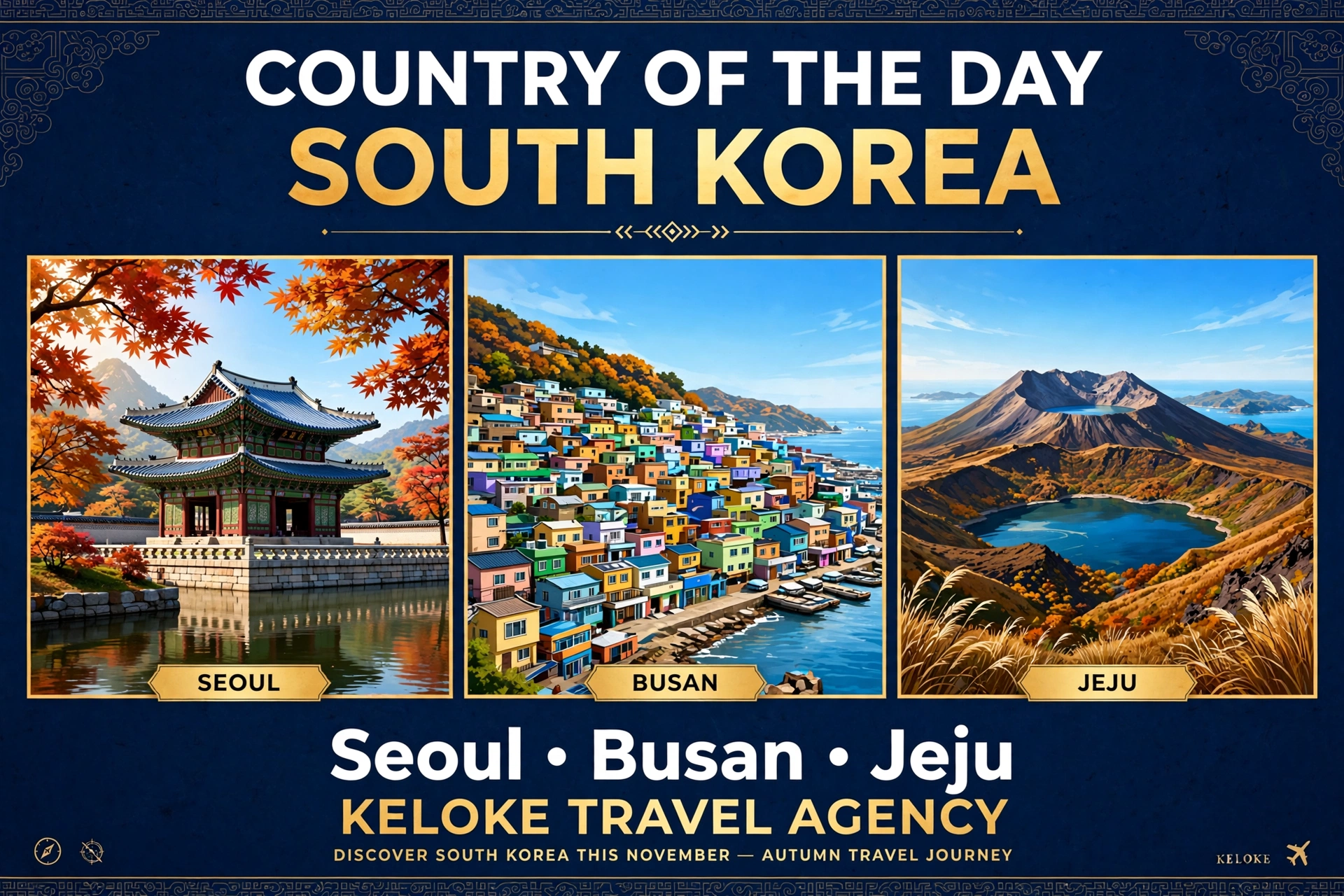
- Seoul: the headline chapter — five grand palaces, with Gyeongbokgung the biggest (arrive for the Royal Guard Changing Ceremony, and entry is free if you wear a rented hanbok). Bukchon Hanok Village's traditional rooftops, Insadong's tea houses and craft shops, Myeongdong's street-food stalls and skincare stores, Hongdae's buskers and indie shops, and the Seoul Tower view from Namsan — plus the DMZ day tour up to the border, a sobering half-day that books out early.
- Busan: the sea chapter — Korea's second city, all beaches and seafood. Gamcheon Culture Village's candy-coloured hillside houses, Jagalchi Fish Market (pick your fish downstairs, eat it upstairs), Haeundae Beach and the glass-floored Oryukdo Skywalk, and Beomeosa Temple in the hills above the city.
- Gyeongju: the history chapter — the capital of the ancient Silla kingdom for a thousand years, nicknamed "the museum without walls": royal tomb mounds in the middle of town, the Bulguksa Temple and Seokguram Grotto (UNESCO), and Cheomseongdae, one of the world's oldest observatories.
- Jeju Island: the island chapter — a one-hour flight from Seoul: Hallasan volcano at the centre, waterfalls, lava tubes, black-sand beaches and tangerine farms. Koreans honeymoon here; go midweek and you'll understand why.
Culture notes
Korean is the language; English shows up on signs, menus and transit in the big cities, and younger Koreans often speak some — a translation app covers the rest. This is the homeland of K-pop and K-drama, and Seoul wears it proudly: studio tours, filming locations and photo booths everywhere. Food is a headline act — kimchi with everything, sizzling Korean BBQ you grill yourself, bibimbap, tteokbokki from a market stall, and a café culture that treats coffee like art. Bow as a greeting, receive things with two hands, and never stick chopsticks upright in rice. Transit is world-class: one rechargeable T-money card covers subways, buses and even taxis, and the KTX fast train runs Seoul–Busan in about two and a half hours.
When to go
Two golden windows: April–May for cherry blossom and mild days, and October–November for autumn colour — the maples around Seoul's palaces, Naejangsan and Seoraksan peak around late October into mid-November, which is exactly when this guide lands. Summer (June–August) is hot, humid and rainy with the monsoon; winter is properly cold — great for ski resorts and snow festivals, hard on sightseeing days. Pack layers in November: palace days are crisp, evenings are near freezing.
Practical tips
- Haitian passport holders — visa-free 90 days, but K-ETA approval REQUIRED before you fly: Haiti is on South Korea's visa-waiver list, so no embassy visa is needed — but Haiti is NOT one of the countries temporarily excused from the K-ETA. Apply only on the official portal, k-eta.go.kr, or the official K-ETA app: the fee is ₩10,000 (about $7–8), decisions usually come within 72 hours, and the approval is valid 3 years for repeat trips, up to 90 days per visit. Apply well ahead — airlines check for an approved K-ETA before boarding, and there is no getting one at the airport. Travellers aged 17 and under or 65 and over are exempt from the K-ETA. If a K-ETA application is ever refused, the fallback is a regular tourist visa at a Korean embassy or consulate. Beware look-alike sites charging $50 or more — the Korean government has appointed no agency; the real address ends in .go.kr.
- U.S. passport holders — visa-free 90 days, K-ETA exempt through 2026, e-Arrival Card instead: Americans enter visa-free for up to 90 days and are temporarily exempt from the K-ETA requirement through December 31, 2026. Instead, file the free Korea e-Arrival Card online at e-arrivalcard.go.kr — it opens 3 days before your arrival date and costs nothing (a paper card on arrival is the backup). One caution for trips in the new year: no 2027 exemption decision had been published when this guide was checked, so if you arrive on or after January 1, 2027, re-check k-eta.go.kr before you travel.
- Both passports, same stay: Whichever passport you carry, the tourist stay is up to 90 days, and a Haitian passport holder living in the US follows the Haitian passport rule — U.S. residency does not transfer the American exemption. Carry your K-ETA approval (Haitian route) or your filed e-Arrival Card (U.S. route) with your passport.
- Money is the South Korean won, and cards rule: The currency is the won (KRW). Korea is one of the most card-friendly countries on earth — cards and phone payments work almost everywhere, even market stalls — but keep some cash for small vendors, street food and topping up your T-money transit card (top-ups are cash at many machines). Change money at banks or licensed counters at the airport or in Myeongdong, never with street changers.
- Power is 220V, plugs are Type C and F: South Korea runs 220V with round two-pin sockets (Type C and the similar Type F). U.S. flat plugs do not fit — bring an adapter — and single-voltage U.S. appliances need a converter, not just an adapter; most phone and laptop chargers are dual-voltage 100–240V, so check the label.
What to pack for South Korea
A K-ETA or arrival card to sort before boarding, 220V round-pin sockets, palace-and-mountain walking days, and November evenings that drop toward freezing. Our country picks: a universal travel adapter and voltage converter with USB ports — Korea's 220V Type C/F sockets are the ones that strand U.S. flat plugs — an RFID-blocking passport and document organizer that keeps your passport and printed K-ETA approval together, a 20,000mAh power bank with a retractable USB-C cable — your phone is your translator, subway map and camera on very long Seoul days — wireless noise-canceling headphones for the long haul in, and a 6-piece compression packing cube set that keeps Seoul, Busan and Jeju layers separate in one bag. Find them in the KELOKE shop.
