
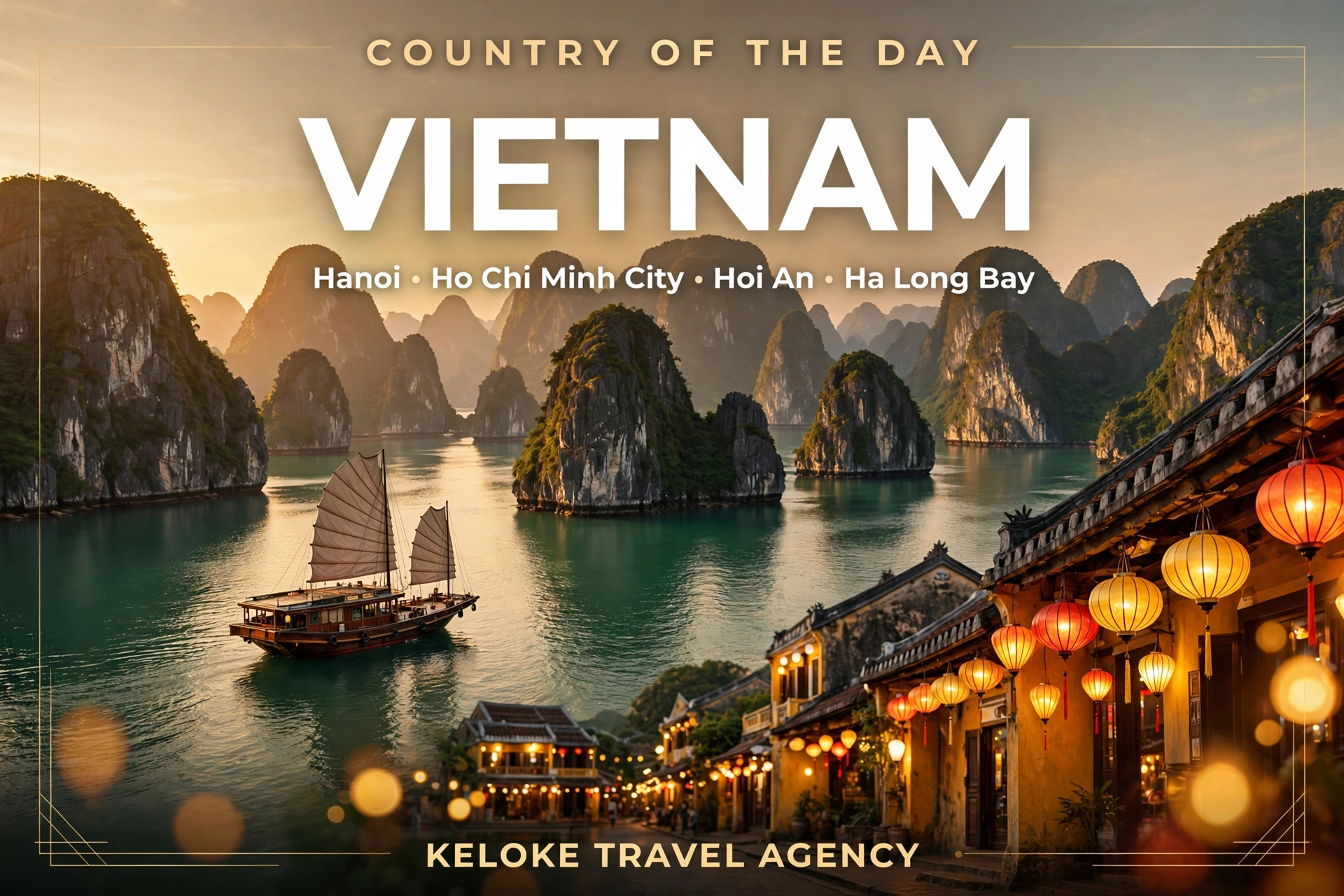
Vietnam: Lantern Streets, Limestone Bays and a Thousand Years of History
Vietnam runs long and thin down the South China Sea coast, and every stretch of it feels like a different trip: a thousand-year-old capital of lakes and street stalls in the north, lantern-lit trading ports in the centre, and a pulsing southern metropolis where the Mekong Delta fans out behind it. The food alone justifies the flight — pho at dawn, banh mi from a cart, coffee strong enough to stand a spoon in. The one thing to handle early is the paperwork: for both of Pop's audiences, Vietnam is an eVisa you hold before you board, not a stamp you pick up on arrival.
The country, one by one
- Hanoi: the headline chapter — the capital for over a thousand years. The Old Quarter's 36 guild streets, Hoan Kiem Lake at sunrise with its tai chi crowds, the Temple of Literature, Ho Chi Minh's Mausoleum and stilt house, and street food that rewards wandering: pho, bun cha, egg coffee in a hidden café up a tailor's staircase.
- Ha Long Bay and the north: the wonder chapter — an overnight cruise among nearly 1,600 limestone karsts rising out of emerald water (UNESCO), kayaking into hidden lagoons at dawn. Inland, Sapa's terraced rice valleys and Hmong villages in the northern mountains, best with a local guide and sturdy shoes.
- Hue and Hoi An (centre): the heritage chapter — Hue's Imperial Citadel and royal tombs on the Perfume River, then over the Hai Van Pass to Da Nang and Hoi An, the lantern-lit old trading port where tailors turn around a suit in 48 hours and the river glows at night. My Son's Cham ruins sit an hour inland.
- Ho Chi Minh City and the Mekong: the energy chapter — still Saigon to most of its people. The War Remnants Museum (hard, essential), Ben Thanh Market, French colonial avenues, rooftop bars, and the Cu Chi Tunnels day trip; then south into the Mekong Delta for floating markets, fruit orchards and river life, with Phu Quoc island off the far coast for beaches at the end.
Culture notes
Vietnamese is the language, tonal and written in a Latin-based script you will see everywhere; English is common in tourism and among younger people in the cities. This is a country that runs on motorbikes — crossing a Saigon street is a skill: walk slowly, steadily, and let the river of bikes flow around you; never stop dead or run. Food is regional and fiercely proud: northern pho is clear and restrained, central food is fiery, southern food sweeter and herb-heavy — and ca phe sua da, iced coffee through a slow drip filter over condensed milk, fuels all of it. Bargaining is normal at markets, done smiling; dress modestly at pagodas and temples, and ask before photographing people up close.
When to go
Vietnam's length means there is no single perfect month — the regions run on different rains. The broadest window is roughly February to April. November, when this guide lands, is a tale of three regions: the north is cool and dry (Hanoi's best walking weather, Ha Long Bay clear), the south is entering its dry season (warm, bright, Mekong trips at their easiest), but the CENTRE — Hue, Da Nang, Hoi An — is in its rainy season, with October–November the wettest stretch and occasional flooding in Hoi An's old town; pack for rain there and keep days flexible. The south's rains run roughly May–October, the north is coldest December–January and hot and humid June–August.
Practical tips
- Haitian and U.S. passport holders — eVisa REQUIRED in advance, neither passport is visa-free: Apply only on the official portal, evisa.gov.vn, at least a week before you fly (processing runs about 3–5 working days): a single-entry eVisa costs $25 and a multiple-entry $50, each good for a stay of up to 90 days, and the fee is not refunded if an application is refused. Do not be misled by the visa-free headlines — the 45-day exemption covers 25 named countries (the UK, France, Germany, Japan, South Korea and others), and neither the United States nor Haiti is on that list or any other exemption list. Since August 2023 the eVisa is open to citizens of all countries and territories, Haiti included, so the online route is the whole story — there is no walk-up visa at the airport, and the old "visa on arrival" approval letters are a pre-arranged agency product, not the official route. Beware look-alike sites charging $50 or more on top of the government fee: the real address ends in .gov.vn.
- Your eVisa names your entry gate — check it against your flight: An eVisa is valid only at the border gate chosen in the application, one of 83 listed international gates (airports including Hanoi, Ho Chi Minh City and Da Nang, plus land borders and seaports). Enter through the gate printed on your approval, carry a printed copy with your passport, and note the clock: you must leave by the eVisa's end date — arriving late inside its window does not buy back the days, and the eVisa generally cannot be extended from inside Vietnam. One genuine exception: fly directly into Phu Quoc from abroad and any nationality gets up to 30 days visa-free on Phu Quoc only — leaving the island for the mainland requires the eVisa.
- Passport — 6 months and 2 blank pages, for everyone: Vietnam requires every foreign traveller's passport to be valid at least 6 months beyond the date of entry, with at least 2 blank pages for stamps. The eVisa application itself asks for a digital passport-style photo and a scan of your passport data page, and every detail must match the passport you travel on. A Haitian passport holder living in the US follows the Haitian passport rule — here both audiences land on the same eVisa, but exemption lists always read the passport, never the residence.
- Money is the Vietnamese dong, and cash still talks: The currency is the dong (VND) — large numbers, so keep a converter handy and count the zeros. Cards are widely accepted at hotels, malls and bigger restaurants in the cities, but street food, markets, small guesthouses and rural travel run on cash; change money at banks, airports or licensed gold-shop counters, carry small notes for vendors, and agree Grab/taxi fares or use the app so the price is fixed before you ride.
- Power is 220V, plugs are a mix of Type A, C and F: Vietnam runs 220V and its sockets vary by building — flat two-pin Type A, round two-pin Type C, and Type F all appear. A universal adapter covers all three; U.S. plugs alone are unreliable here, and single-voltage U.S. appliances need a converter, not just an adapter — most phone and laptop chargers are dual-voltage 100–240V, so check the label.
What to pack for Vietnam
An eVisa printed before boarding, 220V sockets in three shapes, November rain in the centre and long street-food walking days everywhere. Our country picks: a universal travel adapter and voltage converter with USB ports — Vietnam's mixed 220V Type A, C and F sockets are the ones that strand a single-plug kit — an RFID-blocking passport and document organizer that keeps your passport and printed eVisa approval together, a 20,000mAh power bank with a retractable USB-C cable — your phone is your translator, Grab app, map and camera on very long Hanoi and Saigon days — wireless noise-canceling headphones for the long haul in, and a 6-piece compression packing cube set that keeps north layers, centre rain gear and south summer clothes separate in one bag. Find them in the KELOKE shop.
