Malaysia: Two Coasts, One Rainforest Roof, and the Easiest Door in Asia
Malaysia is two countries on one map — the Peninsula, with Kuala Lumpur’s twin towers and Penang’s food streets, and Malaysian Borneo across the sea, where orangutans swing over some of the oldest rainforest on earth. It is Malay, Chinese, Indian and indigenous cultures sharing one table, which is why the national pastime is arguing about where the best laksa is. November is the wet season on the peninsula’s east coast but a workable shoulder month for KL, Penang and Langkawi on the west — afternoon downpours, green hills, thinner crowds. And the paperwork holds a pleasant surprise for this series: it is one of the easiest doors in Asia for both audiences — as long as you know the two lengths and the one free form.
The country, one by one
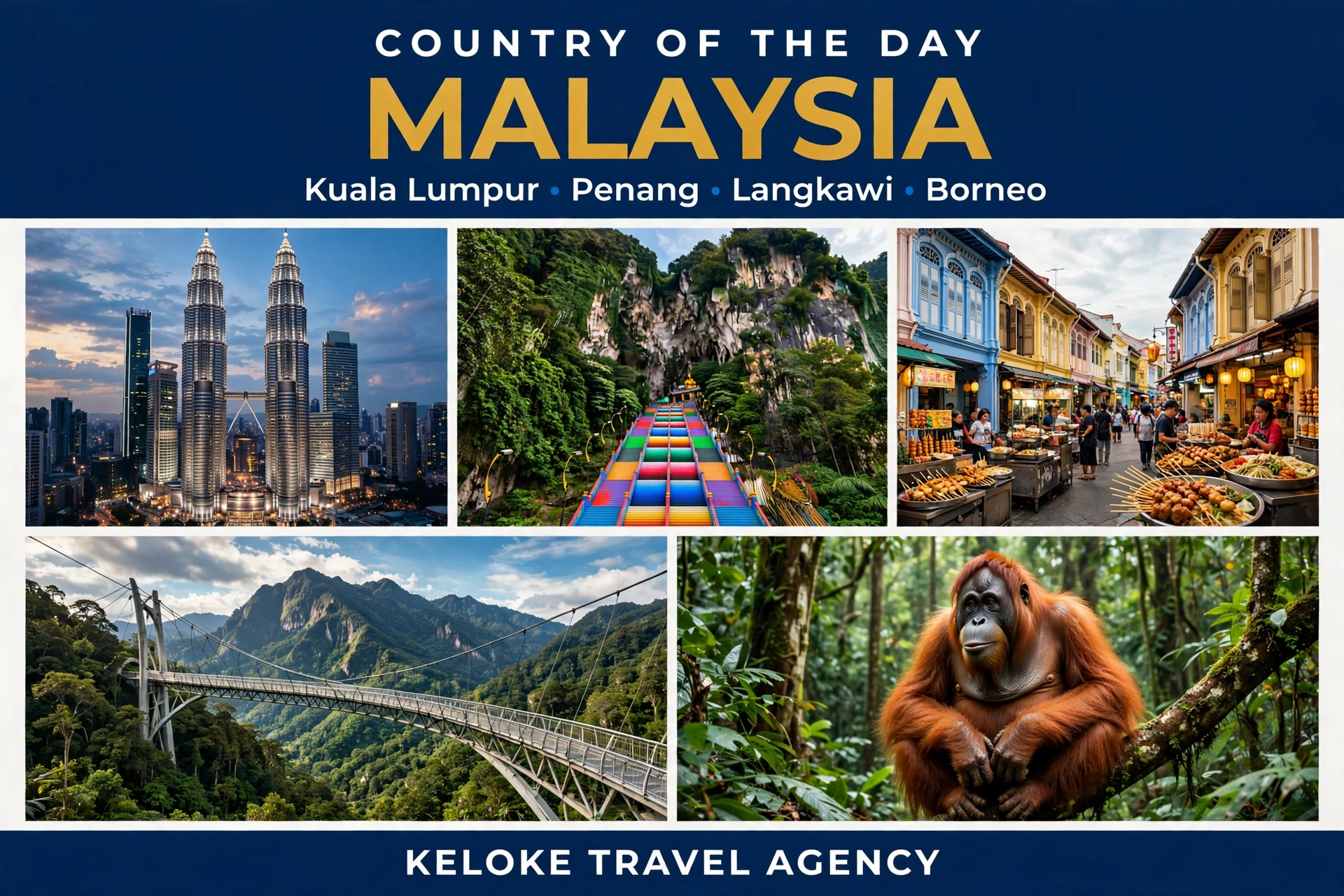
- Kuala Lumpur: the headline chapter — the Petronas Twin Towers over a city that eats around the clock. The KLCC park and skybridge, Batu Caves’ rainbow steps and Hindu shrines just north of the city, Merdeka Square and the old colonial core, and night markets from Jalan Alor’s food row to the Ramadan bazaars in season. Give the capital three days minimum.
- Penang and Langkawi (the west coast): the flavour chapter — George Town, a UNESCO-listed old town of clan jetties, street art and shophouses, and hawker food many Malaysians call the best in the country: char kway teow, asam laksa, nasi kandar. Ferry or fly on to Langkawi, the duty-free island of cable cars, sky bridges and sunset beaches — the classic November-friendly pairing while the east coast rides out the monsoon.
- Borneo — Sabah and Sarawak: the wild chapter — Kota Kinabalu and the mountain that shares its name, the Kinabatangan River’s pygmy elephants and proboscis monkeys, Sepilok’s orangutan rehabilitation centre, and Sipadan’s legendary diving off Semporna. Sarawak answers with Kuching’s riverfront, Bako National Park and the vast Mulu caves. Plan Borneo as its own leg — including its own immigration stamp (see Practical tips).
- The highlands and the south — worth knowing: the range chapter — the Cameron Highlands’ tea plantations and cool air a few hours from KL, Malacca’s Dutch-Portuguese straits history south of the capital, and Taman Negara, one of the world’s oldest rainforests, for canopy walks and river boats.
Culture notes
Bahasa Malaysia is the national language; English is widely spoken in cities and tourist areas, and a terima kasih (thank you) is always welcome. Malaysia is a Muslim-majority country that is easygoing with visitors — dress modestly at mosques (many provide robes), use your right hand to give and receive, and remove shoes when entering homes and temples. The food culture is the social glue: Malay, Chinese and Indian kitchens share the same hawker centres, halal options are everywhere, and nobody will judge a second breakfast. During Ramadan, be considerate eating in public in more conservative areas — and don’t miss the evening bazaars.
When to go
The peninsula’s west coast (KL, Penang, Langkawi) is workable most of the year, with the drier stretch roughly December to February and regular afternoon rain otherwise. The east coast islands (Perhentian, Redang, Tioman) face the northeast monsoon roughly November to February — many resorts close and seas run rough, so a November trip like this one belongs on the west coast and in Borneo. Sabah and Sarawak are year-round with rain always possible; the driest Borneo months run roughly March to September. November’s deal: west-coast cities at shoulder prices, green highlands, and rain you plan around rather than cancel for.
Practical tips
- U.S. passport holders — visa-free 90 days: Americans are on Malaysia’s 90-day visa-exemption list. No visa, no fee, no application — you receive your stay on arrival, and the 90 days count the day you land. Stays are for tourism and short business visits; working needs a different pass entirely.
- Haitian passport holders — visa-free 30 days, and do NOT buy an eVisa: Haiti is on Malaysia’s 30-day visa-exemption list — a Haitian tourist needs no visa at all for a normal visit. Ignore any site trying to sell Haitian travellers a “Malaysia eVisa” with a document checklist and a fee: Haiti is not on Malaysia’s eVisa-eligible list precisely because no visa is required. The real limit to respect is the length — 30 days, not the 90 your U.S.-passport companions get — and Malaysia treats overstays strictly. A Haitian passport holder living in the US follows the Haitian rule: 30 days.
- Everyone — the free MDAC, within 3 days before you land: Whatever your passport, every foreign visitor must submit the Malaysia Digital Arrival Card (MDAC) online within the 3 days before arrival, at the official portal imigresen-online.imi.gov.my. It has been mandatory since January 2024, it is completely free, and it is an arrival form, not a visa. Malaysian authorities have warned by name about paid look-alike websites impersonating the MDAC — if a site charges you for it, close the tab. File it from your departure gate if you like; it only opens 3 days out.
- Bring the entry basics — 6 months, a way out, and funds: Every visitor needs a passport valid at least 6 months on arrival, a return or onward ticket, and sufficient funds for the stay; immigration may ask to see them even on visa-free entry. Neither audience needs a yellow fever certificate for Malaysia — Haiti and the U.S. are not on Malaysia’s mandatory YF list.
- Borneo is a second border inside one country: Sabah and Sarawak control their own immigration under the Malaysia Agreement 1963. The flight from Kuala Lumpur to Kuching or Kota Kinabalu is domestic — and still lands you at an immigration counter, where foreigners show their passport and receive a separate state entry stamp; a Sarawak clearance does not cover Sabah. Carry your passport in the cabin, never in checked luggage, on any Borneo leg, and check the state stamp covers your Borneo dates.
- Money is the ringgit, and small notes rule the hawker stalls: The currency is the Malaysian ringgit (MYR). Cards and e-wallets run the malls and hotels; hawker centres, markets and small towns run on cash — carry small notes, because the best meal of the trip will cost less than the taxi to reach it.
- Power is 240V, plugs are Type G: Malaysia uses the British-style three square-pin plug (Type G) at 240V. U.S. flat plugs do not fit — bring an adapter — and single-voltage U.S. appliances need a converter, not just an adapter; most phone and laptop chargers are dual-voltage 100–240V, so check the label.
What to pack for Malaysia
Two visa-free doors of different lengths, one free arrival card inside its 3-day window, British square-pin sockets, and a passport that has to stay in the cabin even on domestic Borneo hops. Our country picks: a universal travel adapter and voltage converter with USB ports — Malaysia’s 240V Type G sockets are the ones that strand U.S. flat plugs — an RFID-blocking passport and document organizer that keeps your passport, MDAC confirmation and onward ticket together (you will show that passport more times than you expect, Borneo included), a 20,000mAh power bank with a retractable USB-C cable — your phone is your translator, Grab app, map and camera on very long KL and Kinabatangan days — wireless noise-canceling headphones for the long haul in, and a 6-piece compression packing cube set that keeps city clothes, highland layers and Borneo jungle gear separate in one bag. Find them in the KELOKE shop.
