
Indonesia: Island of the Gods, City of a Thousand Islands More
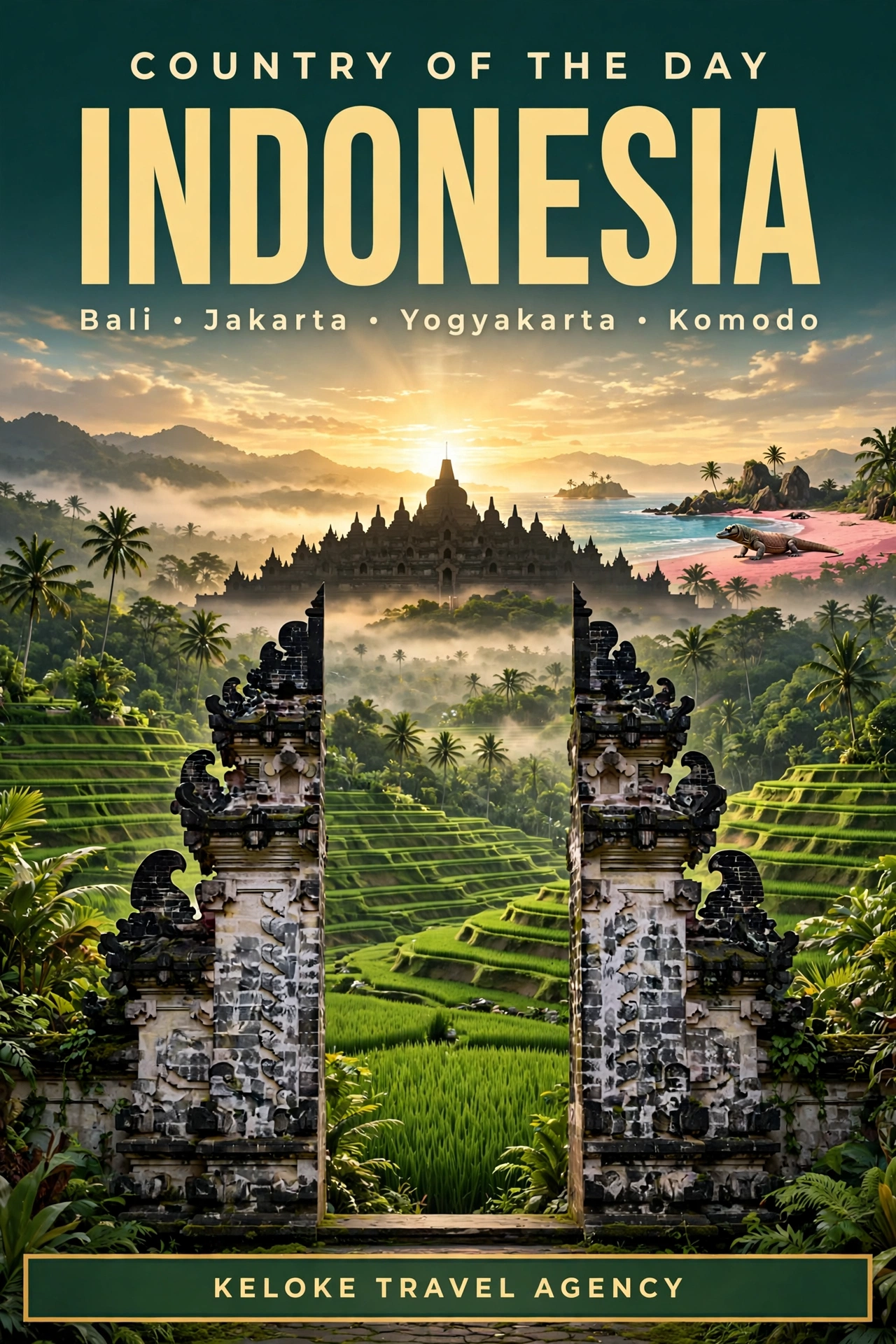
Indonesia is not one trip — it is 17,000 islands strung along the equator, more than 300 peoples and the world’s largest Muslim-majority nation wrapped around one small Hindu island the whole planet knows by name: Bali. You can stand in a Jakarta megamall at lunch, watch sunrise over a 9th-century Buddhist pyramid at Borobudur the next morning, and be face to face with a Komodo dragon by the weekend. November is the shoulder into the rainy season — greener, quieter, cheaper, with afternoon downpours to plan around. The paperwork is the part to get right before you fly, because for Pop’s two audiences Indonesia is two completely different doors.
The country, one by one
- Bali: the headline chapter — the Island of the Gods. Ubud’s rice terraces, monkey forest and gamelan; temples on every corner and offerings on every doorstep; Seminyak and Canggu for beach clubs and surf, Uluwatu’s cliff temple and kecak fire dance at sunset, Sidemen and Munduk for the quiet green interior. Give the island a week and day-trip the Nusa islands (Penida’s Kelingking cliff) by fast boat.
- Jakarta and Yogyakarta (Java): the depth chapter — Jakarta, the vast capital: Kota Tua’s Dutch colonial old town, the National Museum and Monas, and a food scene that covers the whole archipelago. Fly or train east to Yogyakarta for the two giants: Borobudur, the world’s largest Buddhist monument, best at sunrise, and the Hindu towers of Prambanan nearby, with batik workshops and the sultan’s palace in between.
- Komodo and the east: the wild chapter — fly to Labuan Bajo on Flores and sail the Komodo National Park: Komodo dragons with a ranger, Pink Beach, Padar Island’s triple-bay viewpoint, and some of the richest snorkelling and diving on earth. Further east still, Raja Ampat is the divers’ final frontier — plan it as its own expedition.
- Sumatra and beyond — worth knowing: the range chapter — Bukit Lawang in the Sumatran jungle for ethically-run orangutan trekking, Lake Toba’s vast volcanic caldera, Lombok (Bali’s quieter neighbour) for the Gili Islands and the Mount Rinjani trek, and Sulawesi’s Tana Toraja highlands for one of the world’s most distinctive cultures.
Culture notes
Bahasa Indonesia is the national language and is easy to greet in — selamat pagi, terima kasih goes a long way — and English is widely spoken in Bali and tourist Java. Indonesia is majority Muslim and generally easygoing with visitors; dress modestly at temples and mosques (a sarong and covered shoulders in Bali temples, where sash and sarong are often provided), and be extra considerate during Ramadan in Muslim-majority regions. Bali itself is Hindu, and its ceremony calendar means a temple festival is never far away — ask locally what is on, and step around the small palm-leaf offerings (canang sari) on sidewalks rather than over them. Cash and courtesy both smooth everything: bargain smiling at markets, never touch anyone’s head, and use your right hand to give and receive.
When to go
The dry season, roughly April to October, is the classic window — Bali and Java at their sunniest, seas calmest for island-hopping and Komodo sailing. November, when this guide lands, opens the rainy season (roughly November to March): expect short, heavy afternoon downpours rather than all-day rain, emerald-green rice terraces, fewer crowds and lower prices — pack a light rain layer and front-load outdoor plans to the mornings. The far east (Raja Ampat) runs on its own pattern, with its best diving roughly October to April — one of the few places where November is prime time.
Practical tips
- U.S. passport holders — Visa on Arrival / eVoA, IDR 500,000 for 30 days: Americans are on Indonesia’s official Visa on Arrival list. The visa costs IDR 500,000, gives 30 days from arrival, and can be extended once in-country for another 30 days (another IDR 500,000). Skip the airport queue by applying ahead on the official portal, evisa.imigrasi.go.id — an approved eVoA is valid 90 days from issue, and your 30 days only start when you land. Use only the official portal; look-alike sites add fees to a government product.
- Haitian passport holders — visa IN ADVANCE, no visa on arrival: Haiti is NOT on the official VoA list, and Indonesia’s current visa-free exemption covers ASEAN passports only — so a Haitian traveller must hold an approved visa before boarding. The tourist route is the C1 Tourist Visit Visa (the old B211A), applied for online before travel on evisa.imigrasi.go.id: the government fee listed by Indonesian immigration is IDR 1,000,000 (confirm the live total at checkout — some agency sites quote more), it gives up to 60 days and can be extended in-country up to 180 days in total, and processing normally takes about 5 working days. The application asks for a passport valid at least 6 months and 3 months of bank statements showing at least US$2,000. Do not fly in hoping to sort it out at the airport — and note that a Haitian passport holder living in the US follows the Haitian rule: residency does not transfer a travel companion’s VoA eligibility.
- Everyone — the free All Indonesia declaration, within 3 days before you land: Whatever your passport or visa, every international arrival must submit the All Indonesia arrival declaration at allindonesia.imigrasi.go.id (or the official app), no earlier than 3 days before arrival. It is free, it issues a QR code to show at immigration and customs, and since October 2025 it is mandatory at every Indonesian entry point — it replaced the old separate customs (e-CD) and health (SATUSEHAT) forms, so any guide still sending you to those is out of date. It is an arrival form, not a visa: you still need the visa route above as well.
- Bali adds its own levy — IDR 150,000, separate from the visa: If Bali is on your route, every foreign tourist also pays the Bali Foreign Tourist Levy: IDR 150,000 per person (about $9–10), paid cashless once per Bali trip through the official Love Bali system at lovebali.baliprov.go.id (or at the airport/port counters), which emails you a QR voucher. It has run since February 2024, it goes to the province — not immigration — and ordinary tourist visas do not exempt you from it. Pay only on the .go.id site; copycat “Bali tax” pages exist.
- Money is the Indonesian rupiah, and small notes rule: The currency is the rupiah (IDR) — prices run into the hundreds of thousands, so use the converter and count zeros carefully. Cards work well in Bali’s tourist belt and city malls; markets, warungs, drivers and smaller islands run on cash. Change money at banks or reputable authorised changers (count it yourself, last), keep small notes for taxis and temples, and use app-based ride-hailing (Grab/Gojek) so fares are fixed up front.
- Power is 220V, plugs are Type C and F: Indonesia runs 220V with round two-pin sockets (Type C and the similar Type F). U.S. flat plugs do not fit — bring an adapter — and single-voltage U.S. appliances need a converter, not just an adapter; most phone and laptop chargers are dual-voltage 100–240V, so check the label.
What to pack for Indonesia
A visa sorted on the right route before boarding, an arrival declaration inside its 3-day window, 220V round-pin sockets, and rainy-season afternoons in November. Our country picks: a universal travel adapter and voltage converter with USB ports — Indonesia’s 220V Type C/F sockets are the ones that strand U.S. flat plugs — an RFID-blocking passport and document organizer that keeps your passport, printed visa approval and All Indonesia QR together, a 20,000mAh power bank with a retractable USB-C cable — your phone is your translator, Grab app, map and camera on very long Bali and Java days — wireless noise-canceling headphones for the long haul in, and a 6-piece compression packing cube set that keeps Bali beach gear, temple-modest outfits and Java layers separate in one bag. Find them in the KELOKE shop.
