Posted on — Leave a comment

Ghana: Accra Welcome, Castle Coasts and Ashanti Gold

Ghana: Accra Welcome, Castle Coasts and Ashanti Gold

Ghana is West Africa's friendliest first trip — English-speaking, famously welcoming ("Akwaaba" means welcome, and people mean it), and built around one classic route: start in Accra, drive the coast to the great castles of Cape Coast and Elmina with a stop at Kakum's rainforest canopy, then head inland to Kumasi, the Ashanti capital. The paperwork is the one part that punishes improvisation — since May 2026 the visa is online-only and must be approved before you fly — so plan that first and the rest of the trip is easy.

The country, one by one

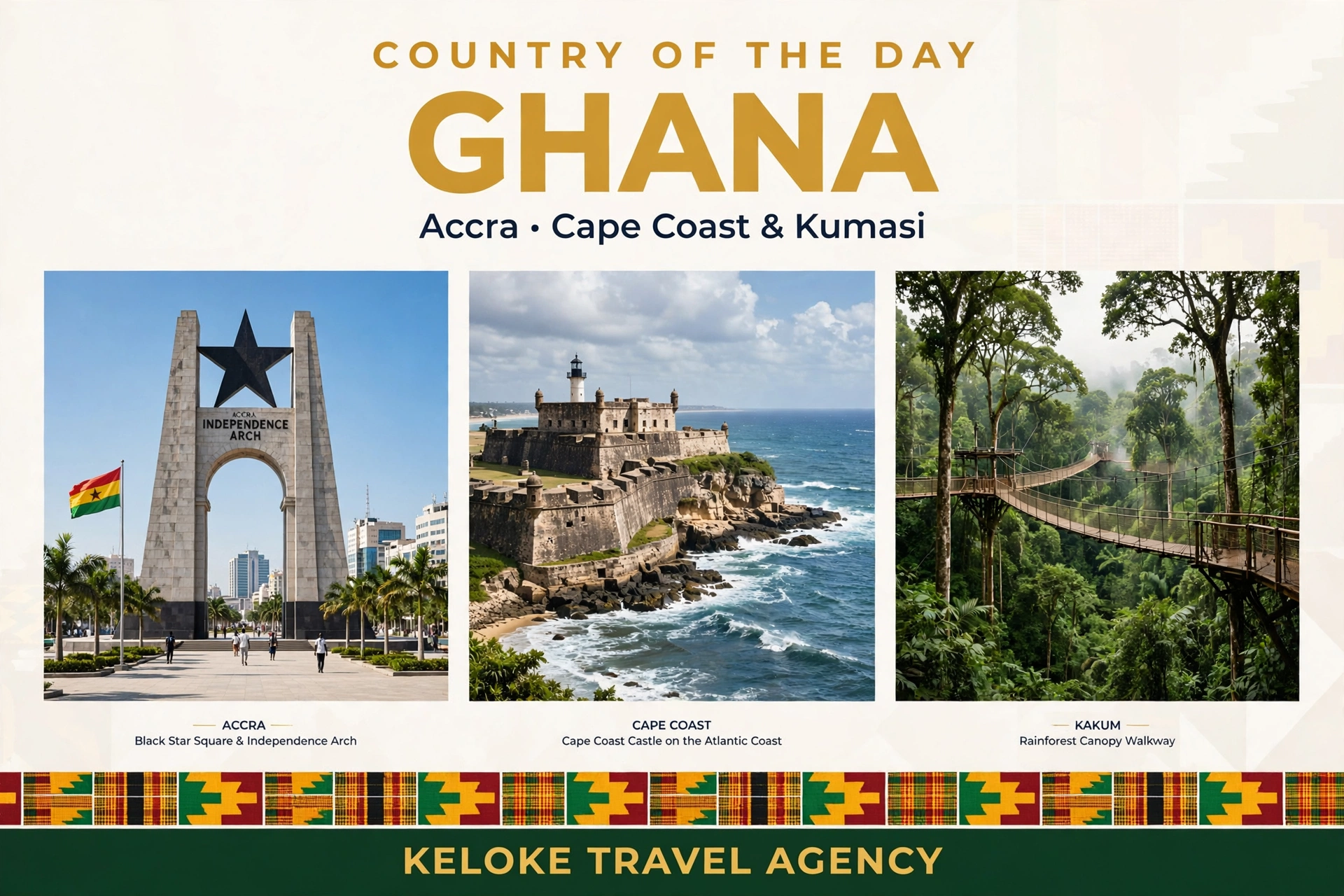
  • Accra: the headline chapter — the capital on the Gulf of Guinea. The Kwame Nkrumah Memorial Park and mausoleum, the Black Star (Independence) Square, Jamestown's lighthouse and fishing harbour, Makola Market's beautiful chaos, and Osu's Oxford Street for restaurants and nightlife. Labadi Beach on a Sunday is Accra at play.
  • Cape Coast and Elmina: the history chapter — about 2.5–3 hours west of Accra. Cape Coast Castle and Elmina Castle (St. George's Castle, the oldest European building in sub-Saharan Africa) are UNESCO-listed and sobering: the dungeons and the Door of No Return are essential, difficult history, best taken with a guide and unhurried. Pair them with the fishing harbour and a beach lunch in Elmina town.
  • Kakum National Park: the rainforest chapter — just north of Cape Coast. Its famous canopy walkway hangs some 30 metres above the forest floor on a series of rope bridges; go early in the morning for birds, butterflies and the quietest crossings.
  • Kumasi and the Ashanti region — worth knowing: the culture chapter — Ghana's second city and the historic Ashanti capital, about 4–5 hours north of Accra by road or a short flight. The Manhyia Palace Museum, the vast Kejetia Market, and Bonwire, the village where kente cloth is woven on wooden looms. Lake Bosomtwe, a crater lake ringed by villages, is the easy half-day escape.

Culture notes

Ghana is home to the Ashanti (Asante), Ga, Ewe, Fante and many other peoples; English is the official language and Twi is widely spoken in the south and centre. This is the land of kente and adinkra symbols, of highlife music and a fierce, joyful jollof debate with Nigeria (pick Ghana's side while you are here). Funerals are major social celebrations, drumming and dancing are everyday life, and greetings matter — a proper "good morning" before business is basic manners. Dress respectfully at the castles and at religious sites, and ask before photographing people.

When to go

The dry season, roughly November to March, is the easiest window: less rain, better roads and the Harmattan haze — dry, dusty trade winds — arriving in December and January, strongest in the north. The south has two rainy seasons, a major one roughly April to July and a shorter one around September to November, with heavy downpours that slow Accra traffic; if you go then, build wide margins into every plan. December is peak diaspora season ("Detty December") — book flights and Accra hotels early.

Practical tips

  • Haitian and U.S. passport holders — paid e-Visa REQUIRED before travel, no visa on arrival: For Ghana, BOTH Haitian and U.S. passport holders need a visa before they fly — and since May 2026 there is no visa on arrival. Apply on Ghana Immigration's official e-Visa portal, evisa.immigration.gov.gh: a single-entry tourist e-Visa costs $260 with standard processing inside 96 hours (faster tiers cost more — $338 Priority, $442 Express), it is valid 90 days from issue, and your stay — up to 60 days — is set when you arrive. Confirm the live total in the portal before paying, and use only the official portal, never a third-party seller. Don't be misled by the headlines: Ghana's free travel authorisation is for African passport holders and a specific list of waiver countries (Jamaica, Barbados, Trinidad and Tobago and others) — Haiti is not on that list, even though Ghanaians can visit Haiti visa-free. A U.S. green card does NOT change this rule: a Haitian passport holder living in the U.S. follows the Haitian passport rule.
  • Passport and yellow fever — the two documents that decide boarding: Bring a passport valid at least 6 months with 3 blank pages. The ORIGINAL yellow fever vaccination certificate (International Certificate of Vaccination) is required for entry for travellers over 9 months old and is checked at the port of entry — a photo or photocopy is not the document; carry the original card with your passport. The e-Visa application itself asks for your passport bio page, a recent photo, your itinerary, accommodation for the full stay and proof of funds.
  • Money is the Ghana cedi: The currency is the cedi (GHS). Cards work at larger hotels, malls and restaurants in Accra, but Ghana still runs heavily on cash for markets, taxis and smaller venues — carry cedis in small notes, use ATMs inside banks or malls, and expect some card machines to fail. Mobile money is everywhere for locals; visitors should not count on it.
  • Power is 230V, plugs are Type D and Type G: Ghana runs 230V and uses two plug types — Type G (three square pins, British style) and the older Type D (three round pins). U.S. flat plugs fit neither, and single-voltage U.S. appliances need a converter, not just an adapter — most phone and laptop chargers are dual-voltage 100–240V, so check the label.
  • Getting around and malaria country: Base in Accra and hire a driver or join a tour for the Cape Coast–Kakum run; intercity coaches and a short domestic flight link Accra and Kumasi. Inside Accra, use hotel-arranged or app-booked rides and allow serious time for traffic. Ghana is a malaria area year-round — talk to your clinician or a travel-health clinic about prevention well before you go, use repellent and sleep under protection where it is provided.

What to pack for Ghana

An e-Visa that must be approved before you board, an original yellow card you cannot lose, 230V sockets in two shapes your plugs do not fit, and real heat from Accra to Kumasi. Our country picks: a universal travel adapter and voltage converter with USB ports — Ghana's 230V Type D and G sockets are the ones that strand U.S. plugs — an RFID-blocking passport and document organizer that keeps your passport, original yellow fever certificate and printed e-Visa approval together, a collapsible 25oz water bottle you fill at the hotel and empty through security for Kakum and castle days in the heat, wireless noise-canceling headphones for the long-haul flights into Accra and the road hours to Kumasi, and a 5-piece packing cube set that keeps a three-base trip — Accra, the coast, Kumasi — in one suitcase without the daily dig. Find them in the KELOKE shop.


Posted on — Leave a comment

Nigeria: Lagos Energy, Abuja Calm and Ancient Groves

Nigeria: Lagos Energy, Abuja Calm and Ancient Groves

Nigeria is Africa's giant — the continent's most populous country, its biggest music and film exporter, and a trip that rewards travellers who plan the paperwork early and then give each region its own time. The classic first trip pairs Lagos, the loud and brilliant commercial capital on the Atlantic, with Abuja, the planned federal capital in the centre, and adds one heritage stop — the rock city of Abeokuta or the sacred grove at Osogbo — instead of trying to cross the whole country in a week.

The country, one by one

  • Lagos: the headline chapter — a megacity on the lagoon and the Atlantic. Base yourself on Victoria Island or in Ikoyi for the Nike Art Gallery's floors of Nigerian art, the Lekki Conservation Centre's canopy walkway high in the trees, live Afrobeats at night, and beach days at Tarkwa Bay, reached by boat. Traffic is part of the city — plan one area per day, not five.
  • Abuja: the calm chapter — the purpose-built capital, with the National Mosque, Aso Rock watching over the city, wide roads and a slower pace than Lagos. Zuma Rock, the giant inselberg on the road north, is the classic photo stop, and Abuja makes the easiest base for day trips into the middle of the country.
  • Abeokuta and Osogbo — worth knowing: the heritage chapter — Abeokuta, "under the rock," is built around Olumo Rock, climbed for views over the old city. Osogbo is home to the Osun-Osogbo Sacred Grove, a UNESCO World Heritage Site of shrines and monumental sculptures in riverside forest, and the centre of the annual Osun-Osogbo Festival.
  • Calabar and the south-east: the slow chapter — Calabar, in Cross River State, is known for its carnival season, its history museums and its gateway position for Cross River National Park's rainforest. It is a flight from Lagos or Abuja, not a casual drive — treat it as its own block if you add it.

Culture notes

Nigeria is home to more than 250 ethnic groups; the largest are the Hausa, Yoruba and Igbo, and English is the official language, with Nigerian Pidgin the street-level bridge everywhere. This is the home of Afrobeats and Nollywood — music is not background here, it is the main event. Jollof rice is a national pride point (never start the jollof wars comparison at the table unless you want a joyful argument). Dress respectfully at religious sites, ask before photographing people, and greet properly — a real greeting before business is basic manners.

When to go

The dry season, roughly November to March, is the easiest window: less rain, clearer roads and the Harmattan haze arriving in December and January in the north. Lagos Carnival-season energy peaks in December, when the diaspora flies home — book flights and hotels early for that month. The rainy season runs roughly April to October in the south, with heavy downpours that slow Lagos traffic to a crawl; if you go then, build wide margins into every plan.

Practical tips

  • Haitian and U.S. passport holders — e-Visa REQUIRED before travel, no visa on arrival: For Nigeria, BOTH Haitian and U.S. passport holders need a visa before they fly — Nigeria is not visa-free for either passport, and there is no visa on arrival anymore. Since May 2025 the visa is an e-Visa: apply on the official Nigeria Immigration Service portal, evisa.immigration.gov.ng, well ahead of your trip (approvals are advertised at 48 hours, but don't cut it close — guidance for Haitian applicants says submit at least 15 business days ahead), and wait for the emailed approval with its QR code before you go to the airport. Airlines deny boarding without an approved visa. A U.S. green card does NOT change this rule: a Haitian passport holder living in the U.S. follows the Haitian passport rule.
  • Landing and exit card — mandatory, free and online: Since 1 May 2025 the paper forms are gone. Every non-Nigerian traveller completes the landing card online at lecard.immigration.gov.ng BEFORE boarding the flight in, and the exit card before leaving. It is free and in addition to the visa, not a substitute for it — use only the official immigration portals, never a paid third-party seller site.
  • Passport, yellow fever and overstays: Bring a passport valid at least 6 months. A WHO yellow fever vaccination card (yellow card) is required for entry, and the U.S. State Department also lists proof of polio vaccination as required. Do not overstay: since 1 September 2025 overstays draw a $15-per-day fine, and long overstays can bring multi-year or permanent entry bans.
  • Money is the Nigerian naira: The currency is the naira (NGN). Cards work at larger hotels, malls and restaurants in Lagos and Abuja, but Nigeria still runs heavily on cash and bank transfer — carry naira for markets, drivers and smaller venues, and expect some card machines to fail. Use ATMs inside banks or malls, and keep small notes handy.
  • Power is 230V, plugs are Type G: Nigeria runs 230V and uses Type G plugs — three square pins, the British style. U.S. flat plugs do not fit, and single-voltage U.S. appliances need a converter, not just an adapter — most phone and laptop chargers are dual-voltage 100–240V, so check the label. Power cuts are a normal part of the day in much of the country, which is why a real power bank is a Nigeria essential, not a luxury.
  • Getting around and malaria country: Domestic flights link Lagos, Abuja and the regional capitals and save days over long road trips. Inside Lagos, use hotel-arranged or app-booked rides and allow serious time for traffic. Nigeria is a malaria area year-round — talk to your clinician or a travel-health clinic about prevention well before you go, use repellent and sleep under protection where it is provided.

What to pack for Nigeria

An e-Visa on your phone, a yellow card you cannot lose, 230V sockets your plugs do not fit, real heat, and power cuts that arrive without asking. Our country picks: a universal travel adapter and voltage converter with USB ports — Nigeria's 230V Type G sockets are the ones that strand U.S. plugs — an RFID-blocking passport and document organizer that keeps your passport, yellow fever card and printed e-Visa approval together, a 20,000mAh power bank with a built-in retractable cable for outage hours and long Lagos traffic days, a 3-in-1 handheld mini fan with power bank and flashlight for the heat when the power is out, and a portable travel first aid kit for road days and excursions far from a pharmacy. Find them in the KELOKE shop.
Posted on — Leave a comment

South Africa: Cape Town, Safari Country and the Garden Route

South Africa: Cape Town, Safari Country and the Garden Route

South Africa is three great trips in one country: a world-class city under a flat-topped mountain, the classic Big Five safari, and one of the most beautiful coastal drives on earth. The planning rule is simple — fly into Cape Town, give the safari its own unhurried block in the northeast, and connect them with the Garden Route or a short internal flight, because the distances are bigger than they look on the map.

The country, one by one

  • Cape Town: the headline chapter — Table Mountain above the city bowl, the cable car up (or the hike, if your legs agree), the V&A Waterfront, Bo-Kaap's colorful lanes, and the penguins at Boulders Beach on the way to the Cape of Good Hope. Robben Island, where Nelson Mandela was held, is the essential history stop — book it ahead, ferries sell out.
  • Kruger and the safari country: the wild chapter — Kruger National Park and the private reserves on its western edge are where lions, elephants, rhinos, leopards and buffalo still roam in real numbers. Stay at least three nights, take the dawn game drives when the animals are active, and let your ranger do the finding — that is what they are brilliant at.
  • Johannesburg and Soweto — worth knowing: the story chapter — most long-haul flights land here, so give it a day instead of just a layover: the Apartheid Museum, Constitution Hill, and a guided visit to Soweto for the Mandela House and the country's living history. It is the chapter that makes the rest of the trip mean more.
  • The Garden Route and Durban: the slow chapter — the Garden Route runs from Mossel Bay to Storms River through Knysna's lagoon, Plettenberg Bay's beaches and the Tsitsikamma forest, best done as a relaxed self-drive over four or five days. Durban, on the warm Indian Ocean side, is the beach-and-curry finish, with the Drakensberg mountains inland for hikers.

Culture notes

South Africa has 12 official languages; English is widely spoken everywhere a traveller goes, and a few local words earn real smiles — sawubona (hello, in Zulu), dankie (thank you, in Afrikaans). The braai is not just a barbecue, it is the national social ritual. Townships are visited with a local guide, never as a drive-through photo stop. And plan around the seasons carefully: South Africa is in the southern hemisphere, so its summer is December to February and its winter June to August.

When to go

For safari, the dry winter months (May to September) are best — the bush is thin, animals gather at waterholes, and Kruger is at its clearest. For Cape Town and the Garden Route, late spring to autumn (October to April) brings the warm, dry weather, with whale season along the Cape coast roughly June to November. December and January are peak local holiday season — book everything early and expect crowds.

Practical tips

  • Haitian passport holders — visitor's visa REQUIRED in advance, no visa on arrival: Haitian passport holders need a South African visitor's visa BEFORE they travel — there is no visa on arrival, and Haiti is not on South Africa's eVisa list or its new ETA list (the ETA's first phase covers only China, India, Indonesia and Mexico), so apply at a South African consulate well ahead of your trip and don't board without it. Airlines check for the visa before boarding. Your passport should be valid at least 30 days past your departure from South Africa with two blank pages — carrying 6+ months validity is safest. A U.S. green card does NOT change this rule: a Haitian passport holder living in the U.S. follows the Haitian rule. Ignore paid sites that promise Haitians a simple online eVisa or ETA — Haiti is on neither system's list.
  • U.S. passport holders — visa-free up to 90 days: U.S. passport holders are visa-free for up to 90 days for tourism or business — no visa and no ETA needed. Bring a passport valid at least 30 days past your return date (6 months is safest) with two unused blank pages, and you are stamped in on arrival. Work or study needs a different visa — the 90-day exemption does not cover it.
  • NEW in 2026 for EVERYONE — the free SARS traveller declaration, within 24 hours of flying: Since 1 July 2026, every traveller entering or leaving South Africa must submit the online traveller declaration on the official SARS site — it is FREE, it replaced the paper customs card, and it is submitted no more than 24 hours before departure (on a connecting trip, 24 hours before your last leg into South Africa). Do it in that 24-hour window on the official SARS site only — any site charging a fee for it is not SARS.
  • Money is the South African rand: The currency is the rand (ZAR). Cards are widely accepted in cities, hotels and restaurants, but game lodges, markets, fuel stops and small towns still reward carrying some cash rand. ATMs are easy to find in cities and airports. Keep small notes for tips — guides, rangers and porters are a big part of how a South Africa trip runs well.
  • Power is 230V, plugs are mainly Type M: South Africa runs 230V. The standard socket is Type M — three large round pins — with Type C and Type N also found in some newer buildings. U.S. flat plugs do not fit, and single-voltage U.S. appliances need a converter, not just an adapter — most phone and laptop chargers are dual-voltage 100–240V, so check the label. A universal adapter/converter kit is the one-pack fix.
  • Yellow fever, distance and driving: A yellow fever vaccination certificate is required only if you arrive from, or transit through, a yellow-fever country — not for direct travel from the U.S. or Haiti. Distances are large: Cape Town to Kruger is a flight, not a drive. Driving is on the LEFT in South Africa; most visitors self-drive the Garden Route and leave the safari driving to their lodge's rangers.

What to pack for South Africa

A 15-hour flight, a dawn game drive and a coastal road trip, all on sockets your plugs do not fit. Our country picks: a universal travel adapter and voltage converter with USB ports — South Africa's 230V Type M sockets are the ones that strand U.S. plugs — coolmax compression socks that make the long-haul flight from the U.S. easier on your legs, wireless noise-canceling headphones for those same overnight hours in the air, a memory-foam travel neck pillow kit with eye mask and earplugs so you land ready for Table Mountain, and a portable travel first aid kit for game drives, Garden Route hikes and long road days far from a pharmacy. Find them in the KELOKE shop.

Posted on — Leave a comment

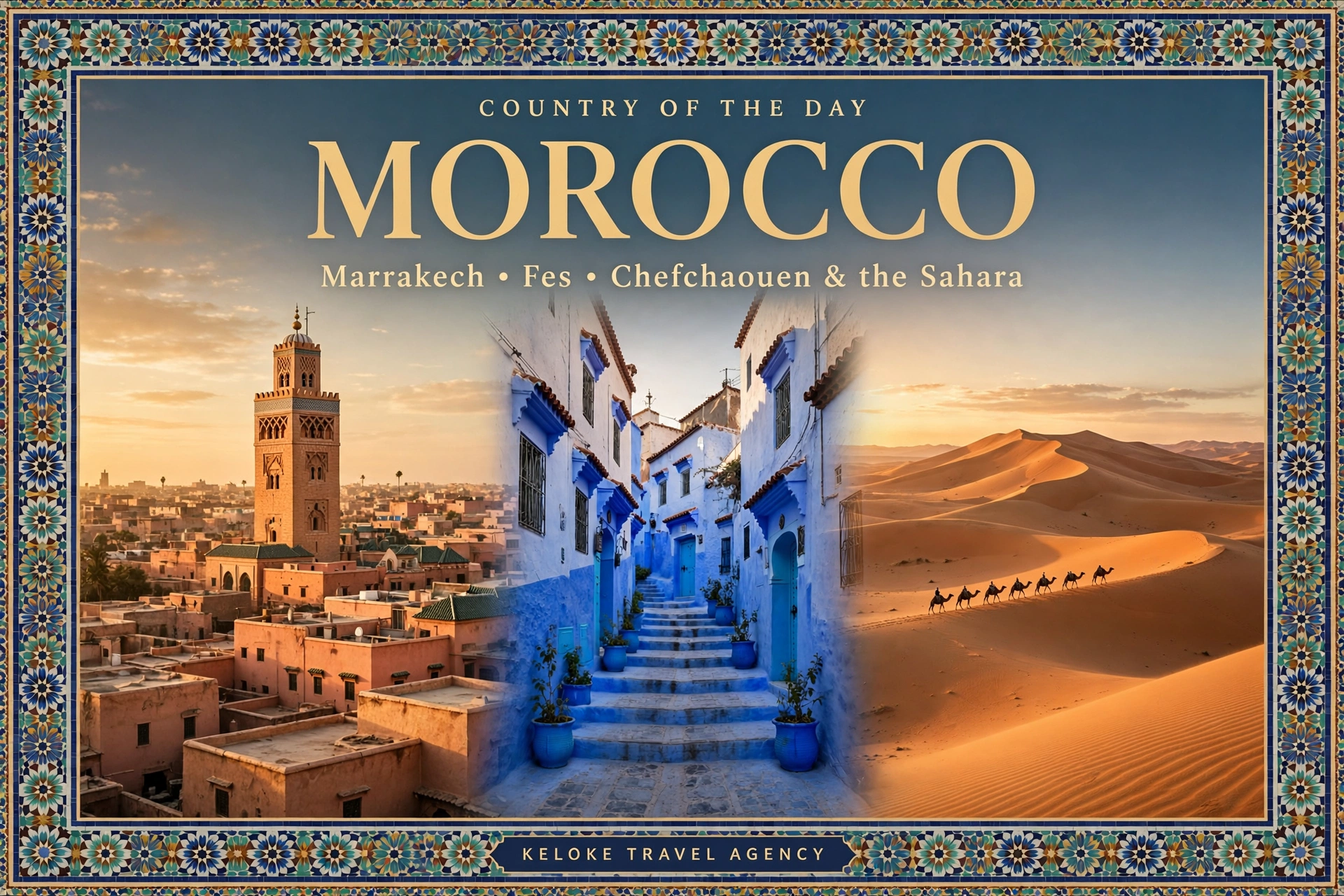
Morocco: Medinas, Blue Streets and a Night in the Sahara

Morocco: Medinas, Blue Streets and a Night in the Sahara

Morocco packs a whole continent of trips into one country: thousand-year-old medinas, a town painted entirely blue, snow on the Atlas Mountains in the morning and a camel ride into the Sahara by sunset. The planning rule is simple — pick a loop (Marrakech, Fes and Chefchaouen, with the desert as the finale), travel between cities by train or driver, and give every medina one unhurried day.

The country, one by one

  • Marrakech: the headline chapter — Jemaa el-Fnaa square at dusk, when drum circles, food stalls and storytellers take over, the souks behind it, and the Bahia Palace and Saadian Tombs for the carved-tile Morocco of the postcards. Stay in a riad inside the medina and start market days early, before the heat and the crowds.
  • Fes: the deep-history chapter — Fes el-Bali, one of the world's oldest living medieval cities, with its tanneries, madrasas and 9,000 lanes. Hire an official guide for the first day; getting lost is the point on the second. Fes is also the food capital — book a cooking class and learn the pastilla properly.
  • Chefchaouen and Casablanca — worth knowing: the contrast chapter — Chefchaouen, the blue-washed mountain town in the Rif, is two slow days of photo lanes, mint tea and mountain air; Casablanca is worth a stop for one building alone, the Hassan II Mosque on the ocean, one of the few mosques in Morocco open to non-Muslim visitors on guided tours.
  • Merzouga and the Sahara: the finale chapter — ride into the Erg Chebbi dunes at golden hour, sleep in a desert camp, and wake before dawn for sunrise over the sand. It is a long drive from the imperial cities, so give the desert two nights, not one, and pair it with the Atlas passes and kasbahs on the way.

Culture notes

Morocco runs on hospitality and negotiation: mint tea is an opening, not a drink, and haggling in the souks is expected — start low, smile, and walk away slowly; the final price usually finds you. Arabic (Darija) and French are the everyday languages; a few words go far: salam (hello), shukran (thank you), and la, shukran (no, thank you). Dress modestly away from resorts — shoulders and knees covered in medinas — and ask before photographing people.

When to go

Spring (March to May) and autumn (September to November) are the sweet spots: warm days in the cities, passable mountain roads, and desert nights that are cool rather than freezing. Summer is fierce in Marrakech and the Sahara, though the coast stays pleasant, and winter brings cold desert nights and snow in the Atlas. Ramadan shifts the daily rhythm — many cafes close by day and cities come alive after sunset — so check dates when you book.

Practical tips

  • Haitian passport holders — visa REQUIRED in advance, no visa on arrival: Haitian passport holders need a visa for Morocco before they travel — there is no visa on arrival. If you hold a US, UK, EU, Canadian or similar residence permit (valid 180+ days) or a multiple-entry visa from one of those countries (valid 90+ days), you can apply online for Morocco's eVisa on the official portal, acces-maroc.ma — single entry, up to 30 days, and apply at least 10 business days ahead. Without one of those, apply at a Moroccan consulate well ahead of your trip. Ignore paid sites that promise Haitians a simple online eVisa without mentioning the permit condition.
  • U.S. passport holders — visa-free up to 90 days: U.S. passport holders are visa-free for up to 90 days — just bring a passport valid 6+ months with a blank page and get stamped on arrival. Living in the US does not change the rule for a Haitian passport — but a US residence permit or multiple-entry visa is exactly what can qualify a Haitian passport holder for the eVisa route above.
  • Money is the Moroccan dirham: Morocco's currency is the dirham (MAD), and it is a closed currency — you exchange or withdraw it inside Morocco, and medinas, taxis, guides and small riads run heavily on cash. Cards work in hotels, larger restaurants and modern shops. Carry small dirham notes for tips and souk purchases, and re-confirm tour and driver prices close to departure.
  • Power is 220V, plugs are Type C and Type E: Morocco runs 220V with round two-pin Type C and grounded Type E sockets. U.S. flat plugs do not fit, and single-voltage U.S. appliances need a converter, not just an adapter — most phone and laptop chargers are dual-voltage 100-240V, so check the label. A universal adapter/converter kit is the one-pack fix.
  • Distance and dress are the real packing rules: Morocco rewards slow travel — trains link Casablanca, Marrakech and Fes well, the desert is a full day from the cities, and medina lanes are cobbled, crowded and step-heavy. Pack for hot days and genuinely cold desert nights in the same bag, and carry a light scarf or layer for modest dress at religious sites. Driving is on the RIGHT; most visitors hire drivers for the desert loop rather than self-drive.

What to pack for Morocco

Medina lanes, mountain passes and a desert night, all on sockets your plugs do not fit. Our country picks: a universal travel adapter and voltage converter with USB ports — Morocco's 220V Type C/E sockets are the one that strands U.S. plugs — an RFID-blocking passport holder and document organizer that keeps your passport, visa papers and cards in one place through medina crowds, compression packing cubes that squeeze warm layers and desert-night clothes into one carry-on, a 3-in-1 handheld mini fan with power bank and flashlight for Marrakech heat and souk afternoons, and a collapsible 25oz water bottle you refill all day instead of buying plastic at every stop. Find them in the KELOKE shop.

Posted on — Leave a comment

Egypt: Pyramids, Pharaohs and the Nile — the Trip of a Lifetime

Egypt: Pyramids, Pharaohs and the Nile — the Trip of a Lifetime

Egypt is the trip people dream about for decades and then wonder why they waited: the only surviving wonder of the ancient world, temples so big they hum, and a river that carries you through 5,000 years of history in a single week. The planning rule is simple — Cairo and Giza first, then follow the Nile south to Luxor and Aswan, start every sightseeing day early against the heat, and leave the Red Sea for the slow finish.

The country, one by one

  • Cairo and Giza: the headline chapter — the Pyramids of Giza and the Great Sphinx on the plateau, the Grand Egyptian Museum beside them, and a capital of minarets, markets and Nile-side cafes. Give Cairo three days: the plateau early in the morning, Khan el-Khalili bazaar by evening, and Islamic Cairo's mosques and citadel in between.
  • Luxor: the open-air museum chapter — Karnak and Luxor Temple on the East Bank, the Valley of the Kings and Hatshepsut's mortuary temple on the West Bank. Cross the river at sunrise, do the tombs before the heat peaks, and take a felucca on the Nile at sunset.
  • Aswan and the Nile cruise: the slow chapter — sail between Luxor and Aswan past Kom Ombo and Edfu, visit Philae Temple on its island, and ride out to Abu Simbel, the colossal temples moved stone by stone to save them from the rising waters. Aswan's Nubian villages and spice markets are Egypt at its gentlest.
  • Alexandria and the Red Sea — worth knowing: the coast chapter — Alexandria for Mediterranean seafood, the modern Library of Alexandria and a very different, sea-breeze Egypt; and the Red Sea resorts of Hurghada and Sharm el-Sheikh for reefs, diving and the beach finish after the temples. Pick one coast, not both, unless you have two full weeks.

Culture notes

Egyptian hospitality is warm, loud and generous — expect tea offered everywhere and haggling treated as friendly sport in the bazaars, where a smile and a walk-away settle most prices. Arabic is the language; a few words go far: shukran (thank you), sabah el-kheir (good morning), and la, shukran (no, thank you) for persistent sellers at the sites. Dress modestly for mosques — shoulders and knees covered, women carry a light scarf for head covering inside — and always ask before photographing people.

When to go

October to April is the sweet spot: warm days, cool evenings and sightseeing weather from Cairo to Aswan. Summer (June to August) brings fierce heat in Luxor and the south, where temple touring becomes a dawn-only sport, though Red Sea resorts stay popular year-round. Ramadan shifts the rhythm — many sites keep shorter hours and evenings come alive after sunset — so check dates when you book.

Practical tips

  • Haitian passport holders — tourist visa ON ARRIVAL, 30 days: Haitian passport holders can get a tourist visa on arrival in Egypt — 30 days, single entry, passport valid 6+ months, with your return ticket and hotel details handy; it's not visa-free entry, and rules can change, so confirm with the Egyptian consulate before you fly. Haiti is not on the official eVisa portal's eligible-country list, so do not let a third-party site sell you an eVisa.
  • U.S. passport holders — visa required, eVisa or on arrival: U.S. passport holders also need a visa: get the eVisa at least 7 days ahead on the official portal visa2egypt.gov.eg, or buy a visa on arrival — $30 in exact-change US dollars (the fee rose from $25 in March 2026), good for 30 days. The official eVisa lists $30 single-entry and $65 multiple-entry; passport valid at least 6 months from arrival.
  • The Sinai-only permit is NOT an Egypt visa: arriving at Sharm el-Sheikh for the South Sinai resorts only, a free short-stay Sinai-only permit exists — it does NOT cover Cairo, Luxor, Aswan or the pyramids. Do not plan a mainland trip around it.
  • Money is the Egyptian pound: Egypt's currency is the Egyptian pound (EGP). Cards are accepted in hotels and bigger restaurants; sites, markets, taxis and tipping (baksheesh is a way of life) run on cash, so carry small pound notes. Prices change — re-confirm site, cruise and tour prices close to departure.
  • Power is 220V, plugs are Type C and Type F: Egypt runs 220V with round two-pin Type C and grounded Type F sockets. U.S. flat plugs do not fit, and single-voltage U.S. appliances need a converter, not just an adapter — most phone and laptop chargers are dual-voltage 100-240V, so check the label. A universal adapter/converter kit is the one-pack fix.
  • Heat and distance are the real packing rules: Egypt days are long, dusty and spread out — Cairo traffic, temple complexes measured in acres, and domestic flights or the sleeper train between Cairo and the south. Sightsee early, carry water all day, and pack light layers for cool desert evenings. Driving is on the RIGHT; most visitors hire drivers rather than self-drive in Cairo.

What to pack for Egypt

Desert sun, dusty temple floors, long days between Cairo, Luxor and Aswan, and sockets your plugs do not fit. Our country picks: a universal travel adapter and voltage converter with USB ports — Egypt's 220V Type C/F sockets are the one that strands U.S. plugs — a 3-in-1 handheld mini fan with power bank and flashlight for Valley of the Kings heat and site queues, a collapsible 25oz water bottle you refill all day instead of buying plastic at every temple, a 20,000mAh power bank with a built-in USB-C cable for dawn-to-dusk camera and map days far from outlets, and waterproof shoe bags that keep dusty site shoes away from clean clothes and carry your shoes at mosque visits. Find them in the KELOKE shop.

Posted on — Leave a comment

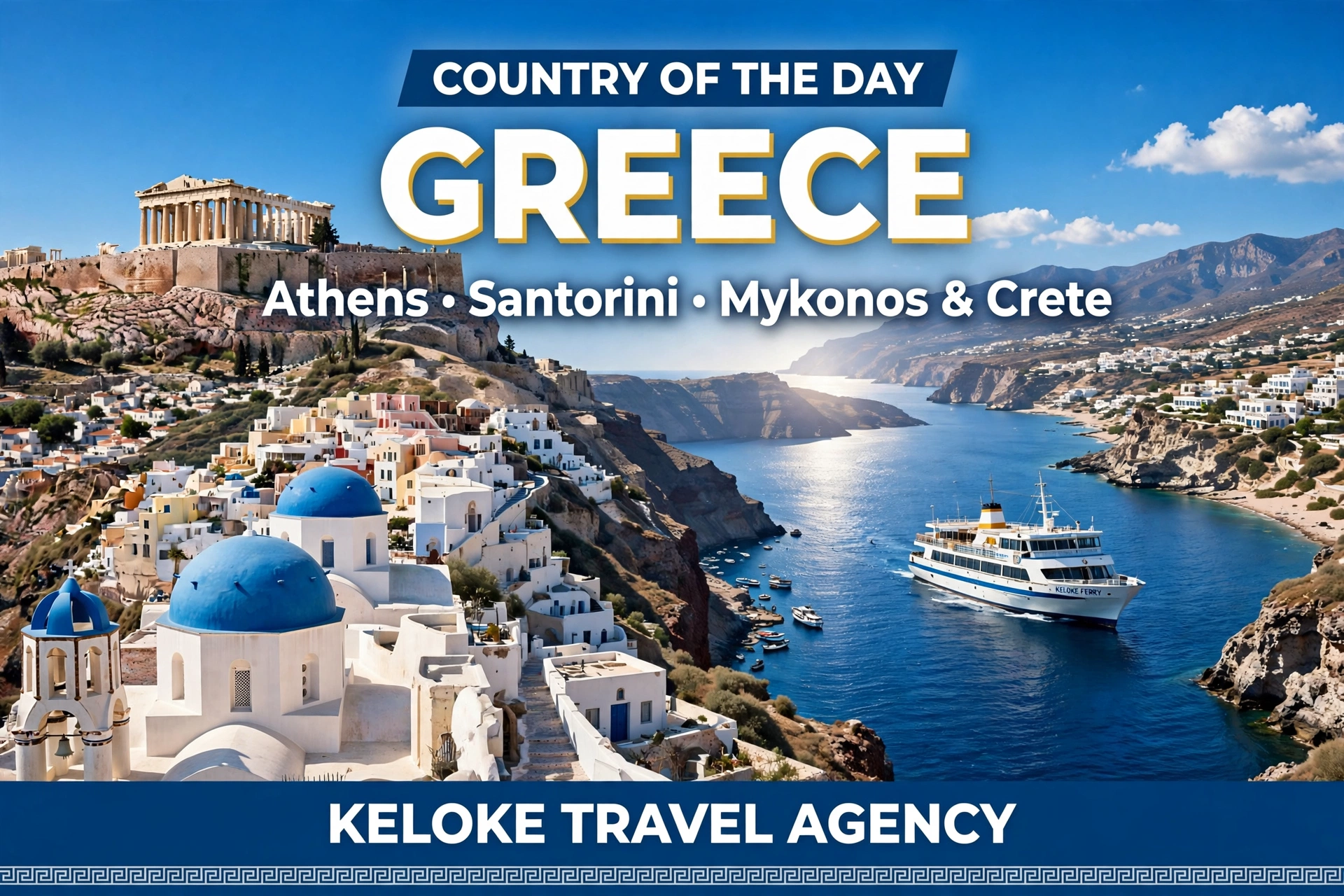
Greece: Athens, Islands and Ancient Light — One Country, a Thousand Trips

Greece: Athens, Islands and Ancient Light — One Country, a Thousand Trips

Greece is two trips in one: a mainland of ancient capitals, mountain monasteries and long road journeys, and an island world where ferries, white villages and blue water set the pace. The planning rule is not to chase every island — pick Athens plus one island group, travel by ferry like the Greeks do, eat late, swim often, and let the heat shape your day: sights early, shade at midday, and the waterfront at sunset.

The country, one by one

  • Athens: the capital chapter — the Acropolis and the Parthenon above the city, the Acropolis Museum, the Ancient Agora, and the lanes of Plaka and Monastiraki below. Give Athens two to three days: climb to the Acropolis early before the heat and crowds, then take the evenings in Psyrri and Exarchia for tavernas and rooftop views back up at the floodlit rock.
  • Santorini: the caldera chapter — white villages of Oia and Imerovigli on a drowned volcano, black-sand beaches at Kamari and Perissa, Akrotiri's buried ancient city, and sunsets that fill every lane in Oia. Santorini is small, busy and priced for its fame — visit in shoulder season if you can, and book caldera-view stays well ahead.
  • Mykonos: the party-and-beaches chapter — Mykonos Town's white maze, its windmills and Little Venice waterfront, and beach clubs that run from quiet mornings to loud nights. It is also a useful ferry hub for the Cyclades, so even a short stop pairs well with quieter islands nearby.
  • Crete: the big-island chapter — Greece's largest island is a country of its own: the Palace of Knossos near Heraklion, Chania's Venetian harbour, the Samaria Gorge hike, and Elafonissi's pink-tinged sands. Crete needs its own days, a rental car, and an appetite — Cretan food, from dakos to slow lamb, is a reason to go by itself.
  • The other islands and the mainland — worth knowing: the quieter chapter — Naxos and Paros for Cycladic villages without the crowds, Rhodes for its medieval old town, Corfu for green hills and Venetian lanes, and on the mainland the clifftop monasteries of Meteora and the oracle site of Delphi. Ferry-hop one or two, and save the rest for the return trip Greece always seems to cause.

Culture notes

Greek life runs on philoxenia — hospitality to strangers — and on long, shared meals where nobody rushes the table. Coffee is a ritual, from a quick freddo espresso on a hot street to a slow Greek coffee in a village kafeneio. Churches and monasteries are living places, not just sights: dress modestly inside, with shoulders and knees covered at sites like Meteora. A few words go far: efharisto (thank you), kalimera (good morning), and parakalo (please / you're welcome).

When to go

Late spring (May to June) and early autumn (September to October) are the sweet spots: warm seas, open tavernas and ferries on full schedules, without peak crowds. July and August are hottest and busiest, island prices peak, and Athens sightseeing becomes an early-morning sport. Winter is quiet and cheap in Athens and the mainland, but many island hotels and ferry routes close or thin out — islands are a spring-to-autumn story.

Practical tips

  • Haitian passport holders — Schengen visa REQUIRED in advance: Haitian passport holders need a Schengen visa in advance for Greece — apply early (processing is normally 15 days and can stretch to 45), with €30,000 travel medical insurance, proof of stay and funds, and a flight reservation; don't buy non-refundable tickets before the visa is granted. This is a short-stay Type C Schengen visa (adult fee €90), applied for at a Greek embassy or consulate or an authorized visa center, in person with biometrics, up to 6 months before travel and at the latest 15 days before.
  • U.S. visitors: visa-free up to 90 days in any 180: U.S. visitors are visa-free for up to 90 days in any 180-day period across the whole Schengen area — days in Italy, Spain or any other Schengen country count against the same allowance — with a passport valid 3+ months beyond departure from Schengen and issued within the previous 10 years.
  • No ETIAS is needed or available yet in 2026: ETIAS is NOT operating as of October 2026 — no applications are open and nobody needs one yet. Any website selling an ETIAS for Greece now is fraudulent. The EU Entry/Exit System (EES) IS operating — a digital border registration (passport scan, photo and fingerprints) at your first Schengen entry — with no advance application and no fee; expect a digital check at the border, nothing to do before you travel.
  • Money is the euro: Greece's currency is the euro (EUR). Cards are widely accepted in Athens and the tourist islands; small tavernas, taxis, markets and remote villages can prefer cash, so carry small euro notes. Prices in this post are not quoted because they change — re-confirm ferry, site and tour prices close to departure.
  • Power is 230V, plugs are Type C and Type F: Greece runs 230V with round two-pin Type C and grounded Type F sockets. U.S. flat plugs do not fit, and single-voltage U.S. appliances need a converter, not just an adapter — most phone and laptop chargers are dual-voltage 100-240V, so check the label. A universal adapter/converter kit is the one-pack fix.
  • Ferries and heat are the real packing rules: Island trips mean ferry decks, cobbled lanes, boat days and serious summer sun. Pack light enough to carry up village steps, bring sun protection and a refillable bottle, and plan ruins and hikes for early morning. Getting around: metros and buses cover Athens, ferries link Piraeus and Rafina to the islands, domestic flights serve the big islands, and a rental car earns its keep on Crete and the mainland — driving is on the RIGHT.

What to pack for Greece

Ancient hills in the heat, ferry decks, island steps and long days away from your hotel in one trip. Our country picks: a universal travel adapter and voltage converter with USB ports — Greece's 230V Type C/F sockets are the one that strands U.S. plugs — a 3-in-1 handheld mini fan with power bank and flashlight for Acropolis climbs, ferry queues and hot island lanes, a collapsible 25oz water bottle you refill all day instead of buying plastic at every ruin, packing cubes that keep island-hopping luggage ferry-light and organised between Athens, Santorini and Crete, and a double-support travel neck pillow for the long overnight flight in and slow ferry crossings. Find them in the KELOKE shop.

Posted on — Leave a comment

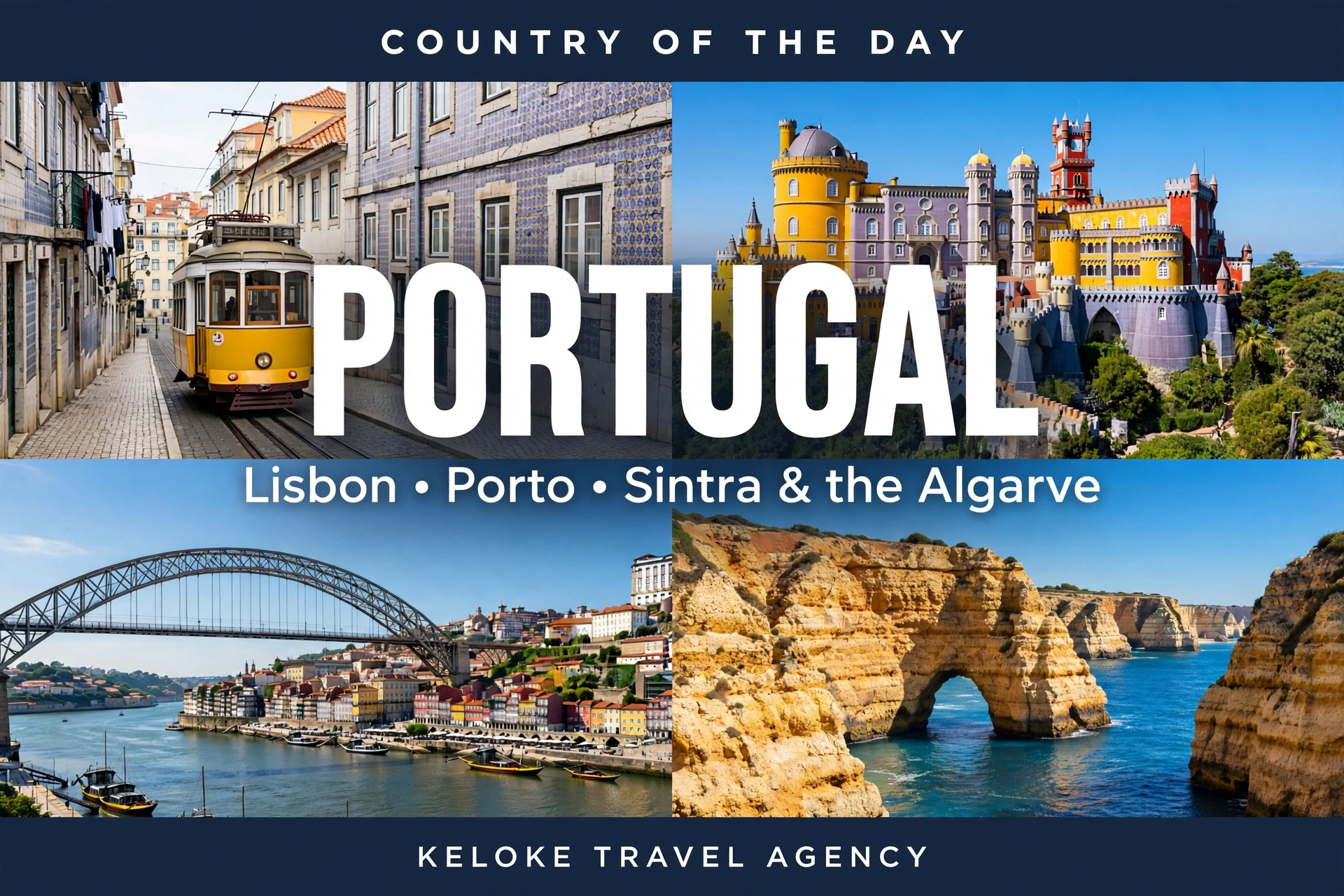
Portugal: Hills, Tiles and Atlantic Light — Small Country, Many Trips in One

Portugal: Hills, Tiles and Atlantic Light — Small Country, Many Trips in One

Portugal packs a capital of steep miradouros, a wine river in the north, fairy-tale palaces an hour from Lisbon, a golden cliff coast in the south, and two Atlantic island groups into a country you can cross in a day — but should not. The planning rule is pace, not distance: pick Lisbon plus one other region, walk slowly, eat long lunches, and let the hills set your schedule. Cobblestones are beautiful and unforgiving, so good shoes matter more here than almost anywhere else in Europe.

The country, one by one

  • Lisbon: the capital chapter — seven hills of tiled facades, laundry lines and viewpoints. Ride Tram 28 early before it fills, wander Alfama’s lanes below Sao Jorge Castle, take coffee and a warm pastel de nata in Belem by the Jeronimos Monastery and Belem Tower, then cross to the LX Factory and the Bairro Alto for dinner and fado spilling from small taverns. Give Lisbon three days minimum; the hills reward slow days, not checklists.
  • Porto & the Douro Valley: the northern chapter — Porto’s Ribeira waterfront, the Dom Luis I Bridge, Livraria Lello and port cellars across the river in Vila Nova de Gaia, where the great port houses age their barrels. Upstream, the Douro Valley stacks steep terraced vineyards above the river — take the train or a boat to Pinhao, taste at a quinta, and stay a night among the vines if you can.
  • Sintra: the palace chapter — a cool, green day trip (or overnight) from Lisbon, with the colourful Pena Palace on its hilltop, the romantic gardens and initiation well of Quinta da Regaleira, and the Moorish Castle’s walls above town. Go early, book palace entry ahead in high season, and wear real walking shoes for the climbs between sites.
  • The Algarve: the coast chapter — golden cliffs, sea caves and calm coves in the south. Base in Lagos for the Ponta da Piedade headland and boat trips to the Benagil Cave, Tavira for a quieter, older Algarve, and Faro as the gateway town. Summer is busy and hot; spring and autumn give the same coast with room to breathe.
  • Madeira & the Azores — worth knowing: the island chapter — Madeira, the island of eternal spring, brings levada canal walks, steep Funchal gardens and dolphin boats; the Azores bring volcanic lakes on Sao Miguel, whale watching and green calderas in the mid-Atlantic. Either group is a flight from Lisbon and a trip of its own — add islands only if you have the days.

Culture notes

Portugal runs on saudade — the bittersweet longing you hear in fado, the UNESCO-listed song tradition born in Alfama’s taverns. Azulejos, the blue-and-white painted tiles, cover churches, stations and whole facades, and bacalhau (salt cod) is joked to have 365 recipes, one for every day. On the sweet side: the original Pastel de Belem bakery has served custard tarts since 1837 — eat them warm, with cinnamon. A few words of Portuguese go far: obrigado / obrigada (thank you, said by a man / a woman), bom dia (good morning), and por favor (please).

When to go

Spring (March to May) and autumn (September to October) are the sweet spots for Lisbon, Porto and Sintra: warm, bright and less crowded. Summer (June to August) is peak for the Algarve and the islands — book ahead, expect heat inland and full beaches — while winter is mild on the coast, wetter in the north, and the cheapest, quietest time for city trips, with Madeira staying spring-like year-round. Match the region to the month: cities in shoulder season, coast in late spring or early autumn.

Practical tips

  • U.S. visitors: visa-free up to 90 days in any 180: U.S. citizens do not need a Portuguese tourist visa for stays of 90 days or less. That 90-day limit is shared across the whole Schengen Area in any rolling 180-day period — days in Spain, France or Italy count against the same allowance. Your passport must have at least 3 months validity beyond your date of departure and 2 blank pages. No vaccinations are required for entry, and you must declare currency of EUR 10,000 or equivalent or more on entry or exit.
  • Haitian passport holders — Schengen visa REQUIRED in advance: Haitian citizens with ordinary Haitian passports are on the EU list of nationals who must hold a visa to cross Schengen external borders, so apply for a short-stay Schengen visa before traveling, through the Portuguese consulate or its visa centre for your place of residence — apply well in advance, at least 15 days before the trip and no more than 6 months ahead. Typical files include a passport valid at least 3 months beyond departure from Schengen and issued within the last 10 years, travel medical insurance with at least EUR 30,000 coverage, proof of accommodation, proof of sufficient funds, and a return or onward reservation. Do NOT buy non-refundable tickets before the visa is confirmed — confirm the current fee and exact document list with your consulate.
  • Money is the euro: Portugal’s currency is the euro (EUR). Cards are widely accepted in Lisbon, Porto and the Algarve; small cafes, markets, taxis and rural quintas can be cash-only, so carry small euro notes and coins. Prices in this post are not quoted because they change — re-confirm tour, train and palace ticket prices close to departure.
  • Power is 230V, plugs are Type C and Type F: Portugal runs 230V at 50Hz with round two-pin Type C and grounded Type F sockets. U.S. flat plugs do not fit, and single-voltage U.S. appliances need a converter, not just an adapter — most phone and laptop chargers are dual-voltage 100-240V, so check the label. A universal adapter/converter kit is the one-pack fix.
  • Hills and cobblestones are the real packing rule: Lisbon and Porto are steep, and polished calcada cobblestones get slippery when wet. Pack broken-in walking shoes with grip, plan tram, metro, elevator (the Santa Justa Lift) and funicular rides into hill days, and keep luggage light if your hotel is up an Alfama or Ribeira lane — wheeled bags fight those streets.
  • Getting around: trains link Lisbon-Porto in about 3 hours and Lisbon-Faro for the Algarve; metro and trams cover Lisbon, and ride-hailing is common in the cities. Sintra is about 40 minutes by train from Lisbon’s Rossio station. Driving is on the RIGHT, and a rental car helps most in the Algarve, the Douro and rural areas — less so in Lisbon’s old town.

What to pack for Portugal

Steep tiled streets, Atlantic wind, palace climbs and long days away from your hotel in one trip. Our country picks: a universal travel adapter and voltage converter with USB ports — Portugal’s 230V Type C/F sockets are the one that strands U.S. plugs — noise-cancelling over-ear headphones for the transatlantic flight in and train rides between Lisbon, Porto and the Algarve, compression packing cubes so city layers, coast clothes and a light jacket ride in one carry-on strategy, a 20,000 mAh fast-charge power bank for navigation-heavy hill days, Sintra palace circuits and Algarve boat days far from outlets, and an insulated vacuum travel mug that keeps coffee hot on a cool miradouro morning and water cold on an Algarve afternoon. Find them in the KELOKE shop.

Posted on — Leave a comment

Argentina: Tango, Waterfalls and the End of the World — One Country, Every Climate

Argentina: Tango, Waterfalls and the End of the World — One Country, Every Climate

Argentina is the eighth-largest country on Earth, and it behaves like several countries stacked north to south: subtropical jungle and the biggest waterfalls on the planet at the top, a European-feeling capital and wine country in the middle, and glaciers, penguins and the southernmost city in the world at the bottom. Distances are the planning rule here — Buenos Aires to Iguazú is a flight, Buenos Aires to Ushuaia is a longer one — so pick two or three regions, fly between them, and let each one be its own trip.

The country, one by one

  • Buenos Aires: the capital chapter — Paris-style avenues and café culture with a Latin heartbeat. La Boca's painted houses, San Telmo's antiques and Sunday market, Recoleta Cemetery, Palermo's parks and parrillas, and tango where it was born: a milonga late at night beats any stage show. Give the city three days minimum; it rewards slow wandering and late dinners (nobody eats before 9 PM).
  • Iguazú Falls (Puerto Iguazú, Misiones): the waterfall chapter — some 275 falls spread across nearly 3 km of jungle cliffs on the Brazil border, with the Garganta del Diablo (Devil's Throat) boardwalk standing over a U-shaped chasm 82 metres tall. The Argentine side holds most of the falls and the full trail network — plan a full day inside the park, start at opening, and expect to get wet on the lower circuit.
  • Mendoza: the wine chapter — Argentina's Malbec capital at the foot of the Andes, all tree-lined streets, irrigation channels and bodegas in Maipú, Luján de Cuyo and the high Uco Valley, with Aconcagua (6,961 m, the highest peak outside Asia) on the horizon. Bike the wine routes, book winery lunches ahead, and let the siesta rhythm set the pace.
  • Patagonia — El Calafate & El Chaltén: the glacier chapter — El Calafate is the gate to Perito Moreno, a 30 km-long advancing glacier whose calving icebergs thunder into Lago Argentino in front of the boardwalks. El Chaltén, Argentina's trekking capital, puts the Fitz Roy and Cerro Torre trails right at the edge of town — no shuttle, no fee booth, just walk out of your lodge and up.
  • Ushuaia & Tierra del Fuego: the end-of-the-world chapter — the southernmost city on Earth, between the Beagle Channel and the Martial mountains. Boat the channel past sea lions and the Les Eclaireurs lighthouse, ride the End of the World Train into Tierra del Fuego National Park, eat centolla (king crab), and send a postcard stamped at the end of the world.
  • Worth knowing — Salta & the Northwest, and Bariloche: Salta's colonial north brings red-rock quebradas, high-altitude vineyards in Cafayate and the Train to the Clouds; San Carlos de Bariloche anchors the Lake District with alpine lakes, chocolate shops and Cerro Catedral skiing in winter. Either one swaps cleanly into an itinerary in place of Mendoza.

Culture notes

Argentina runs on ritual: the asado (a slow, social barbecue that is an event, not a meal), mate shared from one gourd and passed hand to hand — accept when offered, it's a welcome — and fútbol as a genuine civic religion, with the Boca–River Superclásico dividing the capital. Tango is UNESCO-listed heritage, café cortados stretch for hours, and the Italian and Spanish immigration waves show up everywhere from hand gestures to dinner at 10 PM. A few words of Spanish go far, and note the local accent: the 'll/y' sounds like 'sh' — calle sounds like 'ca-sheh'.

When to go

Seasons are reversed south of the equator, and the country is too long for one best month. Buenos Aires is best in spring (September–November) and autumn (March–May) — summer (December–February) is hot and humid. Patagonia is a November-to-March destination: outside that window the wind is fierce, days are short and many services close. Iguazú is year-round, with the fullest falls after rainy periods and the most comfortable temperatures March–May and August–September. Mendoza's vendimia (harvest festival) peaks in early March. Bariloche skis June–August. Match the region to the month, not the other way around.

Practical tips

  • U.S. visitors: visa-free up to 90 days: U.S. citizens do not need an Argentine tourist visa for stays of 90 days or less. Your passport must be valid at entry — bring six months' validity anyway, since airlines and connecting countries often enforce it — and you need one blank page for the entry stamp. No vaccinations are required for entry, and you can carry up to US$10,000 (or equivalent) undeclared if you are over 16.
  • Haitian passport holders — tourist visa REQUIRED in advance: Haitian citizens with ordinary Haitian passports must get an Argentine tourist visa before traveling — this is stated directly by the Argentine Embassy in Haiti (ehait.cancilleria.gob.ar, 'Visa Turista': 'Los ciudadanos haitianos, titulares de pasaportes haitianos ordinarios, requieren visa para ingresar a la Argentina en calidad de turistas') and by argentina.travel, which lists Haiti among the countries that need to apply. The process is personal, with a consular interview: request the form and an appointment at the embassy (ehait@cancilleria.gov.ar / (509) 2940-6711) at least about 30 days before your planned travel, bring proof of work and income, bank/credit-card statements, a round-trip flight reservation, and a hotel reservation or a notarized invitation letter; the fee at the Embassy in Haiti is USD 50, paid by bank deposit on the appointment day. A granted tourist visa allows a stay of up to 90 days, extendable once. Do NOT buy air tickets before the visa is confirmed — the embassy itself advises against it. (An older Cancillería visa-regime chart still lists Haiti as visa-free — that chart is stale: Argentina reinstated the tourist visa for Haitian citizens in August 2018. Do not rely on it.)
  • Money is the peso — and prices move: Argentina's currency is the peso (ARS), and inflation means posted prices, tour rates and exchange conditions change fast — re-confirm every price close to departure, carry a mix of cards and some U.S. dollars in clean notes to exchange through official channels, and never rely on a price printed in an old guidebook (or an old blog post — including ours: the daily runner re-verifies before publishing).
  • Power is 220V, plugs are Type C and Type I: Argentina runs 220V with two plug shapes — the European-style Type C and the angled three-pin Type I. U.S. flat plugs do not fit Type I sockets, and single-voltage U.S. appliances need a converter, not just an adapter — a universal adapter/converter kit is the one-pack fix.
  • Distances are flights, not drives: Buenos Aires–Iguazú is ~1.5 hours by air (17+ by bus), Buenos Aires–El Calafate ~3.5 hours, Buenos Aires–Ushuaia ~3.5 hours. Book domestic flights early (Aerolíneas Argentinas, Flybondi, JetSMART), and note Buenos Aires has two airports — Ezeiza (EZE, international) and Aeroparque (AEP, domestic/regional); many connections require changing airports across the city, so leave hours, not minutes.
  • Altitude appears quietly in the northwest: Salta city sits ~1,200 m, but Cafayate, the quebradas and the Train to the Clouds climb past 4,000 m — take the climb days easy, hydrate, and go light on the Malbec until you've acclimatized.
  • Yellow fever is an Iguazú question: no vaccine is required to enter Argentina, but yellow fever vaccination is recommended for the forested northeast including Iguazú Falls (Misiones) for travelers aged 9 months to 60 years — ideally at least 10 days before. It is NOT recommended for itineraries limited to Buenos Aires, Mendoza or Patagonia. Ask a clinician what fits your exact route.
  • Driving is on the RIGHT, and rental cars make sense in Mendoza, Salta and the Lake District — less so in Buenos Aires, where the Subte, buses and taxis cover the city.

What to pack for Argentina

Subtropical jungle, capital evenings and subantarctic wind can all land in the same suitcase. Our country picks: a universal travel adapter and voltage converter with USB ports — Argentina's 220V Type C/I mix is the one that strands U.S. plugs — noise-cancelling over-ear headphones for the 9–11 hour overnight flights in and the long domestic hops and buses between regions, compression packing cubes so Buenos Aires layers and Patagonia insulation ride in one carry-on strategy, a 20,000 mAh fast-charge power bank for glacier boardwalks, Iguazú trail days and end-of-the-world boat trips far from outlets, and an insulated vacuum travel mug that keeps coffee hot through a Patagonian morning and mate culture company all day. Find them in the KELOKE shop.

Posted on — Leave a comment

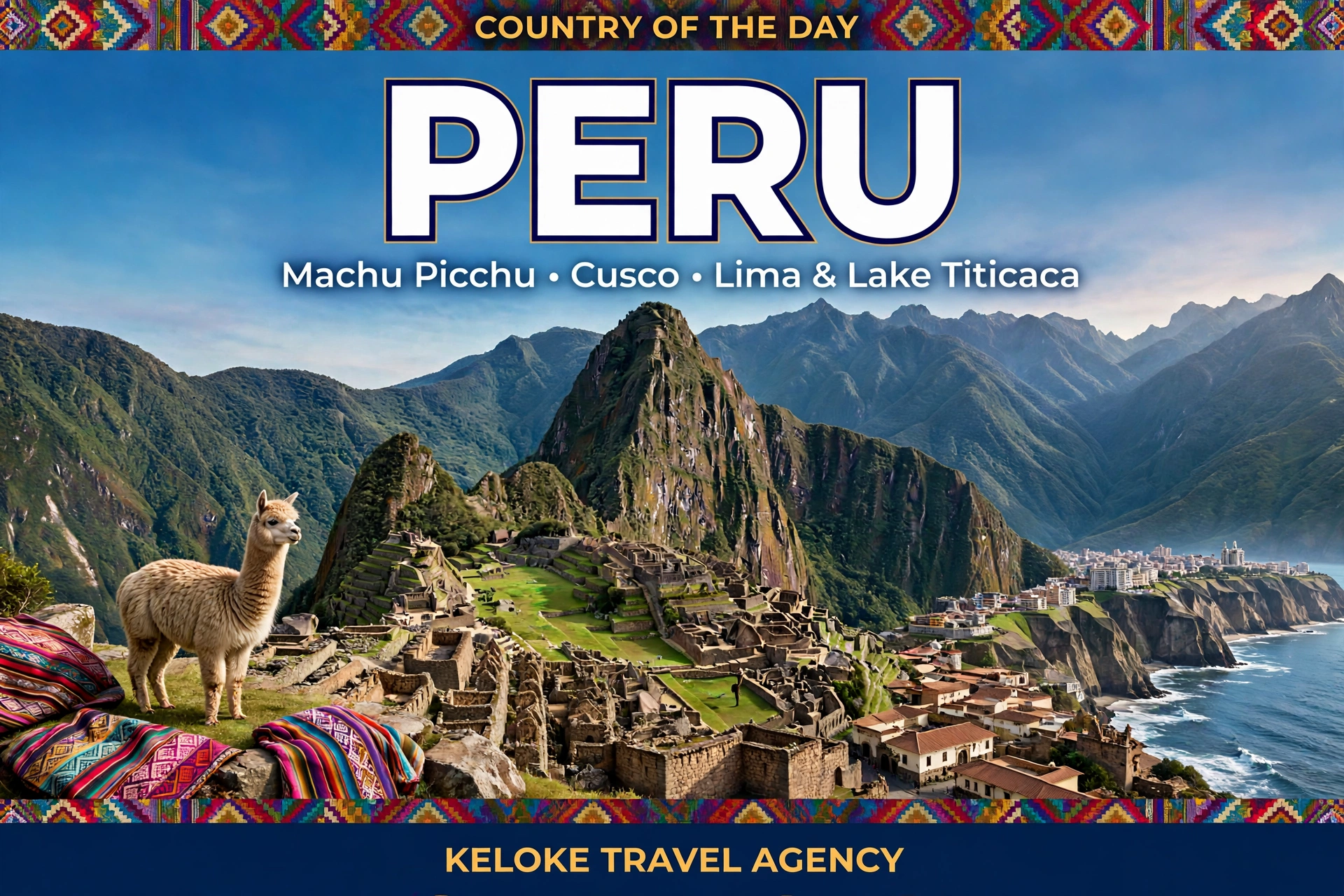
Peru: Coast, Andes and Jungle — Three Worlds in One Country

Peru: Coast, Andes and Jungle — Three Worlds in One Country

Peru is three trips stacked into one ticket: a desert capital that became South America’s food capital, an Inca heartland where the cities sit higher than most airplanes’ cruising worries, and an Amazon basin that covers more than half the country. The planning rule that makes it work is altitude, not distance: Lima first, the Sacred Valley second, Cusco and Machu Picchu only once your body has caught up. Sequence it right and Peru is the trip people measure every other trip against.

The country, one by one

  • Lima: the basecamp chapter — start at sea level in the capital, where the historic centre’s colonial balconies and catacombs sit a short ride from Miraflores’ cliff-top parks and Barranco’s street art and cafés. Lima is also the table: ceviche at lunch (never dinner, by local rule), lomo saltado, ají de gallina, and tasting menus that book out weeks ahead. Give Lima two days, not a layover.
  • Cusco & the Sacred Valley: the Inca chapter — Cusco, the former Inca capital at about 3,400 metres, layers Spanish churches on top of Inca stonework that still fits together without mortar. Drop down into the Sacred Valley — Pisac’s terraces and market, Ollantaytambo’s fortress and living Inca town plan, the Maras salt pans and Moray’s circular terraces — which sits lower than Cusco and is the smart place to sleep your first highland nights.
  • Machu Picchu: the headline — the 15th-century Inca citadel in its cloud-forest saddle between two peaks, reached by train to Aguas Calientes and a bus up the switchbacks, or on foot via the multi-day Inca Trail. Entry is by timed, circuit-based tickets that sell out in high season, the name on the ticket must match your passport, and the first visit runs with an official guide — book weeks to months ahead, not on arrival.
  • Lake Titicaca & Puno: the high-lake chapter — at about 3,812 metres, the world’s highest navigable lake, where the Uros people live on floating islands woven from totora reeds and Taquile Island’s weavers produce textiles UNESCO lists as heritage. Puno is the shore base; the lake light at sunrise is the reason to stay a night, not day-trip it.
  • The Peruvian Amazon — Puerto Maldonado & Iquitos: the jungle chapter — Puerto Maldonado, a short flight from Cusco, is the gateway to Tambopata’s macaw clay licks, oxbow lakes and giant river otters; Iquitos, reachable only by air or river, is the deep-Amazon city for lodge stays and pink river dolphins. This is a different Peru entirely: hot, humid, dawn-start days, and wildlife on the river’s schedule, not yours.

Culture notes

Peru’s layers run deep: Quechua and Aymara cultures that predate and outlasted the Inca Empire, Spanish colonial cities, Afro-Peruvian music and food traditions on the coast, and Amazonian peoples across the east. Quechua is co-official and widely spoken in the highlands — a few words (Allillanchu, hello; Sulpayki, thank you) open doors. On the table beyond ceviche: pachamanca earth-oven feasts, rocoto relleno in Arequipa, cuy as a traditional Andean dish visitors can choose for themselves, and pisco — Peru’s grape brandy — in its home country. Textiles are the souvenir with meaning: alpaca in Cusco and Taquile, woven with natural dyes and patterns that identify the maker’s community.

When to go

The Andes run on two seasons. The dry season, roughly May to October, is the classic window: clear Machu Picchu mornings, firm Inca Trail footing, and festival season in Cusco (Inti Raymi falls on June 24). The rainy season, roughly November to April, means greener valleys, thinner crowds and lower prices — but cloud can sit on Machu Picchu and highland roads and trains can be disrupted by heavy rain, so build in buffer days. Lima plays by opposite rules: its summer is December to April, while May to November brings the garúa, a cool grey sea mist. The Amazon is visitable year-round; its drier stretch, roughly May to October, makes trails and wildlife spotting easier.

Practical tips

  • U.S. visitors: visa-free, up to 90 days granted: U.S. citizens do not need a Peruvian tourist visa. Bring a passport valid at least six months from the date of entry — airlines enforce this at check-in. Peru’s official tourism portal puts the maximum stay the authorities grant at 90 days; read the days you are actually given on entry (entry is now recorded digitally) before you leave the immigration desk, and plan to the stamp, not the brochure.
  • Haitian passport holders — consular visa in advance: Ordinary Haitian passport holders require a tourist visa obtained BEFORE travel from a Peruvian consular office — the Peruvian government instructs applicants to apply at least 15 calendar days before the trip, and applying does not guarantee approval. Typical files include a passport valid at least six months, proof of travel to and from Peru, accommodation, a recent photo and proof of sufficient funds; the consulate can ask for more. Haitian diplomatic and official passport holders are visa-exempt. Confirm the current rule and your consulate’s exact list before booking anything non-refundable (see KELOKE’s Haitian passport guide for the full country map).
  • Altitude is the real itinerary rule: Cusco (about 3,400 m), Puno (about 3,825 m) and the high passes sit well above the level where altitude sickness starts. Sleep lower in the Sacred Valley first, take the first 24–48 hours easy, eat light, go easy on alcohol, hydrate steadily, and let coca tea do its traditional work. Anyone with heart or lung conditions should talk to a clinician before a highland itinerary — and if severe symptoms hit, descending is the treatment, not pushing on.
  • Machu Picchu tickets sell out: timed entry tickets for the citadel — and the separate Inca Trail permits — go weeks to months ahead in the dry season. Buy through the official channel, with the passport you will actually travel on; the ticket name and passport must match at the gate.
  • Yellow fever is an Amazon question, not a highland one: no vaccination is required to enter Peru from the U.S., and yellow fever vaccination is not recommended for itineraries limited to Lima, Cusco, Machu Picchu and the highlands. It IS recommended for jungle areas below about 2,300 metres — Puerto Maldonado, Iquitos, Tambopata, Manu — ideally at least 10 days before entering the jungle. Malaria medication is likewise an Amazon conversation to have with a clinician; the highlands and Lima have no malaria transmission.
  • Money is the sol: Peru’s currency is the sol (PEN). Cards are widely accepted in Lima and Cusco hotels and restaurants; markets, small towns, Sacred Valley sites and Amazon lodges run on cash in small notes — and torn or damaged U.S. dollar bills are routinely refused, so carry clean notes if you bring dollars to exchange.
  • Power is 220V — check your devices: Peru runs 220V, double the U.S. standard, with Type A, B and C sockets (U.S.-style flat plugs fit many outlets). Phone and laptop chargers are almost always dual-voltage — read the label — but single-voltage U.S. appliances (hair dryers, some shavers) need a converter, not just an adapter.
  • Getting around: domestic flights link Lima–Cusco, Lima–Puno (via Juliaca) and Lima/Cusco–Puerto Maldonado in about an hour each; the Cusco–Aguas Calientes leg is train-only (plus the Inca Trail on foot). Driving is on the RIGHT.

What to pack for Peru

Sea level, 3,400 metres and the jungle floor in one suitcase. Our country picks: a memory-foam neck pillow travel kit for the long-haul into Lima and the early domestic hops up to Cusco and Juliaca, Coolmax compression socks for long flights and circulation on high-altitude days, an 80-piece portable first aid kit for Inca Trail blisters, Sacred Valley scrapes and jungle bites hours from a clinic, a collapsible water bottle — steady hydration is the first altitude rule, and a bottle that folds flat rides every train and trail — and an RFID passport holder and document organizer that keeps the passport your Machu Picchu ticket is named on, your entry record and your consular paperwork in one hand at every checkpoint. Find them in the KELOKE shop.

Posted on — Leave a comment

Panama: One Canal, Two Oceans, a Whole Continent in Miniature

Panama: One Canal, Two Oceans, a Whole Continent in Miniature

Panama is the trip that refuses to be one thing: a working wonder of engineering where supertankers rise and fall in front of you, a 500-year-old old town of plazas and rooftop bars, Indigenous-run Caribbean islands with no cars and no resorts, an Afro-Caribbean archipelago built for slow days, and cool coffee highlands where the sunrise can show you both oceans at once. It is the narrow waist of the Americas — about 80 kilometres of land holding the Pacific and the Atlantic apart — and the planning rule is simple: Panama City is the hub, every region is a short hop from it, and the dry season makes all of it easier.

The country, one by one

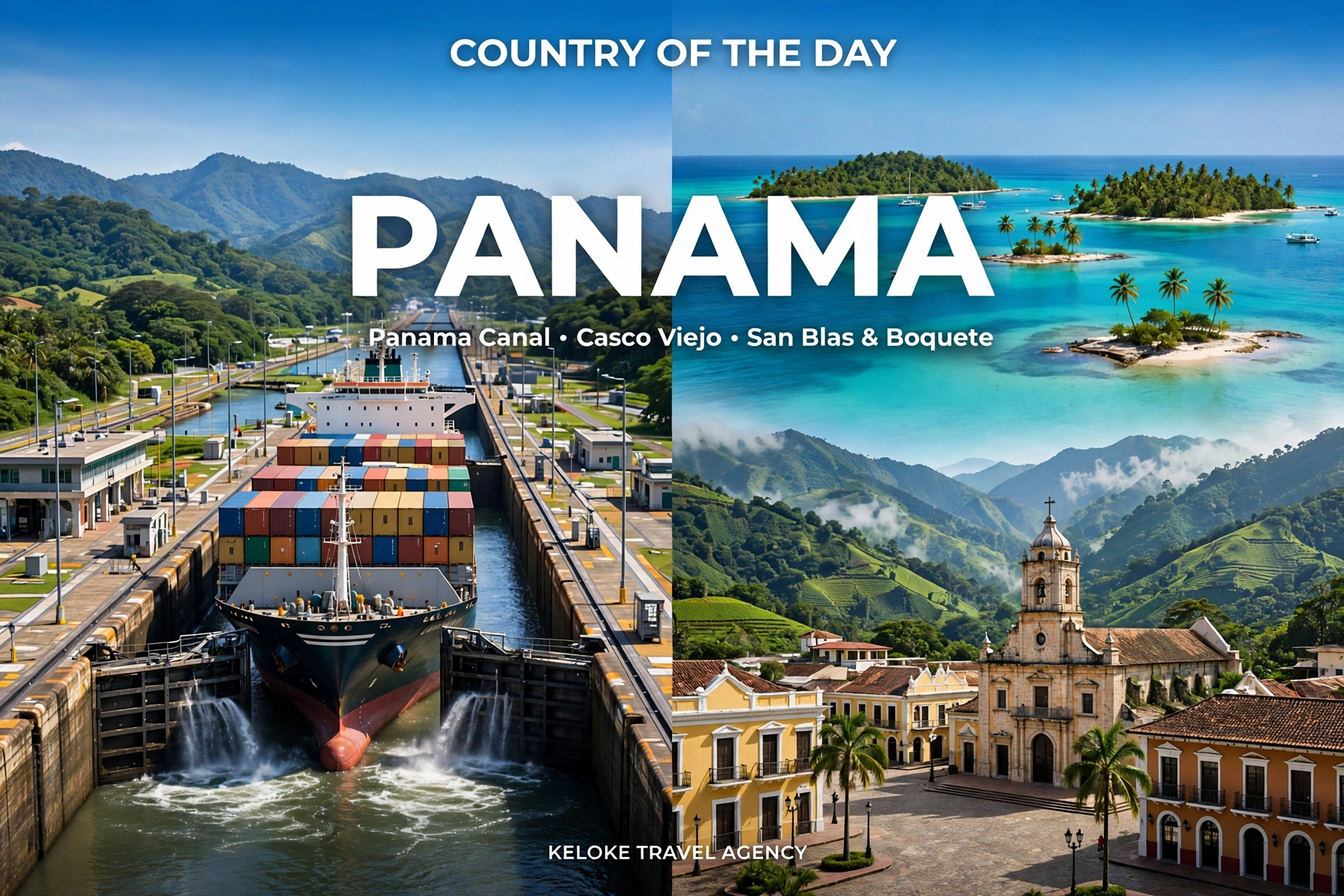
  • The Panama Canal — Miraflores & Agua Clara: the headline — at the Miraflores Locks visitor centre on the Pacific side you stand on viewing decks as ships are raised and lowered through the chambers, with a museum that tells the whole brutal, brilliant story; on the Atlantic side, the Agua Clara visitor centre watches the newer, bigger Neopanamax locks at work. Go in the morning or late afternoon, when ship transits are most frequent.
  • Casco Viejo & Panama City: the basecamp chapter — the UNESCO-listed old town of Spanish colonial churches, French-era plazas and restored mansions turned cafés and rooftop bars, the presidential palace on the waterfront promenade, and across the bay the modern skyline and the Amador Causeway, built from canal excavation rock, running out toward the Biomuseo, Frank Gehry’s riot of colour about Panama’s land bridge between continents.
  • Guna Yala (San Blas): the island chapter — an autonomous Indigenous territory of some 365 low Caribbean islands, run by the Guna people on their own terms: palm islands the size of a football field, thatch cabañas, lobster for dinner, mola textile art, and boat transfers from the Cartí coast after a mountain road from the capital. No big resorts, patchy signal, cash only — that is the point.
  • Bocas del Toro: the slow chapter — an Afro-Caribbean archipelago on the Caribbean side where the towns are built on stilts over the water, transport is by water taxi, and the days split between Red Frog Beach, starfish flats at Starfish Beach, surf breaks and cacao farms on Isla Colón and Bastimentos.
  • Boquete & Volcán Barú: the highlands chapter — a cool mountain town in Chiriquí wrapped in coffee farms, famous for Geisha coffee, one of the most prized (and priciest) beans on earth; flower gardens, river rafting and cloud-forest trails fill the days, and the pre-dawn hike or 4×4 ride up Volcán Barú, Panama’s highest point at 3,475 metres, can show strong hikers both the Pacific and the Caribbean from one summit on a clear morning.

Culture notes

Panama is a crossroads by birth: Spanish colonial roots, Afro-Panamian culture carried from the canal-era Caribbean migrations (Congo traditions in Colón, calypso in Bocas), seven Indigenous peoples including the Guna, Emberá and Ngäbe, and Chinese, South Asian and American threads from a century of canal life. The pollera, the embroidered national dress, and tamborito music anchor the folklore calendar; Carnaval in Las Tablas and Panama City is one of Latin America’s biggest street parties. On the table: ceviche at the capital’s fish market, sancocho chicken soup, patacones (fried green plantain), ropa vieja, and coffee that the whole world wants. A fair warning about souvenirs: the famous “Panama hat” is woven in Ecuador — Panama’s own crafts are the Guna mola and Emberá basketry, and those are the ones to bring home.

When to go

Panama has two seasons and two coasts that do not always agree. The dry season, roughly mid-December to mid-April, is the easiest all-round window: canal skies are clear, roads to Cartí and the highlands behave, and Carnaval lands inside it. The rainy (“green”) season, roughly May to November, means lush hillsides and afternoon downpours rather than all-day rain — Panama City plans still work if you front-load your days. Bocas del Toro plays by Caribbean rules: its driest stretches are usually February–March and September–October, and it can rain there in any month. Boquete is spring-cool all year (pack a layer), and the Barú summit is a dry-season game — clear both-oceans sunrises are a December-to-April prize.

Practical tips

  • U.S. visitors: visa-free, up to 180 days: U.S. citizens enter Panama as tourists without a visa for up to 180 days — among the most generous stays in the region. Bring a passport valid at least 3 months beyond entry (6 months is safer and what many airlines prefer), a return or onward ticket, and proof of at least US$500 in funds (cash, card or statement). Airlines check the onward ticket at check-in, and the number of days on your entry stamp is the law of your stay — read it before you leave the immigration desk.
  • Haitian passport holders — Authorized Visa in advance, start early: Haiti is on Panama’s Authorized Visa list. Ordinary Haitian passport holders must have an authorized visa approved through a Panamanian consulate BEFORE travelling — approval can take up to 60 business days, so start months ahead, and do not finalize travel arrangements until the visa is granted. For air transit only, Haitian citizens have been exempt from Panama’s separate transit visa since Executive Decree No. 21 (August 25, 2025), so a layover in the airport’s international area no longer needs that transit visa — but entering Panama itself still requires the authorized visa above. One real exception: holders of a valid multiple-entry visa or residence permit from the U.S., Canada, the UK, an EU country, Australia, Japan, Singapore or South Korea (valid at least 6 months from arrival; U.S. permanent residents qualify on their green card) may enter without a Panamanian visa for up to 30 days. Haitian diplomatic passport holders are visa-exempt. Re-check the current rule with Panamanian Migration before booking (see KELOKE’s Haitian passport guide for the full country map).
  • Passport validity: Panama’s official minimum is 3 months beyond entry, but carry 6 months when you can — airline check-in desks are the strictest readers of this rule.
  • Yellow fever: a yellow fever vaccination certificate is required if you arrive from a country with yellow-fever transmission risk; the vaccine is recommended for jungle and Darién-adjacent travel in any case — carry the yellow card with your passport.
  • Money is the U.S. dollar: Panama’s balboa is pegged one-to-one with the dollar and exists only as coins — U.S. paper bills are the everyday currency, and cards are widely accepted in the capital and tourist towns. Guna Yala runs on cash in small bills (territory entry and island fees are paid on the spot), and Bocas water taxis are cash work too.
  • Power is plug-and-play for Americans: Panama runs 110V with Type A and B sockets — the same plugs and voltage as the United States, so U.S. devices plug straight in with no adapter or converter.
  • Getting around: Panama City’s Metro and Metrobus cover the capital cheaply; domestic flights from Albrook airport reach Bocas, David (for Boquete) and the Pearl Islands in under an hour; the Cartí road for Guna Yala is 4×4-and-motion-sickness territory, arranged through your island host. Driving is on the RIGHT.

What to pack for Panama

Two coasts, one canal and a cool highland. Our country picks: a 3-in-1 handheld fan with power bank and flashlight for the humid lock-side viewing decks and island nights, a collapsible water bottle that empties flat for domestic island-hopper flights and fills at every stop, a 20,000mAh power bank with retractable cable for long transit days between the canal, Cartí and Bocas, waterproof shoe bags that keep wet-landing sand and rainy-season mud away from clean clothes, and an RFID passport holder and document organizer that keeps the passport, onward ticket and funds proof together for the immigration desk and the Guna Yala checkpoints. Find them in the KELOKE shop.