Posted on — Leave a comment

Guyana: South America’s Wild, English-Speaking Corner

Guyana: South America's Wild, English-Speaking Corner

Guyana is the trip for travelers who think they have seen the Caribbean and South America and want the version with almost nobody else in it: one of the world's great waterfalls reached by a small plane over endless green, a capital of white wooden colonial buildings on stilts, rainforest canopy walkways at dawn, and savannah ranches where giant otters and jabiru storks outnumber tourists. It is South America's only English-speaking country, culturally Caribbean, geographically Amazonian — and the planning rule is simple: Georgetown is the basecamp, the interior is the prize, and every interior hop runs on small planes, boats and weather, so build in spare days.

The country, one by one

  • Kaieteur Falls: the headline — a single drop of about 226 metres (roughly five times Niagara's height) on the Potaro River, reached by charter flight from Georgetown's Ogle airport over unbroken rainforest. Most visits are day flights with guided viewpoints at the top of the falls; some pair Kaieteur with Orinduik Falls for a swim on the way back.
  • Georgetown: the basecamp chapter — St. George's Cathedral, one of the world's tallest wooden churches, the Stabroek Market clock tower, the seawall at sunset, the Botanical Gardens and their manatees, and heritage wooden houses raised on stilts against the floods. Give it a full day at the start and a spare night at the end.
  • Iwokrama & the canopy walkway: the rainforest chapter — the Iwokrama Forest reserve and its canopy walkway strung high above the forest floor near Atta Rainforest Lodge, at its best at sunrise when macaws and toucans cross at eye level; Surama village, an Indigenous Makushi community, is the model community-run eco-lodge stay nearby.
  • The Rupununi savannah: the wildlife chapter — open grasslands in the south reached by a short flight to Lethem or Annai: giant river otters at Karanambu, black caiman research nights at Caiman House in Yupukari, horse ranches, and the Kanuku Mountains on the horizon. At Easter, Lethem's Rupununi Rodeo fills the town.
  • Shell Beach & the coast: the far chapter — a remote stretch of Atlantic coast where up to four species of sea turtles nest (main season roughly March to August), reached by boat and 4×4 from Georgetown; this is expedition travel, planned with an operator, not a day trip.

Culture notes

Guyana's people are its mix: Afro-Guyanese, Indo-Guyanese (the largest group — Diwali and Phagwah light up the calendar), Indigenous peoples of nine nations in the interior, and Portuguese, Chinese and mixed heritages on the coast. English is official, Guyanese Creole is the everyday music of it, the food runs from pepperpot and roti to garlic pork and metemgee, and Demerara rum has a 300-year head start. Mashramani, the Republic Day festival on February 23, is Georgetown's big street party of costumes, calypso and steelpan.

When to go

Guyana is hot and humid all year, around 27–32°C on the coast. The long dry season, roughly mid-August to mid-November, is the easiest all-round window: interior roads and trails hold up, wildlife gathers at shrinking water, and October sits right in it. A shorter dry season runs roughly February to April — good for Kaieteur and the Rupununi, and it holds Mashramani and the Easter rodeo. The long wet season, roughly May to mid-August in the south (the coast has its own two rainy seasons), floods savannah routes and can close overland travel for days, though the falls roar at full power. Whichever window you pick, keep one spare day after any interior flight — weather reshuffles small-plane schedules as a matter of routine.

Practical tips

  • U.S. visitors: visa-free, up to 90 days: U.S. citizens are visa-exempt for Guyana for stays of up to 90 days. Bring a valid passport, your return or onward ticket, and your accommodation details — airlines and immigration officers do ask.
  • Haitian passport holders — approval in advance, do not just arrive: Haiti appears on Guyana's visa-exempt list ONLY for holders of diplomatic, official or special passports. Ordinary Haitian passport holders need a visa arranged before travel — an e-Visa (approval letter) through Guyana's Department of Immigration, or a tourist visa on arrival ONLY with a pre-approval letter from the Ministry of Home Affairs (up to 30 days). Do not book non-refundable travel before the approval is in hand, and re-check the current rule with Guyanese Immigration before booking (see KELOKE's Haitian passport guide for the full country map).
  • Passport validity: plan on your passport being valid at least 6 months beyond arrival, with a blank page for stamps.
  • Yellow fever: a yellow fever vaccination certificate is required if you arrive from a country with yellow-fever transmission risk, and the vaccine is recommended for interior travel in any case — carry the yellow card with your passport.
  • The interior runs on small planes: domestic flights leave from Eugene F. Correia Airport (Ogle) in Georgetown, not the international airport at Timehri; baggage limits are strict and soft bags beat hard cases. Kaieteur day flights need booking ahead and a minimum group — your operator confirms the morning of the flight, weather permitting.
  • Currency is the Guyanese dollar (GYD): Guyana is still largely a cash economy outside Georgetown's hotels and bigger stores; U.S. dollars are the most useful foreign cash in small notes, cards work in the capital, and interior lodges settle by arrangement made in advance.
  • Power is NOT plug-and-play for Americans: Guyana runs 240V with a mixed inheritance of Type A, B, D and G sockets — U.S. plugs fit some outlets and not others, and 120V-only devices need a converter, not just an adapter. A universal adapter/converter (one of our country picks below) is the one-bag answer; check that your chargers say 100–240V.
  • Driving is on the LEFT, and Georgetown taxis and minibuses are the practical way around the capital; interior travel is operator territory — guides, boats and 4x4s arranged through your lodge.

What to pack for Guyana

Rainforest, rivers and small planes. Our country picks: a portable first aid kit for trail days hours from the nearest clinic, a collapsible water bottle that empties flat for the strict Ogle baggage limits and fills for the Kaieteur viewpoints, a universal travel adapter with voltage converter for Guyana's mixed 240V sockets, compression packing cubes that keep wet-season humidity and river clothes in their own sealed world, and an RFID passport holder and document organizer that keeps the passport, yellow-fever card and interior flight papers together through every checkpoint and boat hop. Find them in the KELOKE shop.
Posted on — Leave a comment

Trinidad and Tobago: One Country, Two Different Islands

Trinidad and Tobago: One Country, Two Different Islands

Trinidad and Tobago is the Caribbean's two-for-one: Trinidad is the big, loud, working island — Carnival's home port, oil money, Indo- and Afro-Caribbean food and music stacked block on block — and Tobago, a short flight or ferry northeast, is its quiet little sister of fishing villages, rainforest and reef. The classic mistake is treating them as one place with two names. The classic success is giving each its own days: fetes, food and wetlands on Trinidad, then slow water and empty sand on Tobago. Pick the split first; the packing — heat, beach, and boat days — follows.

The islands, one by one

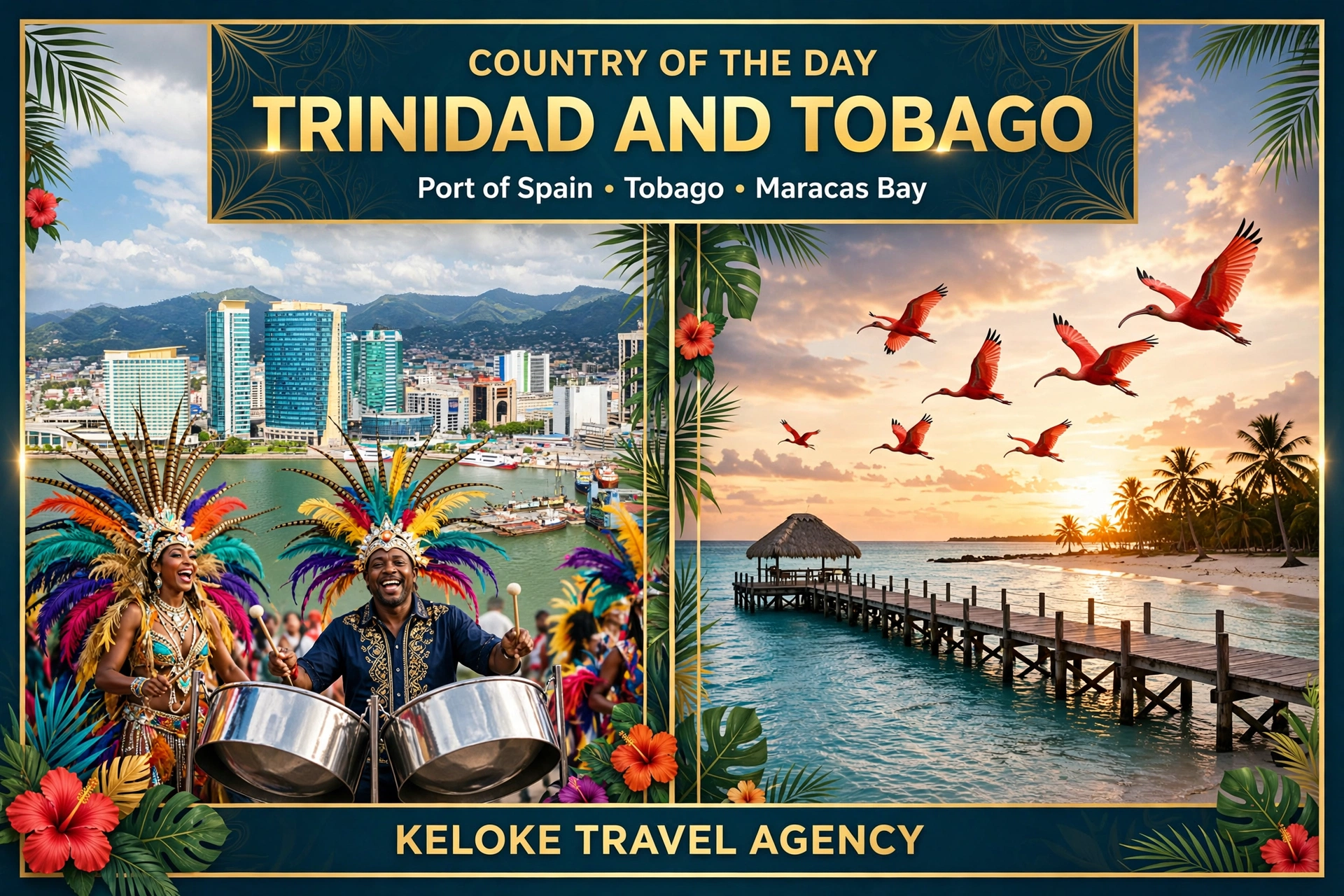
  • Port of Spain & Carnival (Trinidad): the capital and arrival chapter — the Queen's Park Savannah, the Magnificent Seven mansions, Woodford Square, and the world's loudest two days when Carnival (Monday and Tuesday before Ash Wednesday) turns the whole city into a moving stage of soca, steelpan and feathers. Outside Carnival season the panyards still rehearse at night and are worth an evening on their own.
  • The north coast (Trinidad): the beach chapter — the winding mountain drive to Maracas Bay for bake and shark at the water's edge, Las Cuevas' calmer curve beyond it, and up the Paria trail, waterfalls hidden in the Northern Range jungle.
  • Tobago: the slow chapter — Pigeon Point's postcard jetty, Store Bay and the glass-bottom boats over Buccoo Reef, Englishman's Bay for near-empty sand, Main Ridge Forest Reserve (the oldest protected rainforest in the Western Hemisphere), and villages like Castara and Charlotteville where the day's plan is the catch coming in.
  • Caroni & the central wetlands (Trinidad): the wild chapter — the Caroni Bird Sanctuary at sunset, when hundreds of scarlet ibis, the national bird, come in to roost in the mangroves in one red wave; nearby, the Hanuman Murti and Temple in the Sea at Waterloo tell the Indo-Trinidadian half of the country's story.
  • San Fernando & the south (Trinidad): the deep chapter — the second city, San Fernando Hill's view over the Gulf, and La Brea's Pitch Lake, a walkable lake of natural asphalt that has paved roads on other continents.

Culture notes

This is the Caribbean's great mix: African and Indian heritages side by side, with Chinese, Syrian-Lebanese, and Venezuelan threads woven in — and the food proves it: doubles at dawn, roti at lunch, callaloo and pelau on Sunday. Steelpan was invented here, calypso and soca were born here, and liming — the art of hanging out well — is the national sport. English is official, with Trinidadian Creole in daily speech. Carnival is planned a year ahead and band costumes sell out; even outside the season, a fete is never far away.

When to go

January through May is the dry season: the easiest beach weather, Tobago's reefs at their clearest, and Carnival landing in February or March — the single biggest week of the year, with prices and crowds to match, booked months ahead. June through December is the wet season: short, heavy afternoon rains, greener hills, lower prices, and Tobago at its quietest. The islands sit at the southern edge of the hurricane belt and direct hits are rare — one more reason the wet season here is a bargain rather than a gamble.

Practical tips

  • U.S. visitors: visa-free, up to 90 days: U.S. citizens are visa-exempt for Trinidad and Tobago for stays of up to 90 days. You still need a valid passport, a return or onward ticket, and you may be asked to show your accommodation and sufficient funds.
  • Haitian passport holders — visa in advance, no arrival waiver: Haiti is the CARICOM exception — ordinary Haitian passport holders must obtain a visa BEFORE travel (the eVisa/consular route), and they are explicitly excluded from the "Waiver of the Visa" on arrival; only Haitian diplomatic or service/official passport holders are exempt. Do not book non-refundable travel before the visa is in hand, and re-check the current rule with Trinidad and Tobago Immigration before booking (see KELOKE's Haitian passport guide for the full country map).
  • Passport validity: your passport must be valid at least 6 months beyond your arrival date — check it before anything else.
  • Two islands, one hop: Caribbean Airlines flies Piarco (POS) to Crown Point (TAB) in about 25 minutes, many times a day; the fast ferry from Port of Spain to Scarborough takes roughly 3 hours and can be rough in open water — book both ahead in Carnival season, and never schedule the hop on the same day as your flight home.
  • Currency is the Trinidad and Tobago dollar (TTD): U.S. dollars are accepted in many tourist-facing spots but change comes back in TTD; cards work widely in the cities, cash rules in Tobago's villages and at bake-and-shark stands.
  • Power is the easy part for Americans: Trinidad and Tobago uses Type A/B sockets at 115V — U.S. devices plug straight in, no adapter, no converter.
  • Driving is on the LEFT: a British inheritance that surprises Americans at the first junction — on Tobago most visitors are happier with a local driver or short taxi hops, and in Port of Spain the maxi taxis and the Savannah loop are the local way to move.

What to pack for Trinidad and Tobago

Heat, humidity, boat decks, and two islands in one trip. Our country picks: a 3-in-1 handheld mini fan that doubles as a power bank and flashlight for fete nights and hot Savannah afternoons, waterproof shoe bags so Tobago's sandy, seawater-soaked sandals never touch clean clothes, packing cubes that keep Trinidad city clothes and Tobago beach gear in separate worlds inside one bag, a 20,000mAh power bank with a built-in cable for Carnival days that start at dawn and end long after dark, and an insulated travel mug that keeps coffee hot on the early drive over the Northern Range to Maracas and water cold on the ferry deck. Find them in the KELOKE shop.

Posted on — Leave a comment

Cuba: The Island Where the Rules Are Part of the Trip

Cuba: The Island Where the Rules Are Part of the Trip

Cuba is the Caribbean’s great time capsule — 1950s Chevrolets rolling past Spanish colonial plazas, son and salsa pouring out of doorways, and a tobacco valley that looks painted. It is also the one island where a traveler can do everything “right” on the Cuban side and still break the rules on the American side, because for U.S. travelers Cuba is not a normal vacation at all. The classic success is a legal, people-first trip: a private casa in Old Havana, days built around independent Cuban guides, artists and paladar owners, one valley, one colonial town. Pick the purpose first — in Cuba, the purpose is literally the law; the packing — heat, cash, and power cuts — follows.

The regions, one by one

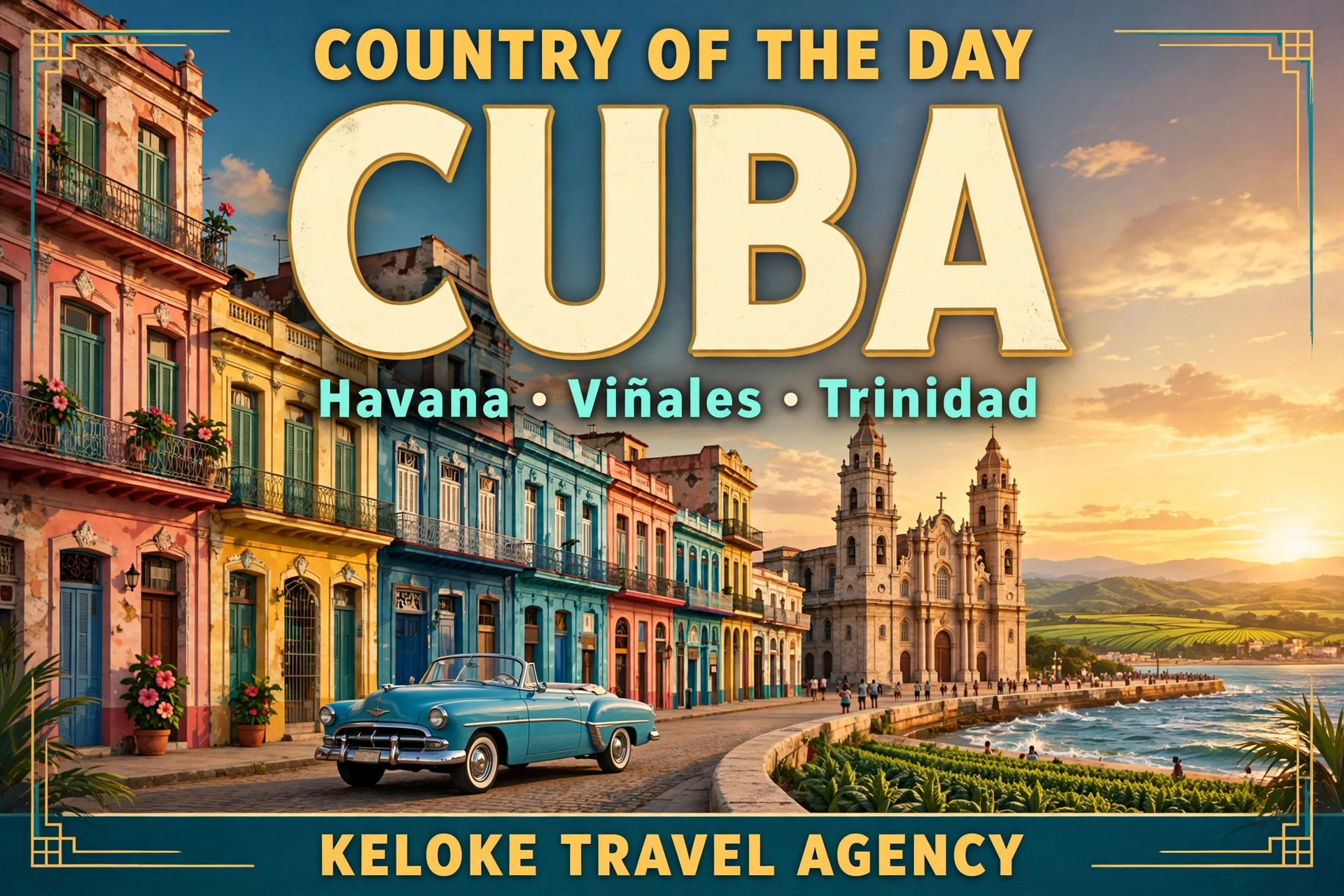
  • Havana: the arrival chapter and most travelers’ base — Old Havana’s four plazas and cathedral, the Malecón at sunset, Vedado’s mansions and the Fábrica de Arte Cubano at night, and the classic-car tours that are cliché because they earn it. Base here and day-trip west or east.
  • Viñales Valley: the green chapter, about three hours west — limestone mogotes rising over red-earth tobacco farms, horseback rides to family fincas where cigars are rolled by hand, and the island’s best countryside mornings.
  • Trinidad: the colonial chapter — a UNESCO time capsule of cobblestones and pastel mansions on the south coast, with Playa Ancón’s beach minutes away and the Valle de los Ingenios sugar mills telling the harder history behind the beauty.
  • Varadero & the north coast: the resort chapter — 20 km of white sand on the Hicacos Peninsula. Beautiful beach, but U.S. travelers take note: many large resorts sit on the U.S. State Department’s Cuba Restricted List, which is one more reason the people-first route bases in casas instead.
  • Santiago de Cuba: the Afro-Cuban heart — the island’s second city, closer in spirit to Haiti and Jamaica than to Havana: son cubano was born in these hills, Carnival in July is the country’s biggest, and the Moncada barracks and El Cobre basilica carry the island’s revolutionary and religious history.
  • Baracoa & the far east: the remote chapter — Cuba’s first town, founded in 1511, ringed by mountains and cacao farms, reached by a mountain road called La Farola. For travelers who want the Cuba almost nobody sees.

Culture notes

Music is not entertainment in Cuba, it is infrastructure: son, salsa, rumba and Afro-Cuban jazz set the schedule of every plaza. The private economy is the culture a visitor can actually support — casas particulares (family-run guesthouses, marked with a blue anchor sign) and paladares (private restaurants, often in grand old mansions) are where the best food, rooms and conversations are. Santiago and the east carry deep African roots — Santería (Regla de Ocha) practice, Haitian-Creole-speaking communities descended from Haitian migrants in Oriente, and tumba francesa dance traditions recognized by UNESCO, so Haitian travelers will find familiar rhythms in the east. Spanish is the language of daily life; English works in Havana’s visitor corridors and fades fast outside them.

When to go

November through April is the dry season: the easiest walking weather, Havana’s jazz festival in January, and the highest casa prices — book ahead. May through October is hot, humid and officially hurricane season (June 1–November 30, highest risk August–October): prices drop, afternoon storms are routine, and flexible plans plus insurance earn their money. July in Santiago is Carnival — worth planning around on purpose, not by accident.

Practical tips

  • U.S. travelers — pure tourism is prohibited, by U.S. law: Americans and anyone subject to U.S. jurisdiction may only travel under one of the 12 OFAC general-license categories — most visitors use “Support for the Cuban People,” which requires a full-time schedule of meaningful activities with independent Cuban people and businesses (private casas, paladares, independent guides), not a beach week. There is no OFAC application to file for a general license, but you must declare the category when booking, keep records of activities and expenses for 10 years, and avoid properties on the Cuba Restricted List. A Cuban visa alone does not make a trip legal under U.S. rules — the two systems are separate.
  • Cuba’s own entry documents: most visitors now enter on Cuba’s electronic visa (the old paper tourist card has been phased out) and must also complete the D’Viajeros online entry form before arrival and carry mandatory health insurance (often bundled by the airline). Keep printed or offline copies of everything — connectivity on arrival is unreliable.
  • Haitian passport holders — consular visa in advance, do not rely on the e-Visa: Cuba lists Haiti among the nationalities that cannot use the standard tourist e-Visa and must obtain a visa in advance through a Cuban consulate, even though some third-party tables still show “eVisa.” Treat the consulate route as the rule, start early, and do not book non-refundable travel before the visa is in hand. (See KELOKE’s Haitian passport guide for the full country map.)
  • Money runs on cash: U.S. debit and credit cards do not work in Cuba at all. Bring clean U.S. dollars or euros in cash — enough for the whole trip — plus small bills for casas, paladares, taxis and tips. Cuba’s currency is the peso (CUP); exchange rates and rules shift, so confirm the current picture the same week you travel and keep money and documents in an RFID-blocking organizer.
  • Power and connectivity — plan for outages: Cuba’s grid has frequent blackouts, sometimes lasting hours. A high-capacity power bank and a rechargeable fan are not luxuries here. Download offline maps and translations before arrival, expect hotel and casa Wi-Fi to be slow or paid by the hour, and note sockets are a mix of Type A/B (U.S.-style) and C/L, with both 110V and 220V in the wild — check before plugging in anything that is not dual-voltage.
  • Bring your health kit with you: pharmacies run short of basics. Carry your prescriptions, pain relief, rehydration salts and a real first-aid kit from home rather than planning to buy them on the island.

What to pack for Cuba

Heat, walking days, cash-only logistics and a flickering grid — Cuba rewards the traveler who arrives self-sufficient. Our country picks: a 20,000mAh power bank with a built-in cable, because blackouts are routine and your phone is your map, translator and record book; a 3-in-1 handheld mini fan that doubles as a power bank and flashlight for hot plazas and dark casa stairwells; a travel first-aid kit, because Cuban pharmacies run short of basics you can easily bring from home; an RFID-blocking passport and document organizer that keeps your cash, e-Visa printout and OFAC records together and protected in a cash-only country; and a collapsible water bottle you can refill at your casa all day instead of hunting for bottled water. Find them in the KELOKE shop.

Posted on — Leave a comment

Puerto Rico: The Island That Runs on Two Rhythms

Puerto Rico: The Island That Runs on Two Rhythms

Puerto Rico is the Caribbean trip with no passport stamp for Americans — and the classic mistake is treating it as only a beach. The island runs on two rhythms: the 500-year-old cobblestone capital and the wild green interior, with a glowing bay and two small sister islands offshore. The classic success is one base in San Juan, one rainforest day, and one island hop. Pick the rhythm first; the packing — rain, heat, and cobblestones — follows.

The regions, one by one

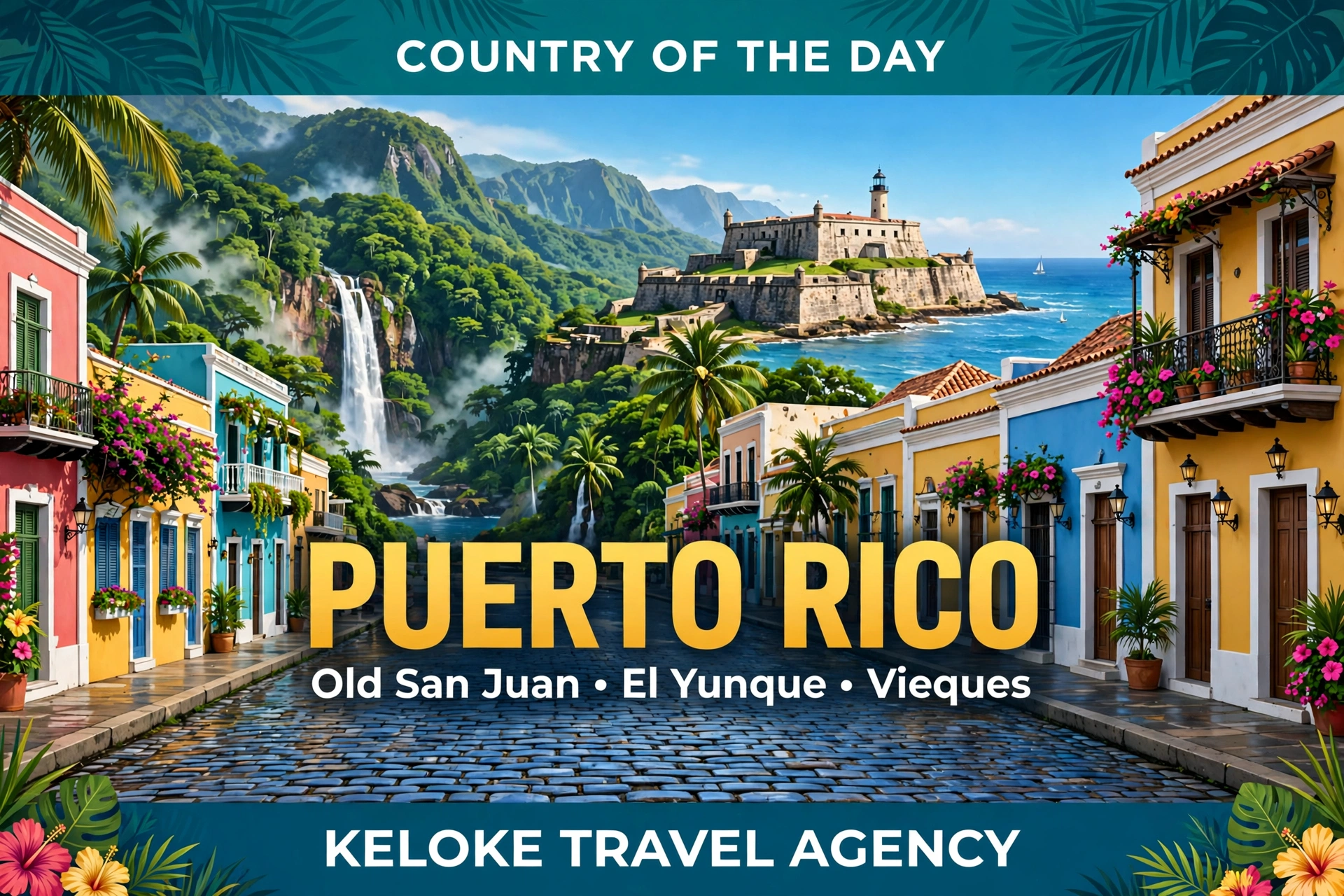
  • Old San Juan & the metro coast: the arrival chapter — blue cobblestone streets, the El Morro and San Cristóbal forts, the cathedral and Paseo de la Princesa, with Condado and Isla Verde beaches a short ride east. Most first trips base here and day-trip everything else.
  • El Yunque National Forest: the only tropical rainforest in the U.S. National Forest system — waterfalls, natural pools, and trails under a canopy that rains on schedule almost every afternoon. Go early, book the reservation window when required, and expect wet trails in any season.
  • The bioluminescent bays: three of the world’s few glow-in-the-dark bays — Mosquito Bay on Vieques (the brightest), Laguna Grande at Fajardo, and La Parguera in the southwest. They are a new-moon experience: the darker the night, the brighter the water, so the calendar matters as much as the booking.
  • Vieques & Culebra: the island-hop chapter, reached by the Ceiba ferry or a short flight — Culebra’s Flamenco Beach is regularly ranked among the world’s best, and Vieques pairs wild horses and empty beaches with the bio bay after dark. Ferry tickets sell out; book ahead and build buffer time.
  • The west & south coasts: Rincón’s surf breaks and sunsets, Cabo Rojo’s salt flats and lighthouse, and Ponce — the island’s second city, with its red-and-black firehouse museum and a slower, more local pace than the capital.
  • The Cordillera & coffee country: the mountain interior — hacienda coffee tours around Jayuya, Adjuntas and Lares, cooler air, and the island Puerto Ricans themselves escape to on weekends.

Culture notes

Spanish and English are both official, and daily life runs in Spanish first — a greeting in Spanish opens doors everywhere. This is the birthplace of salsa’s New York chapter and of reggaetón, and music is not background here, it is the schedule: bomba in Loíza (the island’s Afro-Puerto Rican heartland), plena in Ponce, and live music in every plaza. The food rule is simple: find the chinchorros — the small roadside kiosks — for alcapurrias, bacalaítos and mofongo done the local way.

When to go

December through April is the dry, high season: the easiest beach weather, full tour schedules, the highest prices, and the San Sebastián Street Festival in January filling Old San Juan. May through November is hurricane season (officially June 1–November 30, highest risk August–October): prices drop, the rainforest runs at its greenest, and flexible plans plus travel insurance earn their money. The bio bays glow brightest on the darkest, warmest nights — late spring through fall, away from the full moon.

Practical tips

  • U.S. visitors: no passport needed: Puerto Rico is a U.S. territory, so flights from the mainland are domestic — U.S. citizens travel with a government photo ID (REAL ID-compliant for TSA), no passport and no visa. Green-card holders travel freely the same way.
  • Haitian passport holders — a U.S. visa is required, arranged before travel: there is no separate Puerto Rico visa. Haitian nationals need the same valid U.S. visa (usually B1/B2) required for the mainland United States, in a valid passport, before booking travel; Visa Waiver Program nationals use an approved ESTA instead. Do not book non-refundable travel before the visa is in hand (see KELOKE’s Haitian passport guide for the full country map).
  • Currency is the U.S. dollar: no exchange, no conversion math — cards work almost everywhere, and cash is for chinchorros, ferries and small towns.
  • Power is the easy part: Puerto Rico uses the same Type A/B sockets and 120V as the mainland United States — U.S. devices plug straight in, no adapter, no converter. The grid can still flicker outside the metro area, so a power bank earns its place.
  • Spanish helps, English works: in San Juan and the tourist corridors English is widely spoken; in the interior and the west, basic Spanish phrases carry the day — and are warmly received.
  • Island-hopping runs on the Ceiba ferry and small planes: Vieques and Culebra ferries are cheap, popular, and capacity-limited — residents get priority boarding, so book online ahead, arrive early, and never schedule a same-day flight home after a ferry return.

What to pack for Puerto Rico

Rainforest rain, Old San Juan heat, and ferry days — often all three before dinner. Our country picks: a 3-in-1 handheld mini fan that doubles as a power bank and flashlight for cobblestone afternoons, a collapsible water bottle for El Yunque trails, waterproof shoe bags so rainforest mud and wet sandals never touch clean clothes, compression packing cubes that keep beach, trail and city clothes in separate worlds inside one bag, and a 20,000mAh power bank for long tour days, flickering grids and a phone that has to survive to photograph the bio bay at night. Find them in the KELOKE shop.

Posted on — Leave a comment

The Bahamas: 700 Islands, One Right Pace

The Bahamas: 700 Islands, One Right Pace

The Bahamas is not one destination — it is an archipelago of about 700 islands and cays stretched over 100,000 square miles of some of the clearest water on earth, and the classic mistake is trying to see it all in one trip. The classic success is picking one home base and one adventure: Nassau for the first trip, an Out Island for the second, and day boats for everything in between. Pick the base first; the packing — beach, boat, and ferry days — follows.

The islands, one by one

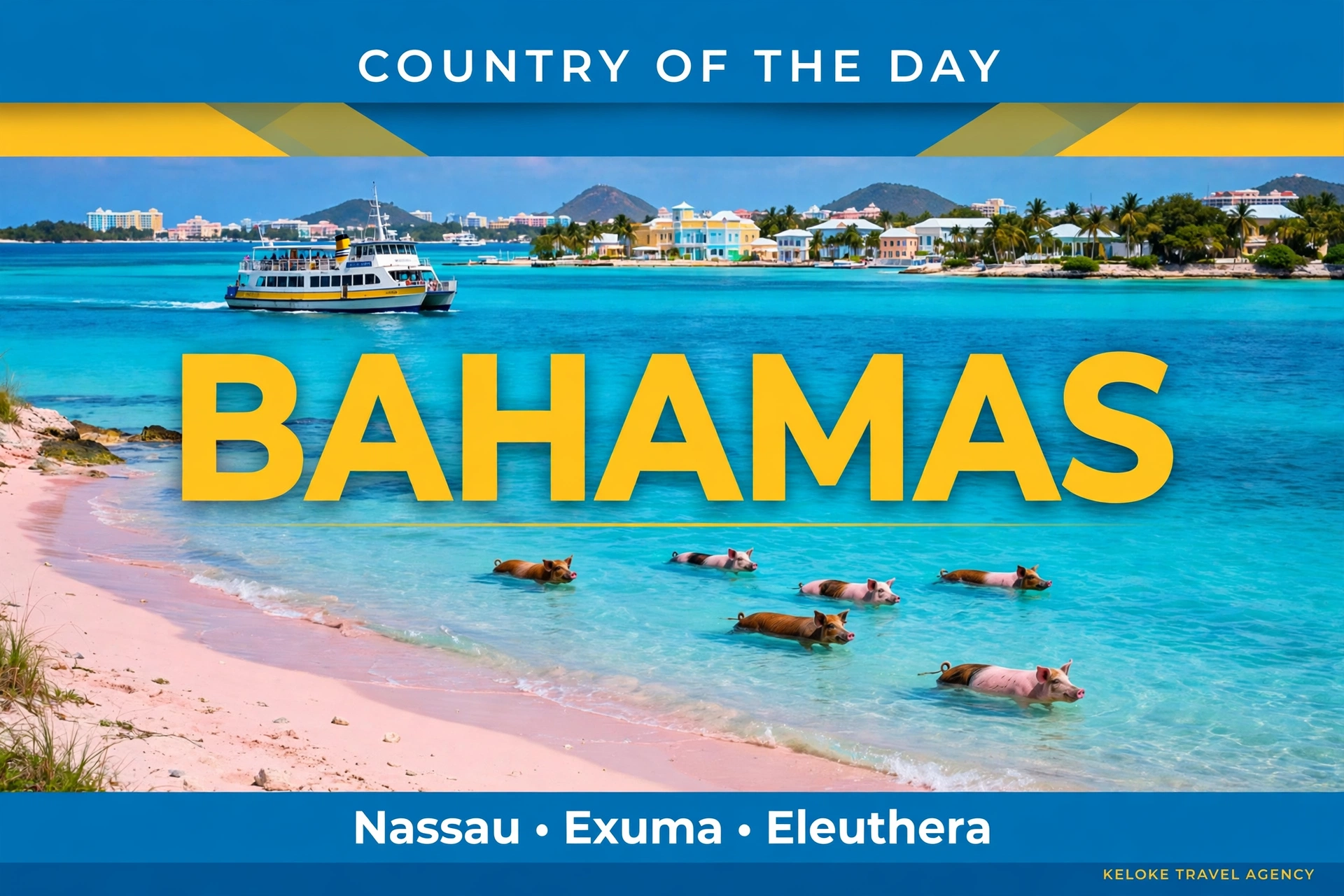
  • Nassau & Paradise Island (New Providence): the arrival chapter and most travelers’ base — the Straw Market and Bay Street, the Queen’s Staircase and Fort Fincastle, Cable Beach, and across the bridge on Paradise Island the Atlantis resort, Marina Village, and Cabbage Beach. Cruise passengers get the port version; staying over gets the real one.
  • Grand Bahama & Freeport: the second city — Lucayan National Park’s caves and mangrove boardwalks, Port Lucaya Marketplace, and some of the closest shark and reef diving to Florida, a short flight or ferry from Fort Lauderdale.
  • The Exuma Cays: the adventure chapter — a chain of 365 cays, the famous swimming pigs at Big Major Cay, nurse sharks at Compass Cay, the Thunderball Grotto snorkel, and sandbars that appear at low tide and vanish by evening. Usually done as a full-day boat tour from Nassau or a stay in George Town, Great Exuma.
  • Eleuthera & Harbour Island: the quiet, pink chapter — Harbour Island’s pink-sand beach, the Glass Window Bridge where the dark Atlantic meets the calm green Bight, and a slow, boutique pace completely different from Nassau.
  • Bimini: the closest chapter — about 50 miles from Florida, Hemingway’s old fishing island, big-game fishing, and dolphin and shark encounters, reachable by ferry from Fort Lauderdale.
  • Andros & the Abacos: the wild and the sailing chapters — Andros is the largest and least developed island, home to blue holes and the world’s third-largest barrier reef; the Abacos are the boating capital, a chain of cays built around Marsh Harbour and Hope Town’s striped lighthouse.

Culture notes

English is the official language, with Bahamian Creole spoken in everyday life — and Haitian Creole is widely heard too, spoken by the large Haitian community that makes up a significant share of the population, so Haitian travelers will hear home in Nassau’s markets. Junkanoo — the Christmas-season street festival of costume, drums, and cowbells — is the cultural heartbeat. The conch is the national dish in every form (salad, fritters, cracked), and the local rule on the Out Islands is simple: the ferry schedule is the schedule, and everything else adjusts.

When to go

December through mid-April is the high season: the driest weather, water at its clearest, full tour schedules, and the highest prices — book boats and rooms ahead. May through November is hurricane season (officially June 1–November 30), with the highest storm risk in August–October; prices drop, the water is at its warmest, and flexible plans plus travel insurance earn their money. Summer brings the heat and humidity in full — and the best swimming of the year.

Practical tips

  • U.S. visitors: visa-free, up to 8 months: U.S. citizens are visa-exempt for the Bahamas for stays of up to 8 months as bona fide visitors. You still need a valid passport, a return or onward ticket, and you may be asked to show sufficient funds for the stay.
  • Haitian passport holders — physical visa, arranged before travel: Haiti is NOT on the visa-exempt list, and Haitian nationals are the stated exception to the Bahamas eVisa route — they must obtain a physical visa from a Bahamian embassy or consulate before traveling. Holders of a valid U.S. or Canadian permanent-residence permit are visa-exempt for up to 30 days. Do not book non-refundable travel before the visa is in hand, and re-check the current rule with Bahamas Immigration before booking (see KELOKE’s Haitian passport guide for the full country map).
  • Passport validity: carry a passport valid well beyond your return date — sources commonly require at least 6 months’ validity when transiting a third country; never let it run close.
  • Currency is the Bahamian dollar (BSD) — pegged 1-to-1 with the U.S. dollar, and U.S. dollars are accepted everywhere. Spend or convert Bahamian change before leaving; it is not exchangeable outside the Bahamas.
  • Power is the easy part for Americans: the Bahamas uses the same Type A/B sockets and 120V as the United States — U.S. devices plug straight in, no adapter, no converter.
  • Driving is on the LEFT: a British inheritance that surprises Americans at the first roundabout — most visitors are happier with taxis, jitney buses, and tour boats, and on the Out Islands a rental golf cart is often the whole transport plan.
  • Island-hopping runs on boats and small planes: domestic flights from Nassau (Lynden Pindling International, NAS) and scheduled ferries connect the main islands — build buffer time around every connection, because weather and loading set the real timetable.

What to pack for the Bahamas

Beach, boat, and ferry days — often all three before dinner. Our country picks: a weekender bag with its own toiletry bag so one light bag covers a Nassau weekend or a ferry hop, packing cubes that keep dry clothes, swimsuits, and the wet set in separate worlds, waterproof shoe bags so sandy, seawater-soaked sandals never touch clean clothes, a 3-in-1 handheld fan that doubles as a power bank and flashlight for hot market afternoons and open ferry decks, and a Bluetooth tracker in your bag for the airport-ferry-excursion chain where bags go missing. Find them in the KELOKE shop.

Posted on — Leave a comment

Costa Rica: Pura Vida, Done One Region at a Time

Costa Rica: Pura Vida, Done One Region at a Time

Costa Rica packs two coasts, a volcano belt, and a cloud forest into a country smaller than West Virginia — and still defeats travelers who try to rush it, because the mountain roads set the schedule, not the map. The classic success is picking two or three regions per trip: a volcano-and-hot-springs chapter, a rainforest chapter, and one coast. Pick the regions first; the packing — heat, rain, and trails — follows.

The regions, one by one

  • San José & the Central Valley: the arrival chapter most people skip too fast — the capital's museums and markets, coffee tours in the hills, and day trips to Poás and Irazú volcanoes. One night on arrival and one before an early flight out is the smart pattern.
  • Arenal & La Fortuna: the postcard volcano, hot springs at its base, hanging bridges through the canopy, and the La Fortuna waterfall. Adventure headquarters: zip lines, white-water rafting on the Balsa and Pacuare, and lake crossings toward Monteverde.
  • Monteverde: the cloud forest — mist, moss, and bridges in the treetops, with some of the best birding on earth (this is quetzal country). Cooler and wetter than anywhere else on the trip; pack a real rain layer, not a poncho afterthought.
  • Manuel Antonio: the Pacific chapter where rainforest meets beach — the national park's trails end at white-sand coves, with monkeys, sloths, and iguanas along the way. Small park, big demand: reserve entry ahead in high season.
  • Guanacaste & the Nicoya coast: the dry, sunny northwest — Tamarindo, Playa Conchal, and Papagayo, resort beaches and surf towns, and the closest thing Costa Rica has to a guaranteed-sun window in the dry season.
  • The Caribbean coast: Puerto Viejo and Cahuita — Afro-Caribbean food, reggae pace, reef snorkeling, and a rainy-season pattern opposite to the Pacific: September–October can be its driest stretch while the rest of the country is wet.
  • The Osa Peninsula: the wild chapter — Corcovado National Park, one of the most biologically intense places on earth. Remote and worth it only with days to spare and a booked guide, which the park requires.

Culture notes

"Pura vida" is not a slogan, it is the operating system — a greeting, an answer, and a reminder that the schedule serves the day. Spanish is the official language; English is widely spoken in tourist regions, less so off the circuit. Costa Rica abolished its army in 1948 and put the money into schools, health care, and the national-park system that now protects roughly a quarter of the country. Respect the parks, the wildlife distance rules, and the no-single-use-plastic push and you will be treated like family.

When to go

December through April is the dry season on the Pacific side and in the Central Valley: the easiest driving, the fullest tour schedules, the highest prices, and parks that book out — reserve ahead. May through November is the green season: mornings are usually clear, afternoons bring serious rain, prices drop, the country turns its deepest green, and September–October is the wettest stretch on the Pacific while the Caribbean coast often goes dry. Whale season on the Pacific runs roughly December–April and again July–October; turtle nesting at Tortuguero peaks July–October.

Practical tips

  • U.S. visitors: visa-free, up to 180 days: U.S. citizens are in Costa Rica's Group 1 — no visa in advance, and the immigration officer can grant up to 180 days, usually matched to your onward ticket. Proof of onward or return travel is required, and officers may ask for proof of funds (about US$100 per month of stay). Your passport must be valid when you arrive and for the stay granted — do not let it run close.
  • Haitian passport holders — restricted visa, arranged before travel: Haiti is in Group 4, the restricted-visa group. The visa must be approved through a Costa Rican consulate and the Restricted Visas Commission before booking travel; stays are up to 30 days, and the passport must be valid at least 180 days (see KELOKE's Haitian passport guide for the full country map).
  • Yellow fever certificate, only from risk countries: required if you are arriving from a yellow-fever risk country in South America or Africa — not needed coming straight from the United States.
  • Power is the easy part for Americans: Costa Rica uses the same Type A/B sockets and 120V as the United States — U.S. devices plug straight in, no adapter, no converter.
  • Currency is the colón (CRC); U.S. dollars are widely accepted in tourist areas and cards work almost everywhere, but colones come back as change — carry small colón notes for local sodas (family diners), park fees, and tips off the resort circuit.
  • Driving is the real itinerary decision: distances look short and drive long — mountain roads, rain, and unlit rural stretches. A 4×4 earns its money in the green season and on the Nicoya and Osa roads, and the local rule is simple: do the long drives in the morning, arrive before dark.

What to pack for Costa Rica

Heat, humidity, rain, and trail mud — in the same day. Our country picks: a 3-in-1 handheld mini fan that doubles as a power bank and flashlight for hot, humid afternoons, a collapsible water bottle for park trails and a country that takes refill-over-plastic seriously, waterproof shoe bags so one muddy Monteverde hike doesn't season the whole suitcase, a compact first aid kit for adventure-tour days far from a pharmacy, and an RFID-blocking passport organizer that keeps the family's documents — and the onward-ticket paperwork immigration asks for — in one dry place. Find them in the KELOKE shop.

Posted on — Leave a comment

Canada: The Second-Biggest Country on Earth, Done in Chapters

Canada: The Second-Biggest Country on Earth, Done in Chapters

Canada defeats travelers who try to “do” it in one trip — it is wider than the United States is tall, and Toronto to Vancouver is a five-hour flight or a four-day train. The classic success is picking one chapter per trip: the Ontario city-and-falls chapter, the Rockies chapter, the French chapter, or the coast-to-coast rail dream when the days are truly there. Pick the chapter first; the packing follows.

The regions, one by one

  • Toronto & Niagara: Canada’s biggest city — the CN Tower, Kensington Market, the Distillery District, and neighborhoods as multicultural as anywhere on earth. Niagara Falls is 90 minutes away: see it from the boat, from the Canadian side’s full panorama, and after dark when it’s lit. Give Toronto three days, Niagara one.
  • Vancouver & the west coast: mountains meeting the ocean — Stanley Park’s seawall, Granville Island’s market, suspension bridges in the rainforest, and whale watching in season. The jumping-off point for the Rockies run and for Whistler, two hours up the Sea-to-Sky Highway.
  • Banff & the Rockies: the postcard chapter — Lake Louise, Moraine Lake, the Icefields Parkway (one of the great drives on the planet), and Jasper further north. Summer books out months ahead; the park shuttles to the famous lakes must be reserved, not improvised.
  • Montreal & Quebec City: the French chapter — Montreal’s bagels, festivals, and old port; Quebec City’s walled old town, the only one of its kind in North America, with the Château Frontenac above the St. Lawrence. Winter carnival season turns the cold into the main event.
  • The Atlantic provinces: Halifax, Prince Edward Island, and Newfoundland — lobster, lighthouses, and the friendliest small towns in the country. Slower pace, shorter chapter, often combined with Quebec by road or ferry.

Culture notes

Canada is officially bilingual — English and French on every federal service and package label, French first in Quebec, where a “bonjour” before you switch to English is both polite and expected. Canadians are famously courteous, but don’t mistake it for softness about rules: park reservations, shuttle bookings, and winter-tire laws are enforced as written. Distances lie on the map — provinces are time zones wide, and “a few hours’ drive” can mean six. Budget the map, not the hope.

When to go

June through September is the main season: warm cities, open mountain roads, festival calendars stacked (Montreal’s jazz festival, Toronto’s film festival in September). Late September–October is the connoisseur’s pick in the east — fall colour in Ontario and Quebec, thinner crowds, cool air. Winter (December–March) is for skiers, northern-lights hunters in the territories, and anyone who wants Quebec City under snow — pack for real cold, not city cold. Spring is the shoulder: cheaper, muddier, waterfalls at full power.

Practical tips

  • U.S. visitors: passport only — no eTA, no visa: U.S. citizens are exempt from Canada’s Electronic Travel Authorization and need only a valid U.S. passport, by air, land, or sea. Stays are typically granted for up to 6 months. U.S. permanent residents are also eTA-exempt but must carry their passport plus official proof of U.S. status.
  • Other visa-exempt visitors: eTA before you fly: visa-exempt nationals (most of Europe, the UK, and others) need an eTA to fly to or transit through a Canadian airport — CAD $7, applied for on Canada.ca only, valid up to 5 years or until the passport expires. It is not needed arriving by car, bus, train, or boat. Most approvals arrive in minutes; some take days, so apply before booking non-refundable legs.
  • Haitian passport holders: Canada puts Haiti on the visitor-visa-required list — apply for a visitor visa (temporary resident visa) well in advance rather than planning around an eTA, which Haitian nationals are not eligible for under the current partial-eTA program (see KELOKE’s Haitian passport guide for the full country map).
  • Power is the easy part for Americans: Canada uses the same Type A/B sockets and 120V as the United States — U.S. devices plug straight in, no adapter, no converter.
  • Currency is the Canadian dollar (CAD); cards and tap-to-pay are near-universal, and U.S. dollars are sometimes accepted near the border at poor rates — pay in CAD. Sales taxes vary by province and are added at the register, not baked into the sticker price.
  • Winter is a driving decision: Quebec legally requires winter tires in season, mountain passes in the Rockies can close or require chains, and daylight shrinks to a few hours in the north. If the trip is winter and the driving is rural, rent the vehicle — and the tires — for the conditions, not the price.

What to pack for Canada

Warm layers that compress, hot drinks that stay hot, and power for very long travel days. Our country picks: compression packing cubes — a winter layer set takes half a suitcase unless it compresses — a vacuum-insulated travel mug for coffee that survives a cold morning drive, compression socks for five-hour cross-country flights and long rail days, noise-canceling headphones for those same long hauls, and a 20,000 mAh power bank — cold days and navigation across big distances are both hard on a phone battery. Find them in the KELOKE shop.

Posted on — Leave a comment

United Kingdom: Four Nations, One Rail Pass, Every Kind of Weather

The United Kingdom rewards travelers who treat it as four countries in one trip — because it is. England, Scotland, Wales, and Northern Ireland share a currency and a rail network, but not a landscape, an accent, or a history. The classic mistake is London and only London. The classic success is a rail loop: London, a historic day-trip city like Bath or York, then Edinburgh and a taste of the Highlands — with the weather packed for, not complained about.

The regions, one by one

  • London: the capital — the Tower of London, Westminster, the British Museum and the National Gallery (both free), and neighborhoods that are each their own trip: South Bank for the river walk, Camden and Shoreditch for markets and street food, Notting Hill for the postcard streets. Give it four days minimum; it repays them.
  • Edinburgh & Scotland: Edinburgh’s Royal Mile runs from the Castle down to Holyrood Palace, with Arthur’s Seat — an extinct volcano — as the city’s own hike. Beyond it: Stirling, Loch Ness, and the Highlands, where the scenery turns mountain-and-loch serious. August brings the Edinburgh festivals, the largest arts gathering on earth; book far ahead.
  • Bath, York & the day-trip belt: Bath’s Roman baths and Georgian crescents, York’s medieval Shambles and great minster, Oxford and Cambridge for the university streets — all 1–2 hours from London by train, which is exactly how to use them.
  • Wales & the north: Cardiff and the castles of Wales, Snowdonia (Yr Wyddfa) for mountain walkers, Liverpool and Manchester for music history and football culture.
  • Northern Ireland: Belfast’s Titanic Quarter and the Giant’s Causeway on the Antrim coast — a short flight or ferry from the mainland, same currency, same ETA.

Culture notes

Britain runs on queues, understatement, and tea — join the queue, don’t skip it, and nobody will say a word, which is the loudest complaint there is. Pubs are living rooms for the public: order and pay at the bar, no table service, no tipping expected at the bar itself. Football is a weekly religion with deep local loyalties; a stadium tour or a lower-league match is a better cultural ticket than most museums. And the weather is a conversation starter precisely because it changes hourly — “four seasons in one day” is not a joke, it’s a packing instruction.

When to go

May through September is the sweet spot: the longest days (Edinburgh is light past 10 PM in June), festival season, and the best odds — never a promise — of dry walking weather. Spring and fall trade a little warmth for thinner crowds and lower prices. Winter is dark by 4 PM in Scotland and genuinely cold in the Highlands, but London’s museums, theatres, and Christmas markets are at their best in December. Big dates move prices hard: Edinburgh in August, London at New Year, Wimbledon in late June–early July.

Practical tips

  • U.S. visitors: no visa, but the UK ETA is now mandatory and enforced: U.S. citizens visit visa-free for tourism stays of up to 6 months — but since 25 February 2026, carriers must check an approved Electronic Travel Authorisation (ETA) before boarding, and there is no grace period. Apply only through the official UK ETA app or GOV.UK (third-party sites charge extra for the same thing). Fee £20 per person — every traveler, including children — valid 2 years or until the passport expires, multiple trips allowed. Most decisions arrive in minutes, but GOV.UK says allow up to 3 working days, so apply before you book around it. An ETA is permission to travel, not a guarantee of entry; carry proof of lodging and onward travel.
  • The UK is NOT in Schengen: its 6-month visitor allowance is its own clock, separate from the EU’s 90/180 rule — a London week does not spend your Schengen days, and vice versa. The EU’s separate ETIAS system does not apply to the UK.
  • Haitian passport holders: the United Kingdom is a visa-in-advance destination for Haitian travelers — apply for a Standard Visitor visa before travel rather than arriving on the ETA scheme, which does not cover Haitian nationals (see KELOKE’s Haitian passport guide for the full country map).
  • Power is different — Type G: the UK uses big three-pin Type G sockets at 230V. U.S. plugs do not fit; dual-voltage phone and laptop chargers need only the plug adapter, while 110V-only devices need a real converter.
  • Currency is the pound (GBP); contactless cards and phones are accepted almost everywhere, including all London transport — buses are cash-free, and an Oyster card or any contactless card taps you through the Tube. Carry a few pounds in coins for small cafés and market stalls outside the big cities.
  • Driving is on the left: if you rent a car for the Highlands or the Cotswolds, budget a day to adjust — roundabouts and narrow lanes demand it. Within cities, trains and the Tube beat driving every time.

What to pack for the United Kingdom

Layers, rain cover, and power that survives long sightseeing days. Our country picks: a universal adapter and voltage converter for the UK’s 230V Type G sockets, a 20,000 mAh power bank — Tube navigation and museum apps drain a phone before dinner — noise-canceling headphones for the overnight flight and the London–Edinburgh train, a 20-inch top-opening carry-on sized for train luggage racks and budget-airline cabin rules, and compression packing cubes so a warm layer, a rain layer, and an evening outfit share one small bag. Find them in the KELOKE shop.

Posted on — Leave a comment

Spain: Art Cities, Late Dinners, and Islands in the Same Trip

Spain rewards travelers who treat it as several trips in one: a royal capital of museums and tapas bars, a Mediterranean port city unlike anywhere else in Europe, the Moorish south, and two island groups — all linked by some of the fastest trains on the continent. The classic mistake is picking one city and calling it Spain. The classic success is a rail loop: Madrid, Barcelona, and Andalusia, with the islands as the beach chapter if the days allow.

The regions, one by one

  • Madrid: the capital — the Prado, Reina Sofía, and Thyssen museums within a short walk of each other, Retiro park, Gran Vía, and neighborhoods like Malasaña where the evening starts late and ends later. Give it three days; it grows on people.
  • Barcelona: Gaudí’s city — the Sagrada Família (book ahead; timed entry sells out), Park Güell, the Gothic Quarter’s lanes, a working beach at Barceloneta, and food markets like La Boqueria.
  • Andalusia (Seville, Granada, Córdoba): the south of the postcards — Seville’s cathedral and Alcázar, Granada’s Alhambra above the Albaicín (reserve far in advance; capacity-limited), and Córdoba’s Mezquita. Hot in summer, golden in spring and fall.
  • Valencia & the east coast: the City of Arts and Sciences, the home of paella (eat it at lunch, like locals do), and a gentler Mediterranean pace.
  • The islands: the Balearics (Mallorca, Menorca, Ibiza) for coves and summer water, and the Canary Islands off Africa for year-round spring weather and volcanic landscapes — an easy add-on flight.

Culture notes

Spanish runs on a later clock: lunch around 1:30–3 PM, dinner rarely before 9 PM, and the evening paseo in between. The siesta is real in smaller towns — shops close mid-afternoon and reopen into the evening. Regional identity is strong: Catalan in Barcelona, Basque in the north, Galician in the northwest — several cultures sharing one country, as Spaniards will tell you plainly. Football is a weekly religion; flamenco is Andalusia’s gift to the world, best seen live in a small venue.

When to go

Spring (April–June) and fall (September–October) are the sweet spots almost everywhere: warm, lighter crowds, Andalusia at its best. July and August bring real heat in the south — Seville can pass 40°C — while the coasts and islands peak. Winter is mild in the south and the Canaries and quiet in the cities. Big dates move prices: Semana Santa in Andalusia, Las Fallas in Valencia in March, San Fermín in Pamplona in July — book far ahead or route around them.

Practical tips

  • U.S. visitors: visa-free, but the 90/180 clock covers all of Schengen: U.S. citizens can visit Spain and the wider Schengen Area without a visa for tourism stays of up to 90 days in any rolling 180-day period — and that allowance is shared across all Schengen countries combined, not 90 days per country. Travel on a passport valid at least 3 months beyond your departure date, and keep proof of lodging and onward travel handy at the border.
  • At the border, expect the new EES registration: the EU’s Entry/Exit System is now operational at Schengen borders — on a first entry, non-EU travelers are registered with fingerprints and a facial image at passport control. Nothing to apply for in advance and no fee; it happens at the desk and can add a few minutes, so build buffer into tight onward train connections.
  • ETIAS is not a thing yet — don’t pay anyone for it: the separate ETIAS pre-travel authorization for visa-exempt travelers had not launched as of October 2026 — secondary reporting says its planned late-2026 start was pulled and 2027 is now expected, no firm date announced. Any website currently charging for an “ETIAS for Spain” is selling something that does not exist yet. The runner re-checks this line the day this guide publishes.
  • Haitian passport holders: Spain is a Schengen-visa destination for Haitian travelers — apply for the visa in advance rather than arriving visa-free (see KELOKE’s Haitian passport guide for the full country map).
  • Power changes sides of the Atlantic: Spain uses Type C and F sockets at 230V — U.S. plugs do not fit and 110V-only devices need a converter, not just a shape adapter. Dual-voltage phone and laptop chargers only need the plug adapter.
  • Currency is the euro (EUR); cards and tap-to-pay are nearly universal in the cities, but carry some euros for small cafés, markets, and taxis in smaller towns.
  • Pickpockets are the real safety issue: the U.S. State Department lists Spain at Level 2 (Exercise Increased Caution, updated August 2026) for terrorism awareness and unrest — and in daily life the tourist risk is skilled pickpocketing in crowded metro stations and markets. Cross-body bag, phone off the café-table edge. The advisory’s one carve-out: the North African enclave of Ceuta sits at Level 3 — not on normal mainland or island itineraries.

What to pack for Spain

One carry-on that survives high-speed trains, cobblestones, and a beach detour. Our country picks: a universal adapter and voltage converter for Spain’s 230V Type C/F sockets, a 20-inch top-opening carry-on sized for AVE train racks and European cabin rules, noise-canceling headphones for the overnight flight and the rail hops, a blackout sleep mask — Spanish evenings run late, Mediterranean mornings bright — and a pack-it cube set so city clothes and beach gear share one bag. Find them in the KELOKE shop.